Siemens digital twin targets lower green hydrogen costs
Siemens, in partnership with solution partner Mescada, is providing the digital engineering technology that will help InterContinental Energy (ICE) turn its patented P2(H2)Node into a repeatable, licensable design for large-scale renewable powered AI compute and green hydrogen production. A world-first, the digital twin solution is expected to reduce the cost of hydrogen production by up to 20 percent and create a repeatable template that can be executed at scale, faster than currently possible.
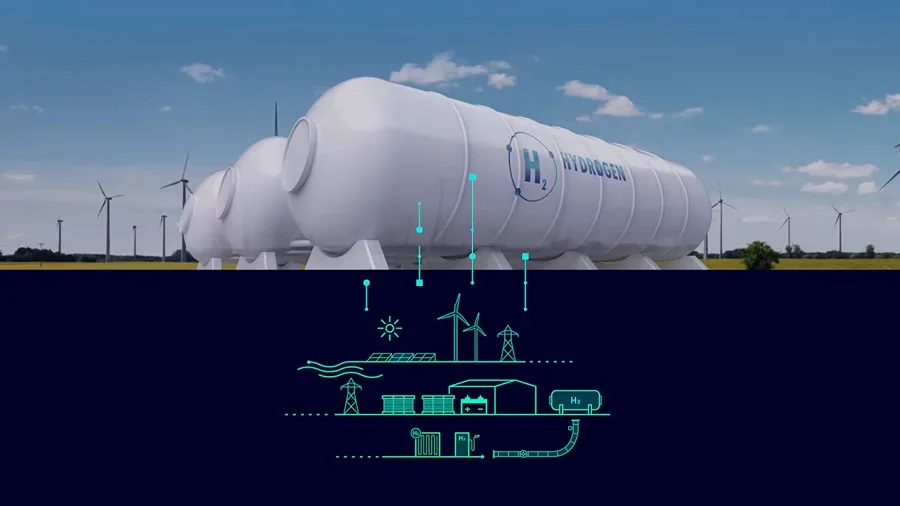
ICE will use Siemens’ gPROMS process modelling and COMOS engineering software to create a digital twin of the P2(H2)Node, which brings hydrogen production together with wind and solar generation. The digital twin will allow ICE to test and compare different equipment and configurations under changing renewable energy and demand conditions, helping identify the optimal design before moving to front-end engineering design (FEED) and final investment decision (FID).
Each node is designed at gigawatt scale, typically pairing 1 to 1.3 gigawatts of combined AI compute and electrolysis with around 2.6 gigawatts of renewables. The project is co-funded by the Australian Renewable Energy Agency (ARENA) through its Advancing Renewables Program, which is contributing $1.56 million towards the $3.12 million project.
In the project, gPROMS acts as the process-modelling engine within ICE’s broader Python-based optimization and data workflow. COMOS provides the controlled engineering-data environment for the standard P2(H2)Node configuration and its project-specific variants, managing equipment, specifications and documents, and supporting the creation of the basic engineering package, including process flow diagrams and piping and instrumentation diagrams.
The project reflects a collaboration model that begins in the early phases of development with Mescada coordinating software delivery, onboarding and first-line technical support, while Siemens provides the technology and escalation support. The approach is designed to carry through as ICE’s projects progress from feasibility into engineering and, ultimately, delivery.
For more information, visit siemens.com.