Caltech Names the Bridget and William Coughran Department of Computing + Mathematical Sciences
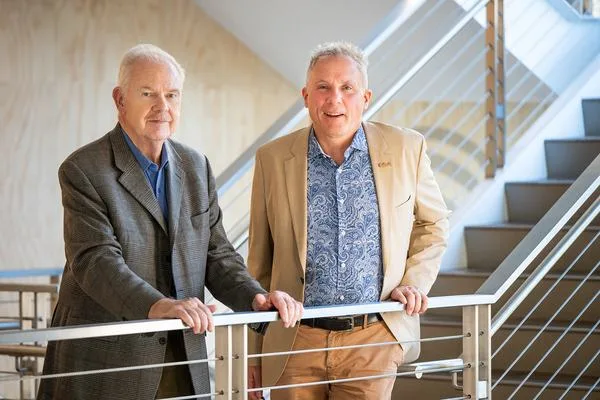
Silicon Valley executive, investor, and mentor Dr. William "Bill" Coughran (BS, MS '75; DAA '24) and his wife Bridget Coughran have committed $67.5 million to Caltech to endow and name the Bridget and William Coughran Department of Computing + Mathematical Sciences (CMS). The gift will provide significant annual funding to support faculty, researchers, and students pursuing new research frontiers and investigating the most challenging, fundamental problems in computation and information. It will also establish an endowment to sustain the department in perpetuity.
"We are approaching a future in which AI and computing will play a pivotal role across the full breadth of science and engineering," says Caltech President Ray Jayawardhana, the Sonja and William Davidow Presidential Chair and professor of astronomy. "Bill and Bridget recognize the tremendous possibilities before us and their extraordinary generosity will empower our researchers to accelerate scientific discovery and explore new vistas for the benefit of humanity. I am deeply grateful for their confidence in Caltech and their vision for what we can accomplish in the decades ahead."
For decades, Caltech faculty, researchers, students, and alumni have played an outsized role in shaping modern computing through field-defining innovations. For example, the late Richard Feynman, winner of the 1965 Nobel Prize in Physics, jump-started quantum computing in the early 1980s. Carver Mead (BS '56, PhD '60, DAA '06), the Gordon and Betty Moore Professor of Engineering and Applied Science, Emeritus, revolutionized the semiconductor industry with the development of very-large-scale integration (VLSI) circuit technology—the process of combining millions of transistors onto a single chip to form integrated circuits, the cornerstone of current computers. And alumnus Gordon Moore (PhD '54, DAA '75), a tech visionary and the co-founder of Intel Corporation, made possible the microprocessors that enabled the first laptops and now power billions of personal electronic devices.
Most recently, emeritus professor John Hopfield was awarded the 2024 Nobel Prize in Physics for work that enabled machine learning with artificial neural networks—the backbone of AI deep learning. Many more seminal contributions have been made in areas including distributed systems, computer graphics, and computer vision.
"For Caltech to continue to do science with a capital 'S,' AI needs to be a substrate of discovery across all research groups," says Bill Coughran, who has been a founder's coach and partner at Sequoia Capital and a Caltech distinguished alumnus. "Bridget and I want to provide the resources to make this happen and to recognize the computer and mathematical scientists who are helping to drive the Institute forward."
Where Computing Is Reimagined, Again and Again
The scientists and engineers in the newly named Coughran Department of Computing + Mathematical Sciences will carry forward Caltech's legacy of fundamental computational and mathematical advancements to novel frontiers, ranging from sustainable computing and computational imaging to collaborative AI agents and quantum cryptography. Many of the department's computer science faculty hold joint appointments in other academic departments, including astronomy, electrical engineering, and economics. In this interdisciplinary environment, the latest advances in generative AI, computational imaging, machine learning, and more, can inform and propel developments in other fields of study.
"Caltech's intention is to promote a scientific revolution by having computational and information science pervade every department and discipline across the Institute, and we can't do that without a strong core," says Harry Atwater, the Otis Booth Leadership Chair of the Division of Engineering and Applied Science, which houses the Coughran Department of Computing + Mathematical Sciences.
"Having an endowment for CMS is critical for Caltech's transformation as a whole," adds Atwater, who is also the Howard Hughes Professor of Applied Physics and Materials Science and director of the Liquid Sunlight Alliance. The Coughrans' support, he says, positions Caltech for a future where machine learning, artificial intelligence, and new computing modalities are central to scientific breakthroughs.
Already, faculty in disciplines across campus are using AI to radically advance science and the process of scientific discovery. For example, Katie Bouman, professor of computing and mathematical sciences, electrical engineering and astronomy; Rosenberg Scholar; and Heritage Medical Research Institute Investigator, uses computational imaging to reveal hidden parts of our universe that we cannot directly observe. She is part of the Event Horizon Telescope team that generated the first-ever image of a black hole, in the distant Messier 87 galaxy, and the first image of the supermassive black hole at the center of our own galaxy. Her methods have been applied to other disciplines, helping to image exoplanets and the magma beneath a volcano, and to improve medical imaging.
Anima Anandkumar, the Bren Professor of Computing and Mathematical Sciences, is pioneering a new generation of AI tools for science that adhere to the laws of nature and can simulate the physical world to invent and discover. The models she developed, called neural operators, enable multiscale learning of complex physical phenomena and were used it to train the first AI-based high-resolution weather model. The model is tens of thousands of times faster than current forecasting systems. In addition, neural operators have been successfully applied in modeling nuclear fusion and quantum chemistry, and in designing novel medical devices. In August, Anandkumar was named among the Time100 AI 2026, a list of innovators and thinkers reshaping the world through their advances in AI.
Meanwhile, as advancements in computing outpace the ability of the public and policymakers to evaluate and regulate them, Caltech plays a critical role in shaping a responsible tech future. As part of his research on optimization and algorithmic efficiency, Adam Wierman, the Carl F Braun Professor of Computing and Mathematical Sciences, examines the environmental and health impacts of data centers on neighboring communities. Amid rising tensions between the builders and nearby residents of data centers, Wierman has developed a framework for research-backed, deployable options that can better integrate data centers into communities and allow them to deploy significantly more computing power.
"There's not always an incentive for industry to manage the environmental or social impacts of AI. It's academia's role to do the research and prove what's possible," Wierman says. "We're told there's no alternative to on-site gas and diesel generators for powering data centers, but we have shown it's possible to avoid on-site generation entirely using coordinated on-site and distributed energy storage, without sacrificing quality service metrics."
A Shared Passion for Innovation
Bill Coughran has long understood the importance of taking action during seismic shifts in technology. Rising to be Google's senior vice president for research and systems infrastructure in the early 2000s, he helped massively scale its operations and vision as the young company introduced and refined a suite of products including the Chrome search engine, YouTube, and Maps. The company's speed of innovation made Google a technology powerhouse and fundamentally changed how people access knowledge and navigate city streets.
His fascination with computers began at Fresno State University, where his father worked as a professor and administrator. By high school, Coughran had secured a part-time job as an application and systems programmer at the university. Later, as a Caltech student, he studied the mathematics underlying computing. He was mentored by John "Jack" Todd, a Caltech professor whose contributions to numerical analysis helped enable high-speed computing.
Bridget Coughran took a different path to Caltech. After earning a geology degree from Fresno State, she moved to Pasadena and took a job in Caltech's Division of Geological and Planetary Sciences. There, she worked for geochemists Samuel Epstein and Hugh Taylor (BS '54, PhD '59), known for examining lunar specimens acquired by the Apollo astronauts. She also worked for Claire Patterson, known for discovering widespread and damaging lead isotope pollution.
"It was fun to be around people who were so enthusiastic about their work," Bridget Coughran says. "Caltech's ability to produce, decade after decade, high-caliber, Nobel-winning scientists is one of the reasons I continue to support the Institute."
A Special Place of Discovery
The Coughrans' transformative gift builds on their 2022 commitment to establish the William M. Coughran Jr. Leadership Chair of the Department of Computing + Mathematical Sciences. The Coughran Leadership Chair endowment provides the department's executive officer with discretionary resources that have been instrumental in supporting graduate students and allowed for the creation of the Computing, Data, and Society Fellows, a program that supports postdoctoral scholars whose computing and data science work promotes a social good.
"Having the flexibility to provide a graduate student with a little extra support at the end of their dissertation may sound small, but it makes a big impact on the individual, their faculty advisor, and our research enterprise," says Chris Umans, professor of computer science and inaugural holder of the Coughran Leadership Chair, who served until last month as the CMS executive officer.
Joel Tropp, the Steele Family Professor of Applied and Computational Mathematics, Coughran Leadership Chair, and current executive officer for the Coughran CMS Department, says he is eager to deploy the annual funding to advance the work of CMS faculty. "This visionary gift allows us to look beyond the short-term funding pressures we encounter to really develop a broader vision about what we can accomplish. We have the resources now to do things we couldn't contemplate before," he says.
The Coughrans' gift will also be used to further support the work of the Computing in the Sciences and Computation and Information Systems Initiative, or CIS2, a campuswide reflection on the opportunities—and threats—of AI, particularly with respect to academia.
"Caltech has a long history of fundamental contributions to computing, and at the same time, its traditional strength is in the sciences," says Pietro Perona, the Allen E. Puckett Professor of Electrical Engineering, director of the Information Science and Technology initiative, and a faculty lead on CIS2. "We are in a great place because I believe that science is the ultimate challenge for AI. As we apply AI to help scientists make progress, we are looking closely at the main pillar of science, the scientific method—can AI help us make new discoveries by noticing unexpected phenomena and coming up with creative hypotheses to explain them? Can it help us design elegant experiments that test those hypotheses most efficiently? Can it help us come up with models that explain our data and are meaningful to scientists? Can it facilitate collaborations by sharing information across fields of science?"
Bill Coughran adds: "Yes, AI is changing month by month, and academia will be forced to respond. But Caltech will remain a special place of discovery—and that is why Bridget and I are proud to support its future."