← Technology, Science & Infrastructure
▣ Distilled locally
Six LED Matrices Make One Impressive Display
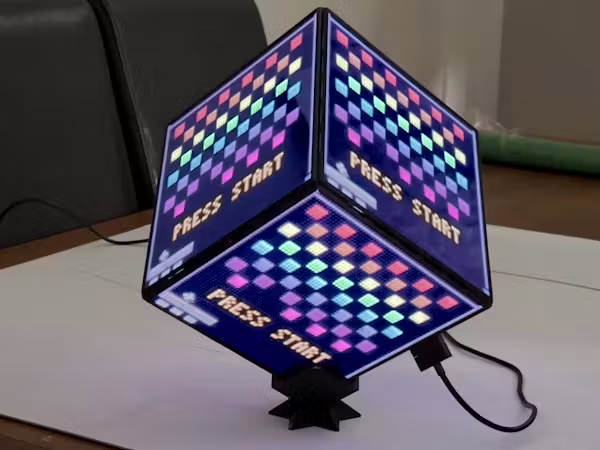
Most LED cubes are made up of individual LEDs arranged in a three-dimensional grid, allowing them to display simple animations and patterns that appear to float in midair. But maker Ross Harvey has taken a different approach with a project called the Lucent Cube. Instead of wiring up individual LEDs, he covered all six sides of a cube with high-resolution LED matrix panels. That makes it possible for the Lucent Cube to show animations, react to music, and play video games across multiple faces. Each side of the cube is equipped with a 64×64 RGB LED matrix panel, giving the device a total of 24,576 individually addressable LEDs. The panels use the HUB75 interface and measure approximately 160 mm square. To make the display look more polished, Harvey placed cell-cast acrylic diffusers over the panels. These soften the individual points of light, creating smoother images that appear to flow around the cube's edges. Powering all those LEDs is a Raspberry Pi Compute Module 4 mounted on a custom carrier board. It handles the graphics, runs applications, and communicates with a companion app over Wi-Fi and Bluetooth. A separate custom driver board interfaces with the six HUB75 panels, which are arranged in two chains of three. The software runs on Raspberry Pi OS Lite and uses the open source rpi-rgb-led-matrix library to control the displays. Harvey wanted the cube to be portable, so he designed a custom power system built around a rechargeable 2S lithium-ion battery pack. A boost converter supplies the 5 V required by the LED panels, which can draw considerable current when operating at high brightness. The cube also contains two speakers and a microphone, with everything mounted inside a custom 3D-printed skeleton. One of the more interesting features is the cube's ability to react to music. Audio captured by the microphone is processed using a Fast Fourier Transform (FFT), which separates the sound into different frequency bands. These values control the colors, brightness, and movement of animations, allowing the entire cube to pulse and change with the music. But it isn't limited to being a fancy music visualizer. Harvey has also developed games that take advantage of the unusual display geometry, including a platformer that spans multiple faces and a twin-stick game controlled using a smartphone. Other applications include animated characters, a world clock, and a variety of visual effects. For anyone interested in building something similar, Harvey has published a detailed build guide covering the electronics, wiring, software, and assembly. He also explains how the custom electronics can be replaced with a standard Raspberry Pi and an off-the-shelf HUB75 controller.The Lucent Cube (📷: Ross Harvey) The hardware is hidden inside the cube (📷: Ross Harvey)
↑ Back to top
Originally published by Hackster News ↗
· rebuilt here from its own full-text RSS feed · all rights
remain with the publisher, please read and support them there.