← Technology, Science & Infrastructure
▣ Distilled locally
Tiny Soft Robot Walks and Grips Without Motors
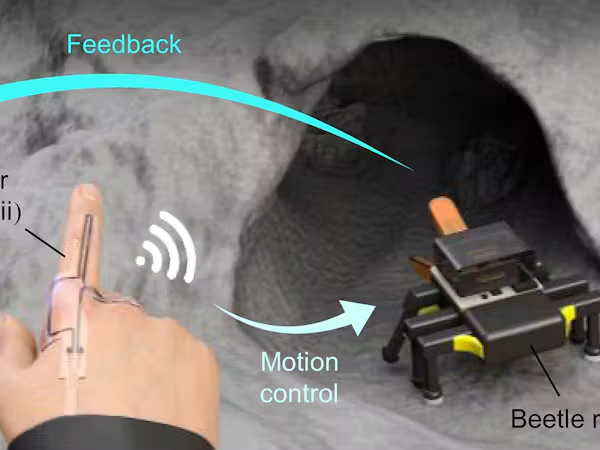
We often see them as pests, so it is easy to overlook just how capable insects really are. Despite their tiny size, they can easily navigate difficult terrain, manipulate objects, and adapt to their surroundings. We can't even come close to replicating their abilities in robots of a similar size. Conventional electric motors, gears, and other mechanical components are simply too bulky and complex for the job. Now, researchers from KAIST have developed a different approach with BeetleBot, a miniature soft robot that walks using artificial muscles. Described in a paper published in Science Advances, BeetleBot takes inspiration from the anatomy and movement of real beetles. It can walk forward, turn left or right, and grip objects, all without relying on traditional motors to produce those movements. It also incorporates a camera, pressure sensors, and a wearable control interface that allows a human operator to direct its movements using finger gestures. The key to BeetleBot's movement is a material called liquid crystal elastomer (LCE), which contracts when heated and returns to its original shape when cooled. The researchers used a 3D-printing technique called direct ink writing to fabricate artificial muscles from this material, embedding flexible metallic heating elements between layers of LCE. Applying a small electrical voltage heats the material, causing it to contract. In testing, the artificial muscles contracted by approximately 45% of their original length when supplied with 3 V. The contraction is reversible, allowing the researchers to produce repeated movements by switching the electrical current on and off. The robot's six-legged body was fabricated using 3D-printed resin, with artificial muscle modules arranged to reproduce the movements of beetle legs. One group of muscles lifts the body, while another provides forward propulsion. Activating these groups in a coordinated sequence allows BeetleBot to walk, while selectively activating muscles on one side causes it to turn. BeetleBot also has a soft gripper that resembles a beetle's mandibles. Like the legs, it uses electrically heated LCE actuators to open and close. An integrated capacitive pressure sensor measures contact forces, allowing the robot to detect when it touches an object and distinguish between different shapes and sizes. For remote control, the researchers developed a wearable finger patch containing a stretchable strain sensor made from carbon nanotubes embedded in a polymer. Different finger gestures produce distinct electrical signals that are converted into commands and transmitted to the robot over Bluetooth Low Energy. The onboard camera provides visual feedback to the operator, while the gripper's pressure sensor supplies information about physical contact. This creates a two-way communication system in which the operator can adjust the robot's actions based on what it sees and touches. The researchers believe this technology could eventually be useful for medical robotics, environmental monitoring, and remote manipulation in locations that are difficult or dangerous for humans to access. However, the artificial muscles currently require temperatures exceeding 100°C, and their heating and cooling cycles limit movement speed. Future improvements to the actuator materials could address these limitations and make the technology more practical for real-world applications.BeetleBot can be controlled by finger gestures (📷: I. Kim et al.) An overview of the system design (📷: I. Kim et al.) The architecture of the gripper (📷: I. Kim et al.)
↑ Back to top
Originally published by Hackster News ↗
· rebuilt here from its own full-text RSS feed · all rights
remain with the publisher, please read and support them there.