The Shenzhen Summit Supplants Yalta
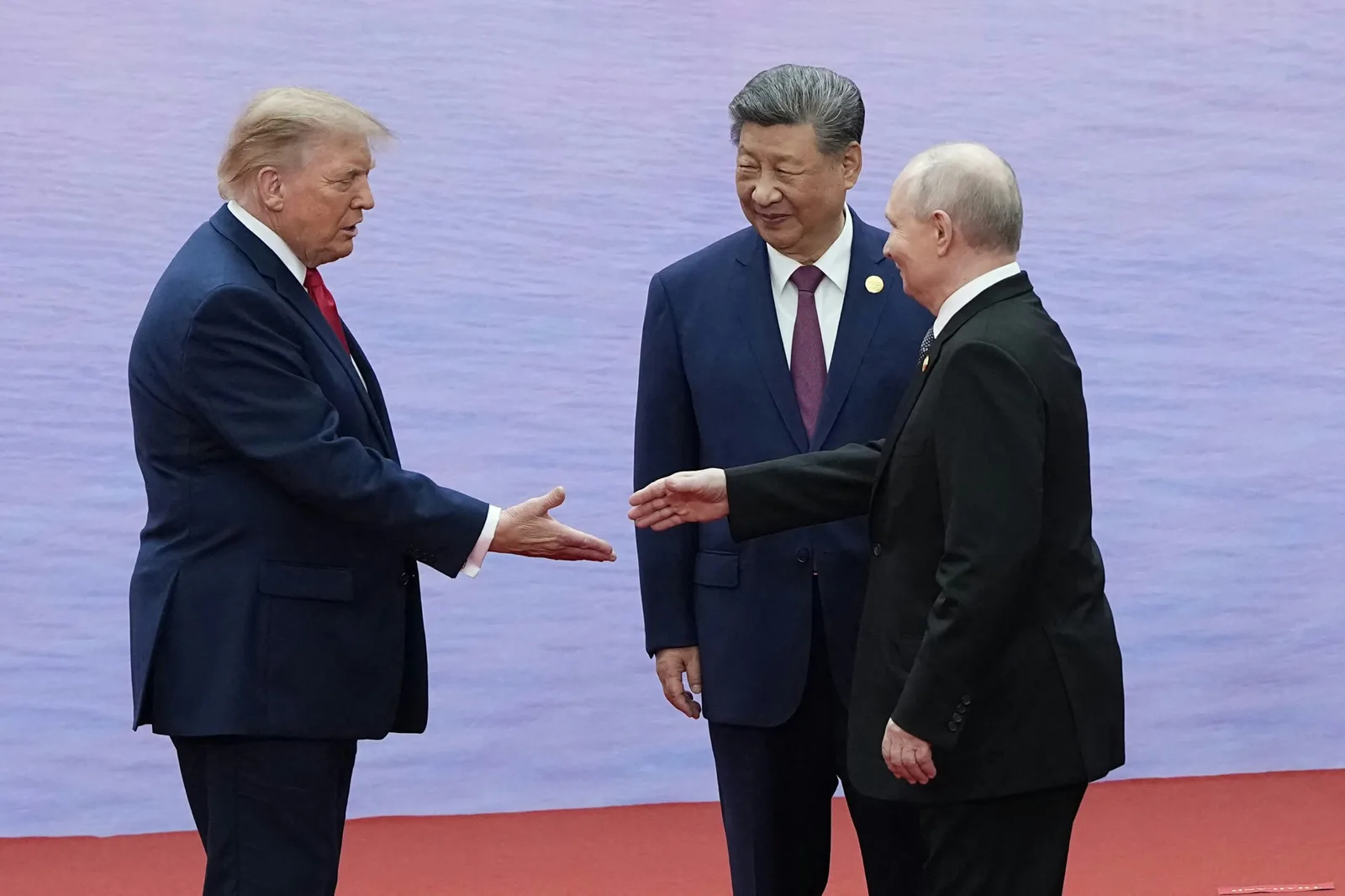
Pundits who dismissed the Shenzhen summit as a mere photo-op lacking substance missed the point. The significance of the conclave was precisely its enframing symbolism, showcasing a new world in which the rules-based order has been supplanted by spheres of influence accommodating each other.
The city of Shenzhen itself is a prism through which we can observe today’s power relations and the evolution of events over recent decades bringing us to this point.
Unplugged Computers in China’s Future Tech Hub
I first visited Shenzhen in 1986, arriving there by tram from Hong Kong and walking across the mainland border. There was barely any bustle, no crowds or traffic and a couple of tall buildings at the most. At our modest hotel, a squatting gardener was clipping the grass with a pair of scissors. The place still exuded the languorous vibe of the fishing village of 30,000 it had been not long before it was designated a “special economic zone” by Deng Xiaoping to attract foreign capital and technology.
On an inspection tour of sprouting industrial parks with then-former California governor Jerry Brown, our hosts proudly showed us what they called a tech hub. What then passed for “data centers” were cavernous, virtually empty warehouses with scores of desktop computers on worktables gathering dust — none were even plugged in.
What seemed embarrassing at the time turned out to be beyond impressive 40 years later. Shenzhen today is a literally glittering technopolis of 20 million people regarded as China’s “Silicon Valley” where Huawei, Tencent, DJI and BYD are all located. It is the center of gravity of China’s AI battle with the United States. The invitation to visit had come some years earlier from Xi Zhongxun, then Party chief of Guangdong province (where Shenzhen is located) and the father of China’s current leader, Xi Jinping. The elder Xi had come to California in 1980 looking for investment in the special economic zone as a key platform of Deng’s policy of “reform and opening up” to the world. On that visit, he met Gov. Jerry Brown and toured the state, including stops at tech sites in the then-fledgling Silicon Valley (Apple and Intel were about it in those days) and Disneyland, where he gamely shook hands with Mickey Mouse.
Years later in 2012, when Brown was governor again for a second time, Xi Jinping, then-vice-president of China on his way to the top, visited California. The irony was not lost on either leader when the governor inquired whether China was interested in helping finance California’s bullet train, already in the works for nearly 20 years.
A Chinese delegation later met with the governor at the Peninsula Hotel in Beverly Hills to discuss possibilities, but the idea never panned out. Those who had once come cup in hand to the Golden State now offered financing terms too tough to abide. By 2026, China had built a 30,000-mile network of bullet trains spanning its vast country. California and the U.S. still have yet to build one.
On that 1986 trip to China, Brown and I also met at Zhongnanhai, the secluded leader’s compound in Beijing, with the ideology chief and youngest member of the ruling Communist Party Politburo at the time, Hu Qili. In a wide-ranging conversation that touched on topics from the “spiritual pollution” of Western influence to Tibetan Buddhism, Hu noted that the Chinese military had reduced its forces by one million soldiers. Many military installations, he said, were converting to commercial applications in light industry and heavy-truck production. Several military aircraft plants were now making refrigerators and motorcycles.
To this, Brown quipped, “If the army is making refrigerators, you must think the polar bear [what the Chinese called Russia] is hibernating.” Laughing, Hu simply replied that since Russia “couldn’t even consolidate control of Cambodia, it is only inviting great trouble to try anything with China.”
Opening then to America while hostile to an ebbing Soviet empire, Hu insisted that “China’s armed forces are sufficient to resist hegemonist efforts from the bear if they come.”
By the time I saw Hu again in 1988, Mikhail Gorbachev had come to power in the Kremlin, attracting some sympathy among reformers in China and inspiring a growing youth movement with his ideas of perestroika and glasnost. Enough of a thaw was in the works that Hu asked me to convey “fraternal greetings” to Aleksandr Yakovlev, then the Soviet party’s main reformist thinker, on my next stop in Moscow.
“The one key power left out of the 1945 Yalta talks that shaped the international order in the dying days of World War II is now setting the agenda for what comes next.”
The Tiananmen Turn
It was in that atmosphere that Gorbachev visited Beijing in May 1989 and met with Premier Zhao Ziyang as tensions with the authorities were mounting on Tiananmen Square. In the wake of the student massacre that June, the liberal-leaning Zhao was purged for revealing “state secrets” to Gorbachev by telling him that Deng, who would order the repression, remained the power behind the throne even though he had formally retired. Hu was also purged.
This was a “ludicrous accusation,” Gorbachev told me later. The real issue, as he saw it, was his advice that the student occupation should be defused politically through negotiation, not force. “I was confident a political solution could be found. I was wrong, unfortunately,” the last Soviet leader lamented.
Deng had drawn the line on Party control that Gorbachev was erasing in Moscow. Deng’s open palm on the economy clenched into an iron fist on political reform. Ever since, Gorbachev’s “new thinking” has been vilified in Beijing as a recipe for the collapse of the Party-state, and something to be avoided at all costs.
A World Safe For Spheres Of Influence
When Vladimir Putin emerged in the tumultuous years after the Soviet collapse, China’s sympathy with a more amenable Russia returned. As the post-Cold War years wore on, the “hegemonist threat” for China shifted to America,s even as it prospered from the relationship.
In the end, China’s leaders came to strategically favor a trusted autocrat ruthlessly obsessed with dominating his own neighborhood over a meddling America endlessly endeavoring, in their minds, to subvert China’s governing system and keep the nation down. Party ideologues, Xi above all, are convinced that the American political class, implicitly if not explicitly, concurs with Bill Clinton’s remark when he was president that China was on “the wrong side of history.” Like many others in those days, Clinton wrongly presumed trade winds would blow open the society.
With a militarily mighty but economically feeble and dependent Russia at its side, China’s leaders have grown more confident in their capacity to contain America in a world made safe for spheres of influence.
The few words spoken for public consumption at the Shenzhen summit about zones of “civilizational values” and the primacy of state sovereignty over international law were code for the long-standing views of Xi and Putin, which the American president has now openly embraced.
Tech Trips The Thucydides Trap
At the first meeting of the Berggruen Institute’s 21st Century Council with Xi Jinping in 2013, the Party leader boasted that “we have never been closer to realizing the dream of Chinese rejuvenation” after the long climb back from colonial humiliation — invoking that history as if it were yesterday.
As Xi sees it, far from being on the wrong side of history, only the firm hand of the Communist Party could have brought the Middle Kingdom to where it is today and can take it where it must go tomorrow.
In 2015, then Premier Li Keqiang launched a “Made in China 2025” campaign with the goal of conquering the latest technologies from electric vehicles and batteries to artificial intelligence within a decade. Xi sees this conquest as rocket fuel for the rejuvenation of the Chinese nation, which he is determined to ensure does not fall behind the West and invite domination by outside forces, as it did during the Ming and Qing dynasties of the late 19th Century.
Strategists in Washington across the partisan landscape see China’s unrelenting resolve to reach its goals as an existential threat to America’s technological supremacy, and all that implies in terms of military might and geopolitical sway.
At our 2013 meeting, Xi pointedly raised an historical reference to “the Thucydides Trap,” whereby a rising power inevitably runs into conflict with an established power, only to say China would seek to avoid it. By now, though, it is clear that of all the contested issues between the U.S. and China, technology is most likely to trip the trap. The Nvidia episode is but one skirmish in a larger battle.
Shenzhen Supplants Yalta
If I were to have a conversation with the ideology chief on the Politburo today, as I had with Hu decades ago, here is what I would imagine him saying: “We have demonstrated we can go head-to-head with America on AI and technology. Today our military is reinvigorated. We have the largest navy in the world and are scaling up our nuclear arsenal toward parity with the U.S. and Russia. To be sure, America remains a formidable foe with the legacy of hegemonist ambitions. But let’s be serious. It is crumbling within. Its aging systems are plagued by outages. It can’t even build one bullet train.”
For Xi, hosting both leaders of the other great powers in Shenzhen, where China’s tech prowess is on full display, is the ultimate icing on the cake of rejuvenation. The one key power left out of the 1945 Yalta talks that shaped the international order in the dying days of World War II is now setting the agenda for what comes next.