← Technology, Science & Infrastructure
▣ Distilled locally
A Scientific Calculator for the Age of AI
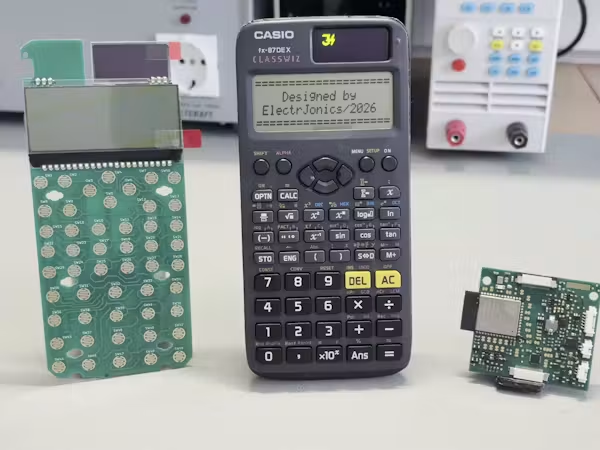
Calculators are great at crunching numbers, but you really have to know what you're doing to solve complex problems. It's up to you to string together the available functions — with perfect precision — to get the correct answer. Jonas, from the ElectrJonics YouTube channel, is looking to change that with an open source, AI-powered calculator that can answer questions, interpret images, and run small AI models locally. Now in its second iteration, the device has been completely redesigned with new hardware and a modular architecture that makes upgrades easier. The original version showed that AI could be integrated into a handheld calculator, but its hardware left little room for expansion. Rather than continue adding features to an increasingly restrictive design, the creator started over with a new schematic, custom PCBs, and an updated enclosure. The result is a more capable device that looks like a calculator but behaves more like a miniature AI assistant. One of the biggest additions to V2 is a built-in camera. This allows users to point the calculator at handwritten equations, printed text, or other objects and have an AI model interpret what it sees. Instead of manually entering a complicated equation, for example, a user could simply capture an image and ask the calculator to solve it. The device also features two displays rather than one. The primary screen handles the calculator interface, while the secondary display provides additional room for information, status messages, and other interface elements. This is especially useful when interacting with AI models, which can return considerably more information than a conventional calculator screen was designed to display. An ESP32 microcontroller powers the device. Its integrated Wi-Fi connectivity allows the calculator to communicate with cloud-based AI services, including OpenAI's models, using an API. Smaller AI models can also run directly on the microcontroller, although their capabilities are necessarily limited by the available processing power and memory. The redesigned electronics are distributed across custom PCBs, with a modular arrangement that separates major components such as the processing hardware, displays, and the keypad. This makes it easier to modify individual sections without redesigning the entire calculator. On the software side, custom ESP32 firmware manages the displays, keypad, camera, wireless connectivity, and AI interactions. The combination of cloud and local inference gives the project some flexibility, allowing users to experiment with different models and capabilities. Of course, a cloud-connected AI calculator isn't going to replace a conventional scientific calculator for every task. But as an open source platform for experimenting with AI in a handheld device, V2 offers plenty of possibilities. And with its new modular hardware, the next upgrade shouldn't require starting from scratch again.The calculator and custom PCBs (📷: ElectrJonics) The device connects to cloud-based services (📷: ElectrJonics)
Originally published by Hackster News ↗
· rebuilt here from its own full-text RSS feed · all rights
remain with the publisher, please read and support them there.
↑ Back to top
© 2026 PaperWeb. Content remains property of respective publishers. · Privacy Policy · Terms