← Technology, Science & Infrastructure
▣ Distilled locally
Turning Sight Into Touch with DIY Smart Glasses
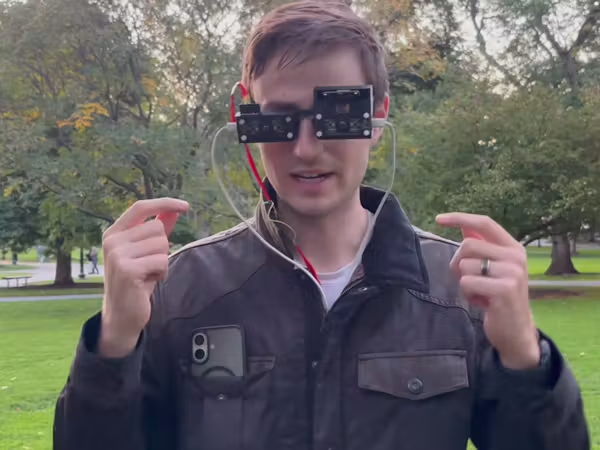
For people who are blind or visually impaired, navigating a busy city street can be difficult, even with the help of a white cane or guide dog. But what if you could sense nearby obstacles through vibrations on your skin? That's the idea behind a project by YouTuber DebackTech, who has developed an experimental pair of smart glasses that use LiDAR sensors and a vibration-equipped shirt to give wearers a sense of their surroundings without relying on sight. The plan is to give visually impaired individuals a sense of spatial awareness without resorting to cameras, audio cues, or any bulky equipment. DebackTech set out with two specific goals in mind: navigating a crowded city street without sight and catching a ball while blindfolded. The project started with a small 64-point LiDAR sensor, which measures distances by emitting light and detecting its reflections. DebackTech found that the resolution of this sensor was too low to be of much use, so he switched to a 512-point sensor and mounted three of them on a pair of glasses. An inertial measurement unit (IMU) was also added to track head movements and orientation. The sensors feed distance measurements to a Raspberry Pi 4, which processes the data and translates it into tactile feedback. The system uses a custom shirt fitted with 16 vibration motors distributed across the torso. Each motor corresponds to a particular region of the user's surroundings, and vibration intensity indicates how close an obstacle is. To complete the build, DebackTech assembled custom motor driver circuits on prototyping boards, connected everything to the Raspberry Pi, and wrote software to filter unreliable sensor readings. Without the filtering, sunlight introduced noise that made outdoor measurements less accurate. With the hardware assembled and tuned, it was time for some real-world testing. DebackTech took the device onto the streets of Boston, where it successfully detected obstacles but struggled with crowded environments. Too many nearby objects could activate multiple motors simultaneously, making the feedback difficult to interpret. Next, an electric scooter test exposed another of the system's limitations — sensor measurements simply don't come in fast enough. The biggest challenge, however, was playing catch while blindfolded. With the LiDAR sensors producing only about 13 frames per second, there wasn't enough time to react to an approaching ball. As a fix, DebackTech developed a trajectory prediction algorithm that estimates where the ball will travel based on its first few detected positions, giving the wearer an earlier warning. DebackTech's prototype isn't ready to replace a white cane or guide dog anytime soon, but the early results are encouraging. There are still plenty of challenges to overcome, particularly when it comes to sensor speed and making the vibrations easier to interpret. Even so, the project offers a glimpse at how technology could one day help people who are visually impaired navigate the world in an entirely new way. Wearing the assistive glasses (📷: DebackTech) A high-level overview of the plan (📷: DebackTech) Testing a LiDAR sensor (📷: DebackTech)
↑ Back to top
Originally published by Hackster News ↗
· rebuilt here from its own full-text RSS feed · all rights
remain with the publisher, please read and support them there.