← Technology, Science & Infrastructure
▣ Distilled locally
The Wristband That Knows What Your Fingers Are Doing
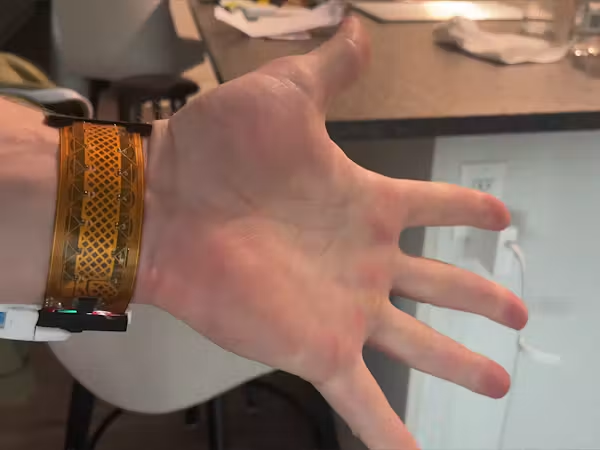
Smartwatches and fitness trackers are commonly found on people's wrists these days, which makes them a convenient platform for monitoring things like heart rate, activity levels, and sleep patterns. But one thing they can't tell you without additional sensors is what you're doing with your fingers. That capability is important for many applications, ranging from tracking athletic performance to controlling other devices, so William van den Bogert designed and built a custom bracelet that can recognize hand gestures by monitoring the movement of muscles and tendons beneath the skin. The bracelet relies on a technique called force myography (FMG), which uses pressure sensors to detect changes in the shape of muscles and tendons as they move. When you make a fist, pinch your fingers together, or perform another gesture, the muscles and tendons in your forearm contract and shift in characteristic ways. Those movements cause subtle changes in pressure around the wrist that can be measured and used to identify what the hand is doing. This approach has some advantages over other gesture recognition technologies. Unlike camera-based systems, FMG doesn't require a clear view of the hand or favorable lighting conditions. It also avoids the need for electrodes that measure electrical activity in muscles, as is the case with electromyography. To put this idea into practice, van den Bogert designed a wearable device that positions multiple force-sensitive sensors against the skin. Each sensor produces an electrical signal that changes according to the amount of pressure being applied. By combining readings from several sensors positioned around the wrist, the system can capture the pressure patterns associated with different hand movements. In order to get usable measurements, consistent contact must be maintained between the sensors and the skin. If the bracelet is too loose, the sensors may not detect small movements. If it is too tight, the sensors can become saturated, making it difficult to distinguish between gestures. A buckle with a tension spring was included in the design to keep contact between skin and sensors as consistent as possible. The bracelet is made up of custom-designed, 3D-printed parts. Flexible printed circuit boards accommodate the electronics, while a microcontroller collects the sensor measurements. A rechargeable battery and wireless communication capabilities make it possible to use the bracelet without being tethered to a computer. There is a big difference between measuring muscle movements and knowing what the fingers are doing. To make that connection, the bracelet uses machine learning to recognize patterns in the sensor data. The training process involved recording measurements while performing known gestures, then using those examples to train a classification model. Once trained, the model could analyze incoming sensor readings and predict which gesture was being performed. There are still a number of issues to work out, particularly when it comes to calibration and variations in how the bracelet is worn. Even so, the project shows how a relatively simple collection of sensors can provide information about hand movements without directly observing the fingers. With further development, similar technology could make it possible to control computers, robots, and other electronic devices using nothing more than subtle hand gestures. This bracelet detects finger movement (📷: the. Amazing, PhD) A closer look at the hardware (📷: the. Amazing, PhD) These sensors make contact with the wrist (📷: the. Amazing, PhD)
↑ Back to top
Originally published by Hackster News ↗
· rebuilt here from its own full-text RSS feed · all rights
remain with the publisher, please read and support them there.