← Technology, Science & Infrastructure
▣ Distilled locally
This Board Can See, Hear, and Think
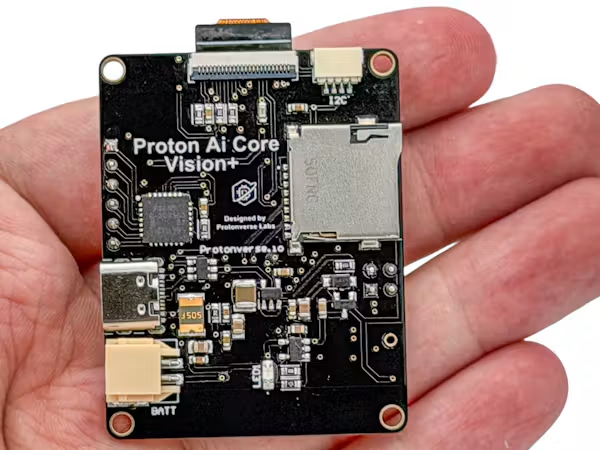
Building a device that can see, hear, and detect movement could take a pile of development boards and modules, along with the wiring and software needed to make everything work together. That's not necessarily a problem for experienced developers, but all of this complexity isn't exactly ideal in an otherwise straightforward project. Protonverse Labs is looking to simplify things with the Proton AI Core Vision+, a development board that combines a high-resolution camera, microphone, and motion sensors with wireless connectivity and support for edge AI applications. At the core of the board is an Espressif ESP32-S3-WROOM-1-N16R8 module, which includes a dual-core Xtensa LX7 processor running at up to 240 MHz, 16 MB of flash memory, and 8 MB of PSRAM. The module also provides 2.4 GHz Wi-Fi and Bluetooth 5 LE connectivity. Although the ESP32-S3 doesn't have a dedicated neural processing unit, it can run lightweight machine learning models locally, making it suitable for applications like object recognition and other sensor-driven AI tasks. The Proton AI Core Vision+ also features an OV5640 5 MP camera with a fixed-focus lens, connected to the board through a flexible cable. A flash LED provides illumination when needed. For audio input, there's a TDK InvenSense ICS-43434 digital MEMS microphone, and an ICM-42670-P six-axis inertial measurement unit provides three-axis acceleration and gyroscopic measurements. Unlike some competing boards, all of these components can operate simultaneously. Also onboard is a microSD card slot for local storage, a Qwiic/STEMMA QT connector for adding I²C peripherals, and an addressable RGB LED. A Microchip ATECC608B secure element provides hardware-backed cryptographic capabilities. Power can come from USB or a single-cell LiPo battery, with onboard charging circuitry included. Programming is supported through Arduino, MicroPython, and Espressif's ESP-IDF. Protonverse Labs has also developed Protonverse Studio, a free browser-based development environment that supports block-based programming and conventional coding workflows. It provides access to live camera and sensor data, along with examples for experimenting with AI-powered vision. In one demonstration, the developers showed off Proton Swarm — a system designed to help people find misplaced tools and materials in a shared workshop. Multiple Proton AI Core Vision+ boards work alongside an Arduino UNO Q to create a visual record of the space. Users can then ask where an item was last seen, saving time otherwise spent searching for it. Protonverse Labs is making the board's schematics, documentation, example sketches, and Arduino firmware publicly available under open source licenses. However, the PCB layout and manufacturing files will remain proprietary, as will the source code for Protonverse Studio. A crowdfunding campaign is planned, though pricing and a launch date haven't yet been announced. For makers interested in experimenting with computer vision, audio processing, and motion sensing, it could offer a convenient alternative to assembling all of those capabilities from separate modules.The Proton AI Core Vision+ (📷: Protonverse Labs) A closer look at the hardware (📷: Protonverse Labs) Protonverse Studio (📷: Protonverse Labs)
↑ Back to top
Originally published by Hackster News ↗
· rebuilt here from its own full-text RSS feed · all rights
remain with the publisher, please read and support them there.