← Technology, Science & Infrastructure
▣ Distilled locally
X-Hinges Creates "Self-Sensing" 3D-Printed Objects — From Gloves to Game-Controlling Sharks
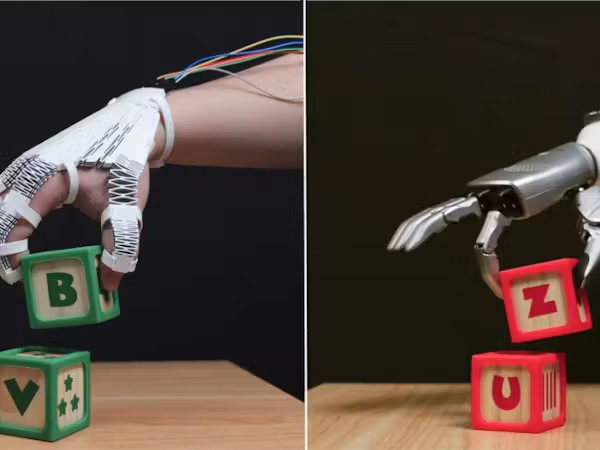
Researchers at the Massachusetts Institute of Technology (MIT) and Tianjin University have developed a "self-sensing" system capable of turning everyday items — including gloves — into motion-sensing "self-aware tools:" X-Hinges. "It's kind of like adding a conscious element to everyday objects," explains electrical engineer and computer science postdoctoral researcher Jiaji Li, a senior author on the X-Hinges paper. "What you get is objects that better understand how they're being used and have more ways to respond. In the same way an AI [Artificial Intelligence] agent is programmed to make certain decisions based on our instructions, these creations have built-in sensing to adaptively react to human touch." The X-Hinge system hinges (no pun intended) on a specialized design software, which takes a 3D model and automatically embeds two different conductive materials where they're required: one for sensors and another for connecting traces, both tweaked so as not to interfere with the other. Once the design is processed, it can be manufactured on a fused filament fabrication (FFF) 3D printer — with performance variations between prints corrected through the use of a computer-vision-based calibration system. "Most methods only allow for one axis of motion, often due to signal interference," lead author Xiang Chang says of prior approaches to the same problem. "X-Hinges enables your 3D-printed item to move from three angles. Ultimately, you get a design with the intended movement you want. It also records motion data in each of those areas at the same time, making the device responsive to different kinds of interactions." To prove the concept, the researchers printed a range of items for testing. A wearable glove tracks the movement of the user's fingers, relaying this to a robot arm that reproduces it; an origami-inspired lamp can detect when it's being pinched or stretched and adjust its brightness. A prototype tactile sensor, meanwhile, can "feel" objects placed upon it to determine what they are, while what looks at first glance like a toy shark is actually a touch-sensitive game controller. The team's work is due to be presented at the ACM Symposium on User Interface Software and Technology early next month; a preprint of the paper is available on arXiv under open-access terms. The objects are printed using a flexible filament plus two types of conductive filament, chosen to prevent interference. (📷: Chang et al)The X-Hinges system lets you 3D print "self-sensing" objects capable of tracking movement and touch. (📹: Chang et al)
↑ Back to top
Originally published by Hackster News ↗
· rebuilt here from its own full-text RSS feed · all rights
remain with the publisher, please read and support them there.