Farsoon adds modular polymer PBF platform for production
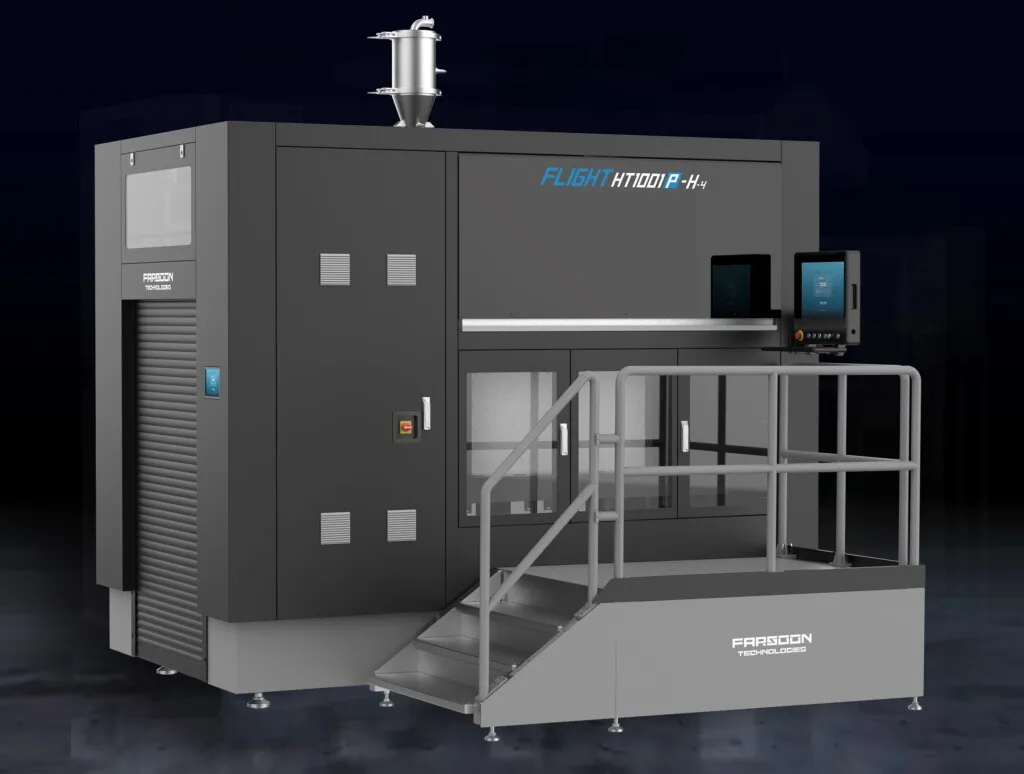
Farsoon Technologies has introduced the Flight HT1002P-CAMS, the latest version of its 1001 and 1001-H platforms for large-format polymer powder bed fusion (PBF). The system is based on feedback from series-production users and builds on Farsoon’s existing platform architecture for industrial part production.
The platform combines a 325-liter build volume, four 300 W fiber lasers and thermal management features with a modular Continuous Additive Manufacturing Solution (CAMS) concept. It is designed to support production workflows, improve equipment use and provide repeatable part manufacturing.
Large-format capacity for production flexibility
With a build envelope of 1,000 × 500 × 650 mm (325 liters), the Flight HT1002P-CAMS can produce long, single-piece components as well as batch production builds. The 1-meter build axis supports elongated geometries used in automotive ducts, interior trim and industrial components, while the 650 mm build height provides additional room for taller parts and nesting.
For series-production applications, the platform can increase the number of parts per build and support part consolidation where design and qualification requirements allow.
Multi-laser operation with two build modes
The Flight HT1002P-CAMS uses four 300 W fiber lasers and offers scanning speeds of up to 20 m/s. The multi-laser configuration is intended to increase throughput compared with conventional CO₂-based polymer SLS systems.
The system provides two operating modes. Production Mode uses overlapping multi-laser scanning fields to increase build speed and output. Premium Mode uses single-laser scanning within a 335 × 550 mm working zone for applications that require tighter process control and certification requirements.
This allows manufacturers to choose a build approach based on throughput and part-quality requirements.
Thermal control for build consistency
The Flight HT1002P-CAMS has a maximum chamber temperature of 220 °C. An updated multi-zone heating architecture and infrared thermal monitoring are used to support temperature consistency across the build area. Dynamic process adjustments and cooling for optical assemblies are also included.
These features are intended to support process consistency across large-format builds and repeated production cycles. Material selection and operating temperatures should be validated for the specific polymer grade and application.
Modular CAMS workflow
The Flight HT1002P-CAMS uses a modular CAMS architecture that can be adapted to different factory layouts and production requirements.
An automated bidirectional conveyor system handles build cartridge loading and extraction through electronic doors on both sides of the build station. Preheating, building, cooling and breakout stations can be configured separately to support the production flow.
Manufacturers can place multiple preheating and cooling units next to the printer or connect them into centralized production cells using automated guided vehicles or robotic arms. With exchangeable build cartridges, build preparation, cooling and part removal can take place while printing continues. This can reduce idle time and support continuous production.
Additional automation options include automatic laser window changers, closed-loop powder supply and recycling, manufacturing execution system integration and remote monitoring. The available functions depend on the configured system and the customer’s integration project.
Based on customer production requirements
The HT1002P was developed from the 1001 and 1001-H platforms and from feedback from users operating polymer AM systems in series production. The platform is intended to address production requirements such as process stability, material handling and equipment utilization.
Multi-laser printing is intended to improve build throughput while the modular workflow is designed to reduce non-printing time. Actual output, material use and cost per qualified part will depend on build loading, operating conditions and the validated workflow.
By combining the printing platform with production workflow options, Farsoon is positioning the system for scaling polymer additive manufacturing in industrial environments.
For more information, visit farsoon-gl.com.