US Army combines airborne drops and helicopter assaults in Pacific war games
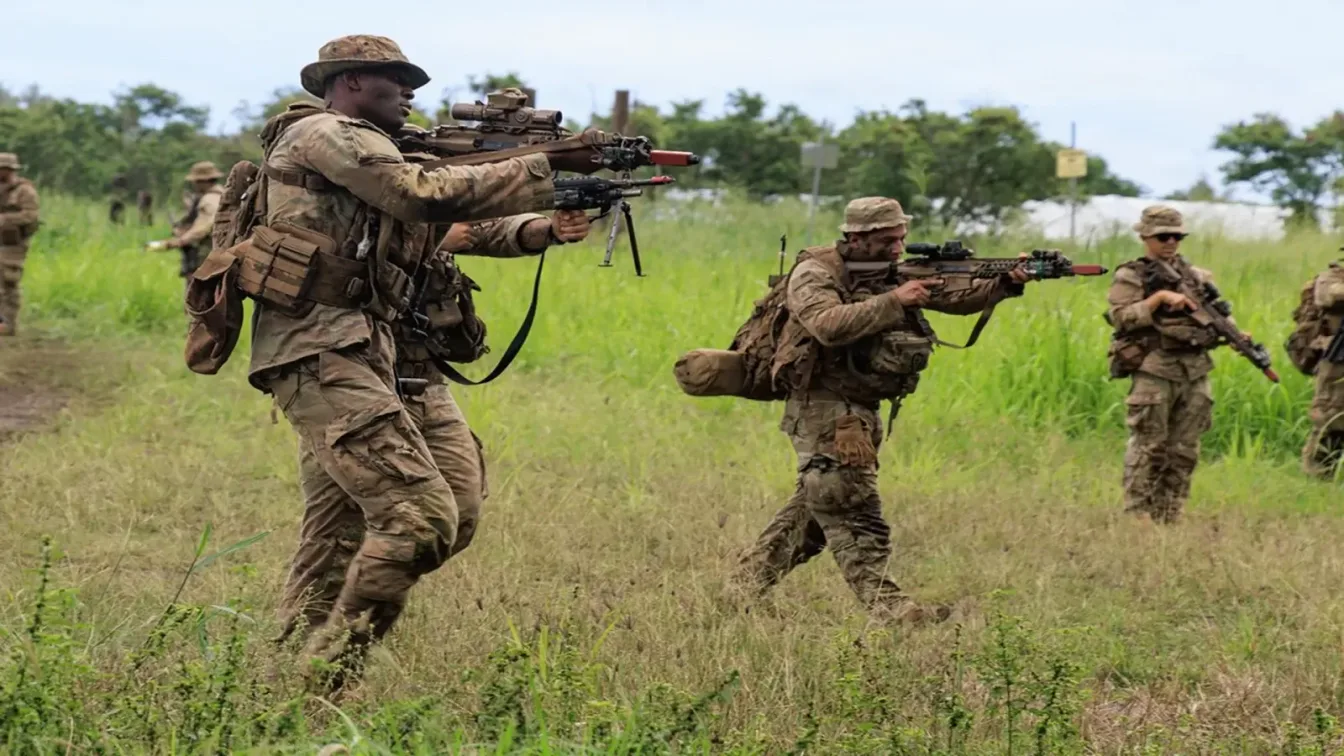
The U.S. Army’s 25th Infantry Division and partner forces moved from an airborne landing on Hawaii’s Big Island into a multi-battalion ground fight, then flew infantry by helicopter across the Pacific in a long-range air assault, according to Army releases. All of it is training against a simulated enemy, not combat.
The exercise is Joint Pacific Multinational Readiness Center Rotation 27-01, or JPMRC 27-01, a combat training rotation across the Hawaiian Islands. The division said thousands of U.S. and multinational forces are taking part. Army photo captions list South Korea, Singapore, France, New Zealand, Japan and the Maldives as participants. A later release described a continuous, 14-day engagement in which an opposing force plays the enemy.
Before the ground phase, the 11th Airborne Division flew about 300 paratroopers roughly 3,000 miles (4,800 kilometers) from Alaska for a jump into Hawaii, an operation known as Arctic Aloha.
From drop zones to open ocean
Forces began moving at night under strict electronic emission control, meaning limits on radio and other transmissions, the Army release said. The release described modern battlefields as saturated with electronic surveillance, the territory of electronic warfare.
Aviation and sustainment teams set up distributed arming and refueling stops across the island chain, the release said, to keep the joint force supplied without revealing its positions. South Korean army reconnaissance teams reached the Big Island aboard New Zealand aircraft to observe the drop zones. Col. Aidan Shattock, the division’s deputy commander for interoperability and a New Zealand Army officer, said forces are “operating within the area where we wish to deter.”
The division’s Nov.9 release said the 25th Combat Aviation Brigade then inserted elements of the 2nd Mobile Brigade into contested terrain, followed by heavy resupply drops from the 8th Theater Sustainment Command. It also said the assault relied on conditions set days in advance. A flight photo in that release is dated Nov. 8.
Networks, allies and open questions
Lightning Surge 6, an exercise running alongside JPMRC, continues to validate the division’s communication networks, the Nov. 7 release said. Soldiers use tactical mesh radios and secure but unclassified data layers. Mesh radios relay one another’s signals without a central tower.
Maj. Gen. Jeff VanAntwerp, the division’s commanding general, said it is one of two divisions with next-generation command and control, or C2, systems. He said its cloud-based design pushes a good amount of computing power down from brigades to the company level.
Several limits apply. The accounts come from Army releases, not independent observers or measured results. They don’t say how many aircraft or troops flew the assault, how the opposing force responded or how the network performed. They also don’t describe the decision-making aids the division said it is adding. The division called the insertion successful, which is its own assessment.
The division said fighting continues across Hawaii Island and Oahu. The earlier Arctic Aloha jump involved in-flight parachute rigging. The division published its releases Nov. 7 and Nov. 9.