← Technology, Science & Infrastructure
▣ Distilled locally
This Spinning Drone Can See Everything Around It
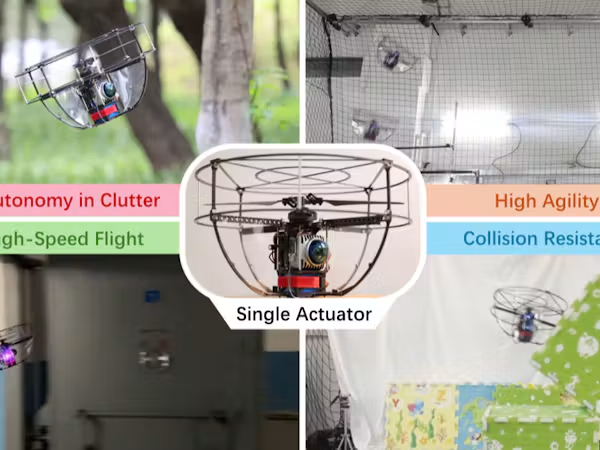
Quadcopters use four motors to control their movement, but is all that hardware really necessary? Researchers at the University of Hong Kong have demonstrated that a drone can fly with just one motor, and it doesn't have to sacrifice maneuverability to do it. Their latest creation, called PULSAR II , is a single-motor drone that can perform aerial flips, navigate obstacles autonomously, and withstand collisions. It also has an unusual way of seeing the world around it. The most interesting part of PULSAR II is its propulsion system. Rather than using multiple propellers, the drone has a single two-bladed rotor driven by a T-MOTOR MN5006 brushless motor. A special swashplateless mechanism allows the aircraft to control its orientation by continuously adjusting the motor's rotational speed. The mechanism uses two asymmetrical hinges that allow the propeller blades to change pitch in opposite directions. Accelerating or decelerating the motor creates an imbalance in the lift generated by the blades, producing torque that changes the drone's orientation. By precisely adjusting motor speed throughout each revolution, the system can control the aircraft's movement in three dimensions. Unlike a normal quadcopter, PULSAR II continuously spins around its vertical axis during flight. While that might sound like a disadvantage, the researchers turned it into a useful feature. The drone carries a Livox Mid360 LiDAR sensor that has a limited vertical field of view. As the aircraft spins, however, the sensor scans its surroundings from every direction, including above and below. This gives PULSAR II an omnidirectional view without requiring additional sensors or a motorized gimbal. An onboard computer powered by an Intel N200 processor handles mapping, localization, and trajectory planning, while an STM32H7-based flight controller runs PX4 software to manage the motor. The entire aircraft weighs 1.12 kilograms and is powered by a six-cell, 53.7 Wh battery. To improve maneuverability, the researchers developed a model predictive control system that anticipates the drone's motion and adjusts its flight path accordingly. They also incorporated a disturbance observer to compensate for unexpected forces, such as collisions. During testing, PULSAR II successfully followed aggressive figure-eight trajectories and performed aerial flips. It demonstrated its collision resistance by recovering from impacts with a falling ball and pushing through a lightweight obstacle. The drone also autonomously navigated dense woods and an underground parking garage using only its onboard sensors and computing hardware. In the parking garage, it reached speeds exceeding six meters per second without GPS or external tracking equipment. PULSAR II is still a research prototype, but its performance shows just how much can be accomplished with a single motor and some clever engineering. The researchers believe the design could eventually be useful for search and rescue, environmental mapping, and inspections in places where GPS isn't available.A single motor powers this drone (📷: N. Chen et al.) The main components (📷: N. Chen et al.) A closer look at the propulsion system (📷: N. Chen et al.)
↑ Back to top
Originally published by Hackster News ↗
· rebuilt here from its own full-text RSS feed · all rights
remain with the publisher, please read and support them there.