← Technology, Science & Infrastructure
▣ Distilled locally
Giving a 1994 Jeep an AI-Powered Tune-Up
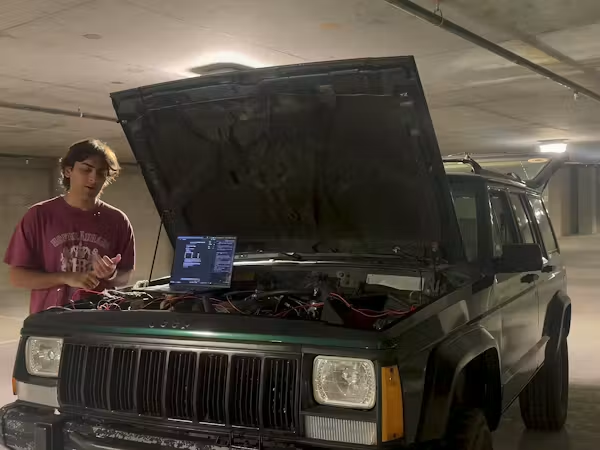
Keeping an older vehicle on the road can be tough, especially when something goes wrong with its electronics. Modern cars have standardized diagnostic ports that make troubleshooting easier, but vehicles built before those ports appeared require specialized equipment that's now difficult to find. That was the problem facing Muhammad Zulali, the owner of a 1994 Jeep Cherokee that kept failing California's emissions test. Rather than track down an obsolete dealership scanner, Zulali turned to AI to help reverse engineer the Jeep's computer using little more than a $3 Arduino. The trouble started with excessive nitrogen oxide emissions during the 25 mph portion of the state's dynamometer test. Without access to live engine data, diagnosing the problem would take a lot of guesswork and potentially require replacing perfectly good components. The Cherokee predates the introduction of standardized OBD-II diagnostics, relying instead on Chrysler's proprietary Serial Communication Interface (SCI). Specialized dealership scanners could communicate with the vehicle's Powertrain Control Module (PCM), but they're increasingly scarce and offer limited data logging capabilities. Zulali's solution was to build a custom interface that could connect the Jeep's computer to a modern laptop. An Arduino Nano clone, costing approximately $3, serves as the interface between the Jeep's diagnostic connector and a laptop running Claude Code and Codex. The prototype was assembled on a breadboard using jumper wires and a few resistors. Getting the two computers talking took some experimentation. Chrysler's SCI protocol uses inverted logic and particular communication timings, so the Arduino needed custom firmware to interpret the signals. Initially, resistors added to the circuit interfered with the relatively weak signal. Claude helped identify the problem, allowing Zulali to establish communication and begin logging live diagnostic data. Once communication was established, the AI assistants began investigating whether the Jeep's firmware could be modified to address suspected calibration problems contributing to the emissions failure. But there was a big problem. The PCM was manufactured in December 1993, several months before Chrysler introduced the hardware required for flash programming on these computers. Although the firmware contained some of the necessary code, the physical circuitry wasn't present. Codex came up with an unusual workaround. Instead of reflashing the computer, it developed a way to inject a small program directly into RAM through the SCI interface. By repeatedly transmitting the code approximately 90 times per second, it could keep the custom routine running. While that technically worked, it's clearly not the ideal solution. However, Codex eventually found a way to store custom code in nonvolatile memory, allowing it to execute directly on the aging PCM. Of course, there's a big difference between trusting AI to write a bit of code for a personal project and letting it make changes to the computer controlling your car's engine. One bad modification could leave you stranded, or worse. But for anyone willing to take that risk, this project shows what is now possible with AI-assisted reverse engineering.Connecting a modern laptop to a '90s Jeep (📷: Muhammad Zulali) The vehicle failed emissions tests (📷: Muhammad Zulali)
↑ Back to top
Originally published by Hackster News ↗
· rebuilt here from its own full-text RSS feed · all rights
remain with the publisher, please read and support them there.