← Technology, Science & Infrastructure
▣ Distilled locally
Selectric-256 Brings Encrypted Messaging to Vintage Computers
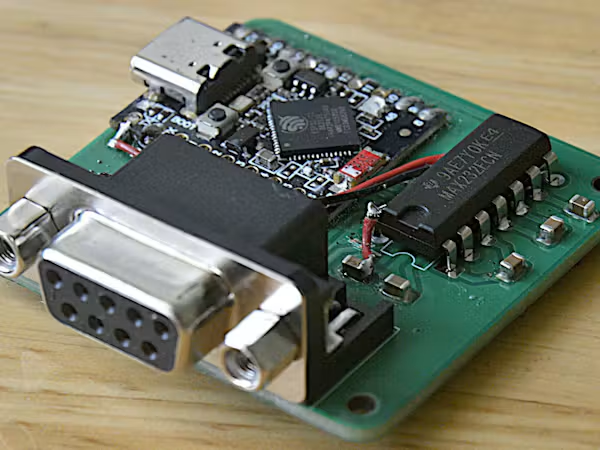
The IBM Selectric-251 is a fictional typewriter from the science fiction television series Fringe . In the show, two of these typewriters are connected through quantum entanglement, allowing messages typed on one to appear on the other, regardless of distance. Unfortunately, quantum entanglement doesn't actually work that way. But that didn't stop Legionlabs from building a real-world alternative called Selectric-256, a hardware device that provides end-to-end encrypted messaging for computers both old and new. Selectric-256 is built around an ESP32 microcontroller and costs approximately $8 per device. It connects to a host computer over USB or a serial connection, allowing that computer to exchange encrypted messages without having its own Internet connection. This makes it possible to use modern encrypted messaging on everything from a high-end laptop to a vintage PDP-11. The device handles all network communication independently of the host computer. It connects to Wi-Fi and exchanges messages through public MQTT brokers, which act as intermediaries between two paired devices. Users can also operate their own MQTT broker rather than relying on a third-party service. Unlike a general-purpose network adapter, Selectric-256 is designed to perform only one task: exchange encrypted messages with its paired counterpart. The host computer never receives unrestricted Internet access, reducing the network surface exposed to potential attackers. Security is provided through a combination of post-quantum cryptography and conventional encryption. Each device contains two permanent 32-byte identifiers, one identifying itself and another identifying its partner. These identifiers allow the devices to locate and authenticate one another when establishing a connection. The devices then use ML-KEM, a post-quantum key encapsulation mechanism, to establish an ephemeral shared secret. Subsequent messages are encrypted and authenticated using AES-256-GCM. An encrypted session counter provides protection against message replay attacks. The permanent identifiers aren't used directly for message encryption, so compromising them doesn't automatically expose previous conversations. However, an attacker who obtains the identifiers could potentially impersonate a device. The current implementation also lacks TLS, although the encrypted messaging protocol doesn't depend on trusting the MQTT broker. In terms of hardware, an ESP32S3 SuperMini is the only mandatory component, although the firmware also supports the ESP32S. Legionlabs designed an optional serial interface PCB incorporating a MAX232 chip, making the system compatible with older computers that lack USB connectivity. The firmware is programmed using the Arduino IDE, and users must configure matching device identifiers before flashing it. Two example Python drivers are available to demonstrate communication between the host computer and the peripheral. Developers can create their own software interfaces using the documented protocol. For more details on this project, or to build your own Selectric-256, be sure to check out the full write-up .Selectric-256 encrypts digital communications (📷: Legionlabs) A closer look at the hardware (📷: Legionlabs) The key exchange process (📷: Legionlabs)
↑ Back to top
Originally published by Hackster News ↗
· rebuilt here from its own full-text RSS feed · all rights
remain with the publisher, please read and support them there.