← Technology, Science & Infrastructure
▣ Distilled locally
RingIO Makes Smart Rings More Interactive
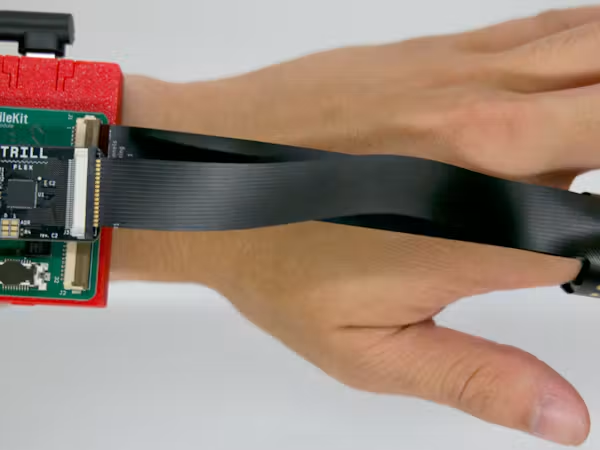
Smart rings are quite popular for tracking health and fitness, but interacting with them is a pain. Their small size leaves little room for buttons, displays, or even vibration motors. Researchers at the University of Chicago have developed a prototype called RingIO that addresses this limitation by allowing users to control devices through touch while receiving feedback directly through their skin. RingIO uses a combination of capacitive touch sensing and electrical stimulation to create a two-way interface that doesn't require a screen. Users can swipe or tap the outside of the ring to issue commands, while tiny electrical pulses delivered to the finger provide tactile feedback. This makes it possible to interact with the ring without looking at it. The prototype is built around a low-cost, commercially available COLMI R02 smart ring fitted with a custom flexible printed circuit board. Measuring just 0.08 millimeters thick, the PCB incorporates 16 electrodes spaced 4 millimeters apart around the ring. Electrodes on the outer surface detect finger movements, while those on the inside deliver electrical stimulation to the skin. A capacitive touch sensor handles input detection, and the open source eTactileKit generates the electrical pulses. An ESP32-C3 microcontroller serves as the processing unit. The researchers chose these components for their flexibility during experimentation, but not their size. The current prototype still requires external electronics strapped to the user's arm, so a redesign would be necessary to make the device practical for real-world use. Unlike conventional haptic feedback, which relies on vibrating mechanical components, electrotactile stimulation produces sensations by applying brief electrical pulses to the skin. These pulses can be delivered through individual electrodes in different sequences, creating the sensation of movement around the finger. To evaluate the system, the researchers recruited 13 participants who completed 4,248 trials involving four different stimulation patterns: pulse, pinch, sweep, and wobble. Participants were asked to identify the patterns and touch the corresponding locations on the ring without looking. Participants correctly identified the patterns approximately 80% of the time, with the sweeping pattern achieving nearly 89% accuracy. The most precise localization results came from the wobble pattern, with an average error of 29.6 degrees when touch feedback was enabled. The team also demonstrated three potential applications. One allows users to unlock the ring with a touch-based passcode, while another turns it into an entirely eyes-free game of Hot Potato. Perhaps the most practical demonstration is a podcast controller that lets users play, pause, and scrub through audio while feeling their playback position through electrical stimulation. RingIO is still an early research prototype, and the external electronics will need to be miniaturized so they can fit within the ring. Electrical stimulation also requires calibration to account for differences in skin sensitivity and moisture. Even so, the research shows how smart rings could become more than passive health trackers, providing a discreet way to interact with technology without constantly reaching for a smartphone.A RingIO prototype (📷: L. Chien et al.) The key components (📷: L. Chien et al.)
↑ Back to top
Originally published by Hackster News ↗
· rebuilt here from its own full-text RSS feed · all rights
remain with the publisher, please read and support them there.