← Technology, Science & Infrastructure
▣ Distilled locally
Turn Anything Into a Tamagotchi
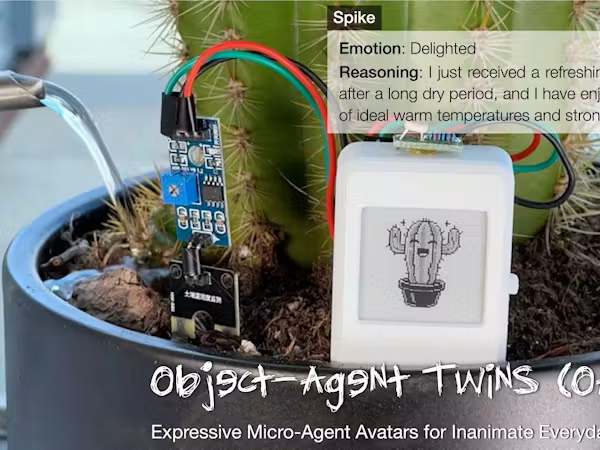
Smart home devices typically communicate with their owners through phone notifications or some type of onboard status indicator. A smart thermostat might display the temperature, for example, while a connected plant sensor can report when the soil is getting dry via a notification. These interfaces are useful, but they can easily be ignored. Researchers at Carnegie Mellon University have developed an alternative approach that gives everyday objects their own personalities, allowing them to express their needs through animated characters that capture their owners' attention. The system, developed by Daehwa Kim and Chris Harrison, is called Object-Agent Twins (OATs) . Inspired by virtual pets like Tamagotchi, OATs are small electronic devices that attach to ordinary objects and display AI-generated characters whose emotions reflect the conditions detected by onboard sensors. A cactus might look depressed when it needs water, for instance, then become delighted after being watered. Similarly, a skateboard might appear bored when sitting unused and excited when someone starts riding it. Each OAT is built around a Waveshare ESP32-S3 development board equipped with a 1.54-inch, two-color E Ink display. The hardware also includes an SHTC3 temperature and humidity sensor, a microphone for measuring sound levels, and a custom expansion board that supports additional sensors. The researchers developed modules for detecting motion, occupancy, light intensity, and soil moisture. A 1,100 mAh lithium-polymer battery powers the device for approximately one week, depending on its sensor configuration. The electronics are housed in a 3D-printed enclosure, with the complete device costing less than $20 to assemble. Optional sensors cost less than $5 each. Users configure their OATs through a web interface, where they describe the object, select appropriate sensors, and define desirable and undesirable conditions. Google's Gemini models then generate a pixel-art character and its behaviors, along with 12 emotional expressions ranging from excited and happy to frustrated and depressed. During operation, the ESP32-S3 wakes every two seconds to collect sensor readings. Local anomaly detection determines when conditions have changed enough to warrant an update, reducing unnecessary wireless communication and conserving battery power. When an update is needed, the device sends current readings and historical sensor data to a cloud server. Gemini evaluates this information against the object's configured behaviors, selects an appropriate emotion, and returns it to the device. The corresponding character animation then appears on the E Ink display. To evaluate the system, the researchers recruited 12 participants who created OATs for objects including refrigerators, plants, dumbbells, a coffee maker, and a 3D printer. All participants successfully configured their devices, taking approximately 15 minutes on average, before deploying them for a seven-day study. The results suggested that giving objects personalities could influence how people interact with them. Some participants changed their routines to make their OATs happy, including exercising more frequently, caring for plants, and improving refrigerator organization. Others reported feeling guilty when their objects appeared unhappy. The team also found some limitations of their system, including confusing emotional expressions and users manipulating sensor readings simply to make their characters happy. Nevertheless, the study suggests that turning ordinary objects into virtual companions could provide an engaging alternative to conventional smart device interfaces.OATs are user interfaces with a personality (📷: Future Interfaces Group) An overview of the system (📷: D. Kim et al.) The hardware (📷: D. Kim et al.)
↑ Back to top
Originally published by Hackster News ↗
· rebuilt here from its own full-text RSS feed · all rights
remain with the publisher, please read and support them there.