The MMX mission launches to Mars’ moons on Monday
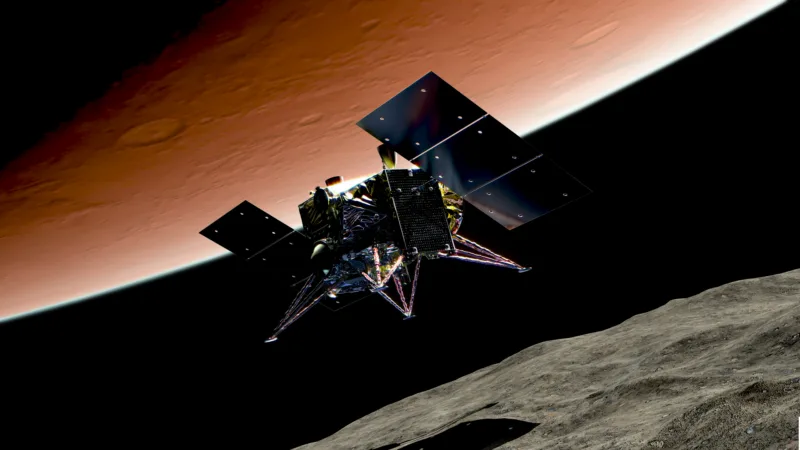
- Japan plans to launch its MMX mission to Mars’ moons on October 19.
- The spacecraft will explore Phobos and Deimos and collect a sample from Phobos.
- The mission aims to return the sample to Earth in 2031.
MMX mission will travel to Phobos and bring a sample home
Japan is about to launch a new mission to Mars’ two moons, Phobos and Deimos, on October 19. Its main goal is to collect soil from Phobos and bring it back to Earth, where scientists hope it will reveal where the moons came from.
The Japan Aerospace Exploration Agency (JAXA) is preparing to launch its Martian Moons eXploration (MMX) mission from Tanegashima Space Center in Japan at 19:41 UTC (2:41 p.m. CDT) on October 19, 2026. That’s 4:41 a.m. Japan Standard Time on October 20.
After a journey of about 10 months, the spacecraft will reach Mars and its moons Phobos and Deimos. There, the mission will deploy a rover to land on and explore Phobos. After taking a sample of Phobos’ soil, it will return to Earth in 2031, depositing its precious cargo in Australia for retrieval.
The 2 moons of Mars
Phobos — which means fear — and Deimos — which means terror — are the only two known moons of Mars, which takes its name from the Roman god of war. Astronomers long assumed these potato-shaped moons were captured asteroids that veered too close to Mars. However, astronomers have recently wondered if these nuggets are pieces of Mars that an impact flung into space. In fact, some think Phobos might once have been a ring around Mars … and it might one day break apart to become a ring once again.
How MMX will reach and sample Phobos
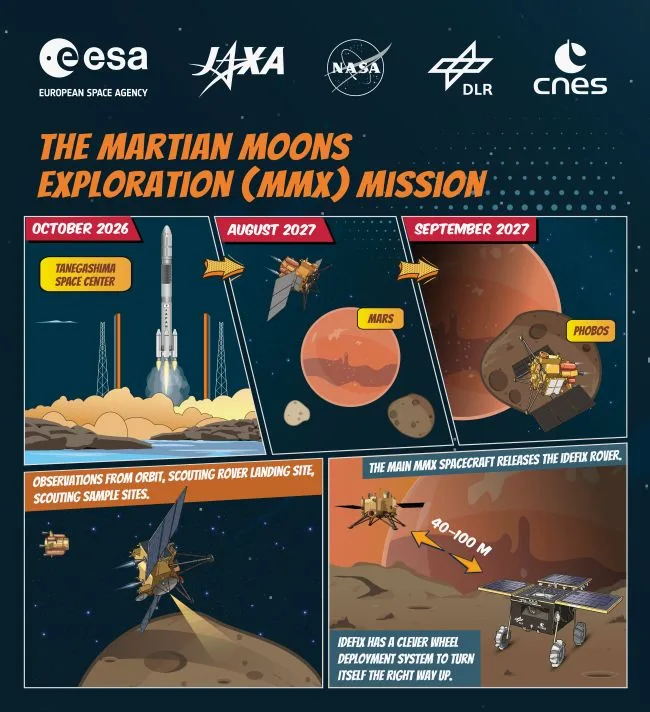
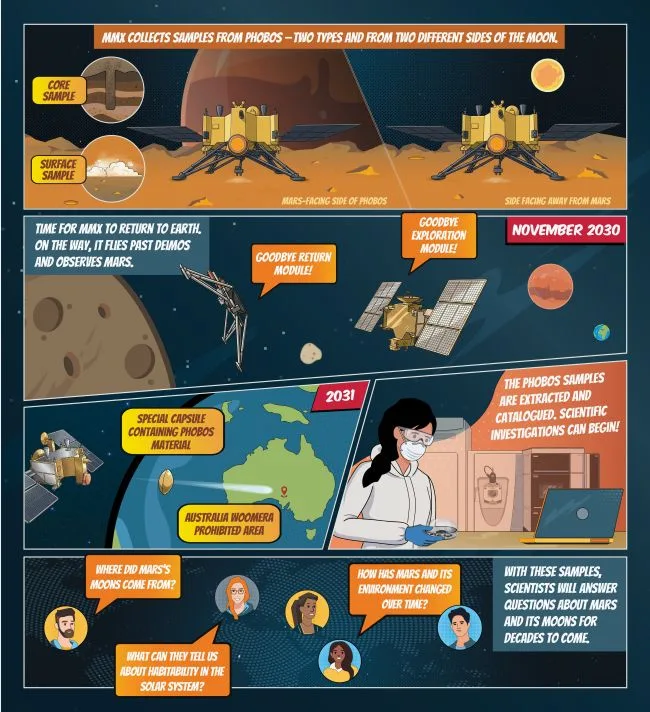
The components of the MMX mission
The MMX spacecraft has three parts. The propulsion module is what will get the spacecraft to Mars. Once there, the exploration module will visit Phobos’ surface with a rover and do soil sampling. Finally, the return module will journey back toward Earth and release a capsule that will target Australia.
Japan modeled the MMX mission after the highly successful Hayabusa2 mission that visited the asteroid Ryugu and returned samples to Earth. The Hayabusa2 mission discovered that Ryugu’s soil contained the building blocks of life.
We can’t wait to see what MMX discovers.
Bottom line: The MMX mission launches October 19 to explore Mars’ two moons. It will land on Phobos, collect a sample and bring it back to Earth in 2031.
The post The MMX mission launches to Mars’ moons on Monday first appeared on EarthSky.