← Technology, Science & Infrastructure
▣ Distilled locally
One Motor Is All This Drone Needs to Fly
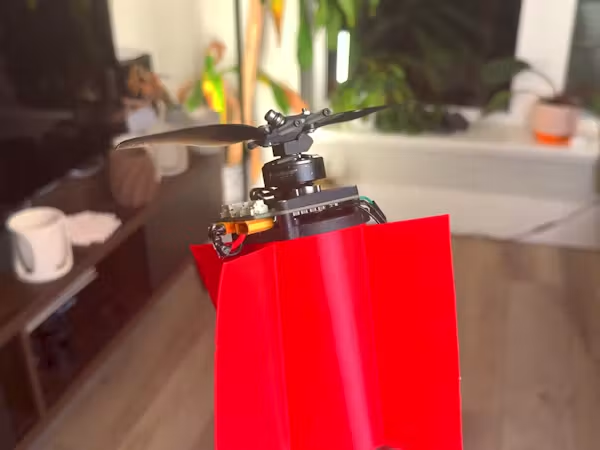
The most common types of drones use four or more motors to control their movement, with each motor independently adjusting its speed to maintain stability and steer the aircraft. Helicopters can get by with a single main rotor, but they need additional mechanical components to control the pitch of the blades and counteract the torque produced by the motor. Joshua Bird decided to take on the challenge of building a drone that can fly using just one motor, without a conventional swashplate or any servos. The key to Bird's design is a custom propeller hub that changes the pitch of its blades in response to rapid changes in motor speed. The blades are mounted on hinges angled at 45 degrees, allowing them to pivot as the motor accelerates or decelerates. Because the blades have inertia, they briefly lag behind the hub during these speed changes, causing one blade to pitch upward while the other pitches downward. This produces an imbalance in lift that can be used to tilt the drone. By carefully timing these changes to specific points in each rotation, Bird can steer the aircraft in different directions using nothing more than its motor. Bird initially experimented with a relatively large, dual-hinge propeller assembly before developing a smaller design that uses a single central pivot. The redesigned hub mounts directly to the motor's rotor bell and incorporates small counterweights that use centrifugal force to return the blades to their neutral positions. The hub was 3D-printed from carbon fiber-reinforced polyphthalamide to withstand the substantial forces involved. Miniature ball bearings and a thrust bearing allow the blades to pivot freely under load. The hardware build was one thing, but a method to control it was also needed. Conventional drone electronic speed controllers rely on back electromotive force to estimate rotor position, but Bird found that they lost synchronization when subjected to the rapid speed changes his design required. He replaced the controller with a Moteus R4 servo drive that uses a magnetic encoder to track motor position directly. This allowed the six-inch propeller to reach nearly 20,000 RPM while the motor accelerated and decelerated up to 300 times per second. At those speeds, vibration became a serious problem. Bird developed a custom high-speed photography system using a synchronized camera flash to examine the spinning propeller. It revealed that the blades were flexing excessively under aerodynamic loads, producing vibrations that overwhelmed the flight controller's accelerometers. Switching to stiffer blades resolved the issue. The drone also needed a way to counteract the motor's torque. Rather than adding another motor, Bird incorporated fixed anti-torque vanes into its 3D-printed TPU body. These reduced the rotation but couldn't eliminate it entirely. That led to another complication: the drone needed to track its heading while its body slowly rotated. With magnetic interference from the motor making a conventional compass unreliable, Bird developed an infrared beacon system that periodically corrects the flight controller's heading estimate. It was a lot of work, but in the end Bird demonstrated stable indoor flight, including controlled hovering and directional movement. The finished drone shows that a single motor can provide both lift and directional control, although eliminating the extra motors comes at the cost of additional complexity.This drone uses a single motor to fly (📷: Joshua Bird) An unusual propeller hub makes controlled flight possible (📷: Joshua Bird) The propeller was printed using carbon fiber-reinforced polyphthalamide (📷: Joshua Bird)
↑ Back to top
Originally published by Hackster News ↗
· rebuilt here from its own full-text RSS feed · all rights
remain with the publisher, please read and support them there.