Look for Mercury this week, farthest from morning sun
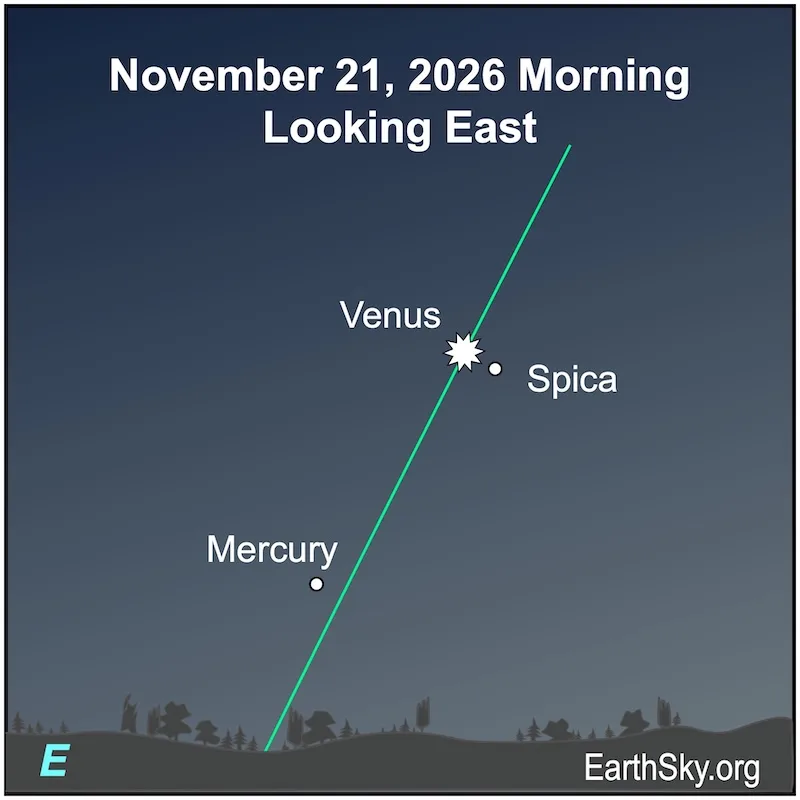
Mercury farthest from the sunrise on November 21
The innermost planet Mercury orbits the sun every 88 days. And Earth is moving, too. So Mercury ends up passing between us and the sun about every 116 days. It last did this on November 4, 2026, reaching the point astronomers call inferior conjunction. And since then, Mercury has been speeding ahead of Earth in orbit.
And now Mercury is back in our eastern predawn sky. Look for it in the sunrise direction shortly just as dawn is breaking. Mercury is bright! But it’s nowhere near as bright as Venus, which rises earlier and appears farther from the sunrise point than Mercury.
Mercury will reach its greatest western elongation – its greatest apparent distance from the rising sun, in the east at dawn – on November 21, 2026. This morning apparition – a brief one – favors the Northern Hemisphere. But Southern Hemisphere observers might glimpse Mercury, too, especially while using binoculars to scan for it along the eastern horizon.
Mercury greatest elongation, November 2026
When to watch: Officially, Mercury emerged the second week of November in the morning sky. Look for it shortly before sunrise. At greatest elongation, Mercury is farthest from the sunrise. In the mornings after that, as it’s edging back toward the sunrise, it’ll brighten a little bit more. That will make Mercury easier to spot in the morning twilight.
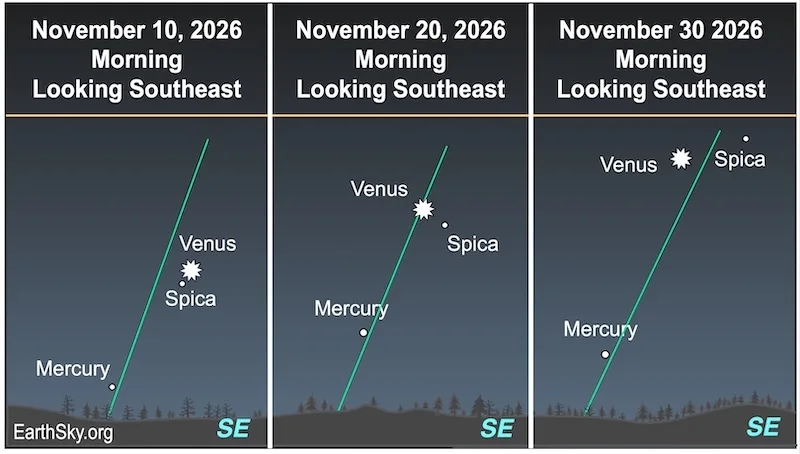
Where to look: Look in the sunrise direction as the sky is brightening.
Greatest elongation – marking Mercury’s farthest point from the sunrise glare – is at at 0 UTC on November 21 (6 p.m. CT on November 20). Mercury will shine at magnitude -0.6 on that morning. And it’ll be 20 degrees from the sun on our sky’s dome.
Through a telescope on and around November 21, Mercury appears 62% illuminated and 6.64 arcseconds across.
Note: This will be a long morning apparition for Mercury, for the Northern Hemisphere. After November 21, Mercury brightens a bit to magnitude -0.9 (bright, but competing with the morning twilight) until it slips away later – around mid-month – in the December morning twilight.
Venus is nearby: Also in the morning twilight – but higher is the sky – is bright Venus.
Mercury finder charts
For precise sun and Mercury rising times at your location:
Old Farmer’s Almanac (U.S. and Canada)
timeanddate.com (worldwide)
Stellarium (online planetarium)
Mercury events in 2026
Jan 21, 2026: Superior conjunction (passes behind sun from Earth)
Feb 19, 2026: Greatest elongation (evening)
Mar 7, 2026: Inferior conjunction (races between Earth and sun)
Apr 3, 2026: Greatest elongation (morning)
May 14, 2026: Superior conjunction (passes behind sun from Earth)
Jun 15, 2026: Greatest elongation (evening)
Jul 13, 2026: Inferior conjunction (races between Earth and sun)
Aug 2, 2026: Greatest elongation (morning)
Aug 27, 2026: Superior conjunction (passes behind sun from Earth)
Oct 12, 2026: Greatest elongation (evening)
Nov 4, 2026: Inferior conjunction (races between Earth and sun)
Nov 21, 2026: Greatest elongation (morning)
Mercury charts from Guy Ottewell
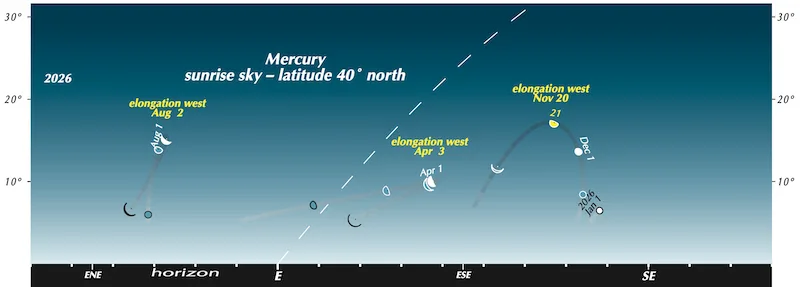
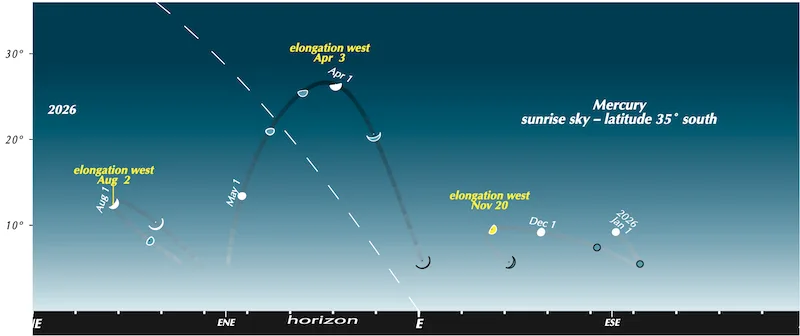
A comparison of elongations
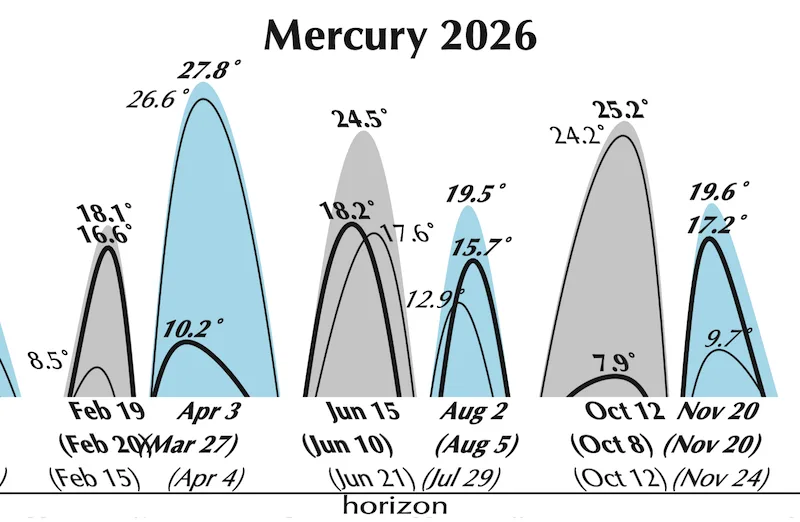
Mercury’s greatest elongations are not equal. Indeed, some are “greater” than others. For example, the distance of Mercury from the sun on our sky’s dome varies from about 28 degrees (maximum) to 18 degrees (minimum).
Also, Mercury’s elongations are better or worse depending on the time of the year they occur and your location on Earth. So, for both hemispheres, spring evenings and autumn mornings are best.
As an illustration, the chart below – from a Northern Hemisphere perspective – might help you visualize these differences.
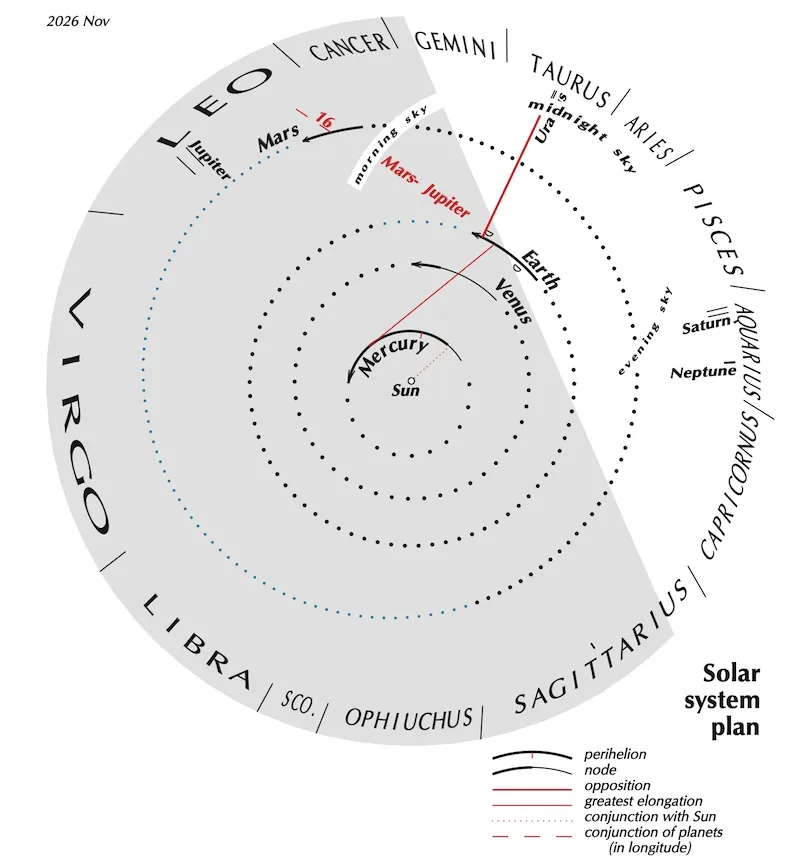
Heliocentric solar system, November 2026
Seasons make a difference
So, in the autumn for either hemisphere, the ecliptic – or path of the sun, moon and planets – makes a narrow angle to the horizon in the evening. Conversely, it makes a steep slant, nearly perpendicular, in the morning. So – in autumn from either hemisphere – morning elongations of Mercury are best. Then, Mercury appears higher above the horizon and farther from the glow of the sun. Conversely, evening elongations in autumn are harder to see.
On the other hand, in the spring for either hemisphere, the situation reverses. Then, the ecliptic and the horizon meet at a sharper angle on spring evenings and at a narrower angle on spring mornings. So, in springtime for either hemisphere, evening elongations of Mercury are best. Meanwhile, morning elongations in springtime are harder to see.
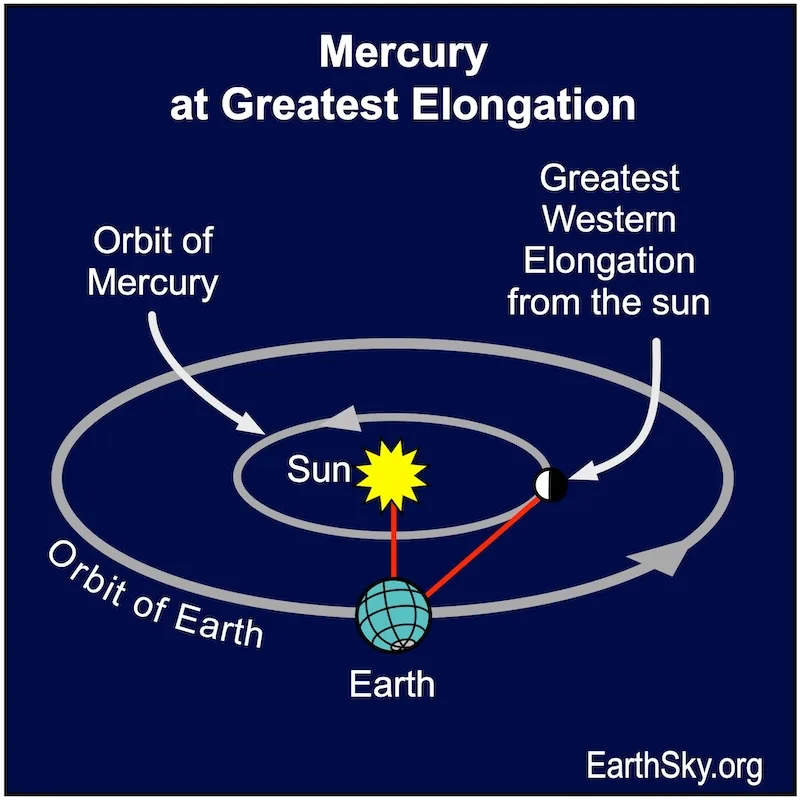
Bottom line: Mercury will reach its greatest elongation – greatest distance from the sunrise – on November 21, 2026. Look east at dawn. It’ll disappear from the morning sky in mid-December. Bright Venus will be nearby.
Do you love twilight? The 3 stages explained
Visible planets and night sky guide
The post Look for Mercury this week, farthest from morning sun first appeared on EarthSky.