C-17 cargo jets with 2,730-mile range set to launch cruise missiles, says Air Force
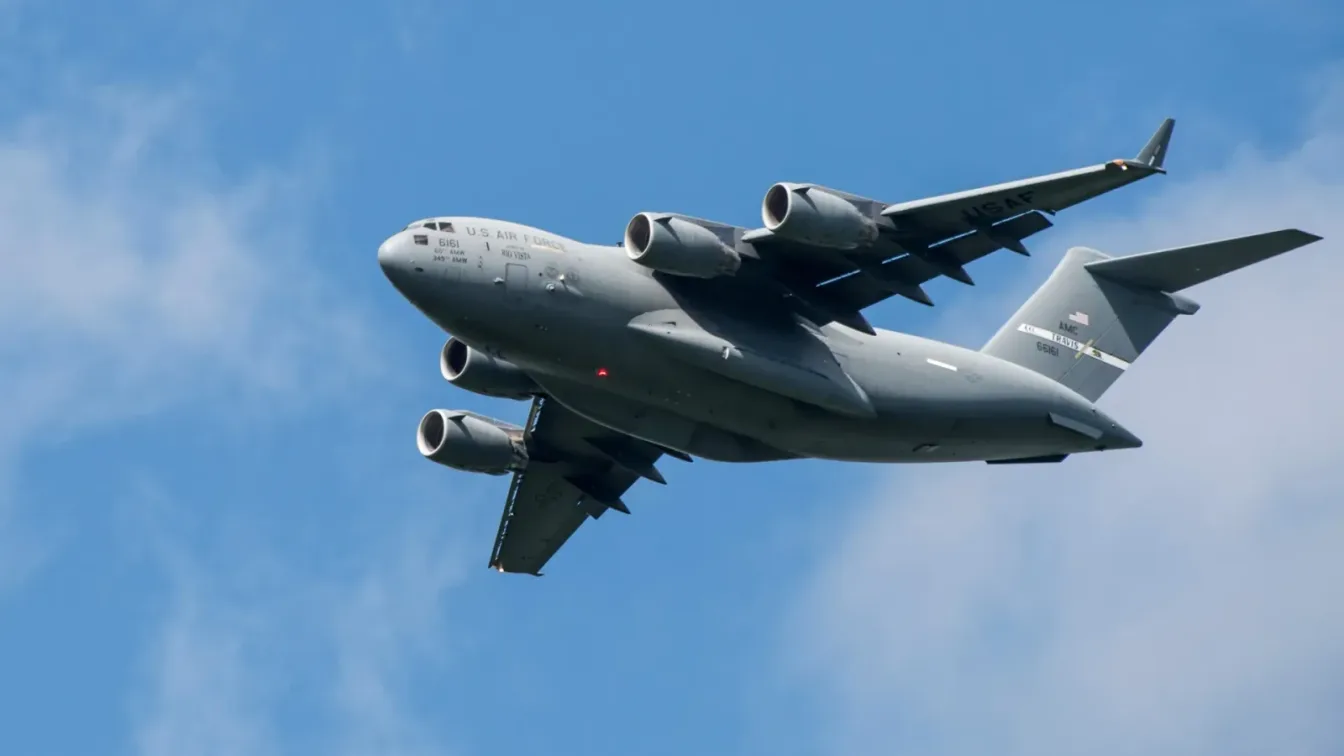
The U.S. Air Force says C-17 Globemaster III cargo planes and other airlifters are close to launching cruise missiles from pallets, after years of experiments. Air Force Chief of Staff Gen. Kenneth Wilsbach discussed the shift Nov. 6 at the Airlift/Tanker Association’s 2026 Symposium in Kissimmee, Florida.
Wilsbach said he was “excited” about arming the mobility fleet but stressed the concept is “more complex than just rolling dumb munitions off the back of an airplane.”
How palletized launch works
A specialized container loaded with cruise missiles sits on a standard airdrop platform. It is released like any other airdrop and deploys a parachute, after which the missiles deploy, ignite their engines, pull up and head for their targets.
The effort is part of the Family of Affordable Mass Missiles (FAMM) program, which aims to expand the munitions stockpile with cheaper, less exquisite air-to-ground missiles. In July, the Pentagon announced framework agreements for multiyear deals with three companies to develop and produce two versions: FAMM-Lugged for fighters and FAMM-Palletized (FAMM-P) for airlifters.
Wilsbach called the system “modular and smart,” with weapons that are “networked and affordable.” He said capabilities like FAMM-P blur the line between combat air forces and mobility air forces, a cultural shift he wants every mobility Airman to embrace.
Air Mobility Command chief Lt. Gen. Dan Tulley said C-130s and C-17s could deliver “mass fires on the adversary” through FAMM-P.
Numbers behind FAMM
The program grew out of Air Force Research Laboratory experiments called Rapid Dragon, which debuted in 2019. The program was previously called “Franklin” and sought cruise missiles at $100,000 per round, versus $1.5 million to $2.6 million for a Joint Air-to-Surface Standoff Missile (JASSM).
In April, the Air Force Life Cycle Management Center renamed the effort “Dragon Cart” and made it a program of record. The 2027 budget request seeks $355 million to buy 1,000 FAMM weapons, and projections show plans to acquire 28,000 over five years for $12.6 billion.
Wilsbach said each FAMM-P costs about a tenth of a JASSM and can be built on a lead time of “months, not years.” The Center for Strategic and International Studies reported in April that U.S. strike aircraft used roughly 1,100 JASSMs during Operation Epic Fury, from an estimated inventory of 4,400. It also noted that JASSMs take two years to go from order to delivery.
The C-17 platform
The C-17, developed by McDonnell Douglas (later Boeing), first flew in September 1991; deliveries began in 1993, and production ran until 2015. The U.S. Air Force and allies built 279, including the United Kingdom, Australia, Canada, Qatar, the UAE, India, and Kuwait.
The four-engine aircraft uses Pratt & Whitney F117-PW-100 turbofans and can operate from short, unpaved runways. It has a maximum takeoff weight of about 585,000 pounds (265.3 metric tons) and a payload of up to about 171,000 pounds (77.5 metric tons). That is enough for an M1 Abrams tank or up to 102 fully equipped paratroopers.
Its practical range is about 2,730 miles (4,400 kilometers) with a 157,000-pound (71.2-metric-ton) load, and it can cruise at up to 516 mph (830 km/h). Aerial refueling lets it fly intercontinental missions with virtually no range limit.