← Technology, Science & Infrastructure
▣ Distilled locally
This Virtual Microphone Follows Your Fingertips
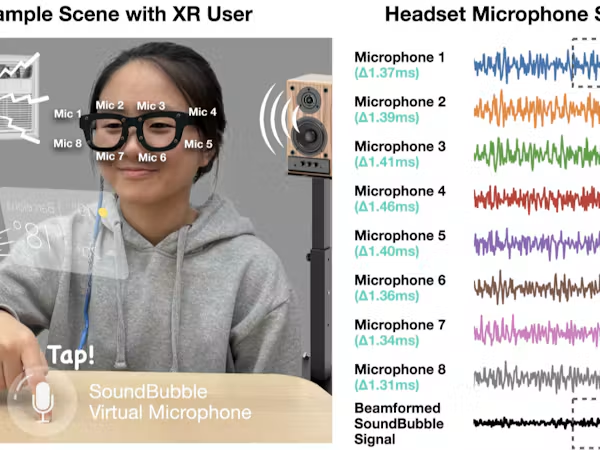
Our hands make all sorts of sounds as they interact with the world, from the click of a button to the nearly imperceptible noise of a finger sliding across a table. Those sounds can reveal quite a bit about what someone is doing, but capturing them normally requires placing a microphone somewhere on the hand. Researchers at Carnegie Mellon University have developed another option that effectively puts a microphone on your fingertip without actually putting anything there. Called SoundBubble , the system uses an array of microphones mounted on an XR headset or pair of smart glasses to create what the researchers describe as a virtual microphone that follows the user's finger. Combined with the headset's existing hand tracking, it can pick out sounds coming from around the fingertip while suppressing noise originating elsewhere. SoundBubble works by taking advantage of the tiny differences in the amount of time it takes sound to travel from the finger to each microphone. Since the headset's cameras already know where the finger is in 3D space, the system can calculate those propagation delays. It then shifts the individual audio streams to bring sounds from the fingertip into alignment before combining them. Sounds coming from other locations generally don't line up and are therefore suppressed. This allows SoundBubble to listen for some extremely quiet interactions. The researchers demonstrated it detecting taps and swipes on ordinary surfaces, finger-to-finger micro-gestures, the operation of handheld objects, and interactions with passive buttons, knobs, and sliders. The latter could be particularly useful for XR interfaces because a completely passive 3D-printed control could become interactive without adding electronics or sensors to the object itself. The approach also helps solve a problem for camera-based hand tracking. Determining whether a finger is touching a surface or hovering slightly above it can be difficult visually. SoundBubble can instead listen for the sound produced by contact, combining that information with the finger position supplied by the cameras. In tests with 10 participants, SoundBubble achieved a 94.7% overall true positive rate across three evaluated applications. Ad hoc touch detection reached 97.5%, while passive widget interactions reached 97.1%. Held-object activity recognition was more challenging, but still achieved an 89.4% true positive rate. The researchers also tested the system with loud music, cafe noise, and participants talking, with target sounds reaching 20 dB below the background noise. SoundBubble isn't limited to bulky experimental headsets, as you might expect. Simulations using smaller microphone setups found that an eight-microphone glasses-style array retained roughly the performance of the 16-microphone setup, while reducing the array to four microphones caused a more noticeable decline. That could make the technique especially interesting for future AR glasses. Instead of adding rings, wristbands, or other sensors to track subtle interactions, the glasses could simply listen to what your fingers are already doing.SoundBubble can focus on sounds made by the hands (📷: D. Kim et al.) An overview of the approach (📷: D. Kim et al.)
↑ Back to top
Originally published by Hackster News ↗
· rebuilt here from its own full-text RSS feed · all rights
remain with the publisher, please read and support them there.