← Technology, Science & Infrastructure
▣ Distilled locally
AI Sniffs Out Drones Using Magnetic Fields
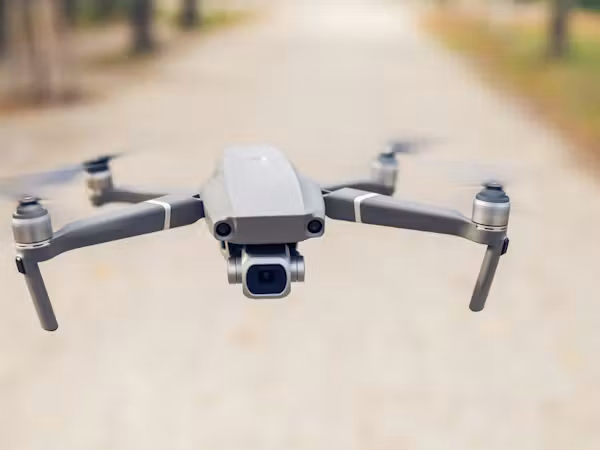
Drones have many useful applications, but they have also become an increasingly serious threat to our privacy, as inexpensive, commercially available aircraft can be used for surveillance. Detecting these small aircraft isn't always easy, especially when they're too small to reliably track with conventional radar. Researchers at Florida International University have now developed an alternative approach that uses the magnetic fields generated by a drone's electric motors to detect and identify it, without transmitting any signals that could reveal the detector's location. Traditional drone detection systems generally rely on radar, cameras, microphones, or radio frequency monitoring. Each approach has its limitations. Radar systems can be expensive and reveal their own positions by transmitting radio waves, cameras require a clear view of the target, and acoustic sensors struggle in noisy environments. The team's new system instead takes advantage of something that drones can't avoid producing: extremely low frequency (ELF) magnetic fields. Every drone has a magnetic fingerprint These magnetic fields are generated by the brushless DC motors that power most small drones. Because different drone models use different motor configurations, their magnetic emissions contain distinctive characteristics that can be used to identify them. And unlike radio communications, these emissions are present even when a drone is operating autonomously without transmitting control signals. To capture these signals, the researchers developed a sensitive circular loop antenna paired with a low-noise analog front end. The antenna detects the faint magnetic fields produced by nearby drones, while the analog circuitry amplifies and conditions the signals for further processing. Because the entire system operates passively, it doesn't transmit anything that an adversary could use to locate it. AI finds the signal in the noise Of course, simply detecting a magnetic field isn't enough to determine whether a drone is approaching, much less identify its model. To accomplish that, the researchers used a signal processing technique called spectral correlation function (SCF) estimation. This technique analyzes repeating patterns in the magnetic emissions, producing maps that highlight characteristics associated with the motors and their electronic controllers. Those maps are then fed into a convolutional neural network based on the VGG16 architecture. The AI model learns to recognize the magnetic signatures associated with different drones, allowing it to distinguish between multiple aircraft types and situations where no drone is present. High accuracy at a low cost The researchers tested their system outdoors using three commercially available micro-drones at distances of up to 15 meters. They achieved detection accuracy as high as 98.52%, while identifying the specific drone type, or the absence of a drone, with an overall accuracy of 83.5%. The smallest drone proved more difficult to identify because its motors produced weaker magnetic emissions. The limited detection range means this technology isn't ready to replace radar, but it could provide an inexpensive additional layer of protection. The prototype costs only a few hundred dollars to develop, making it practical to deploy multiple passive detectors around sensitive locations. The team is now working to develop the technology further.
↑ Back to top
Originally published by Hackster News ↗
· rebuilt here from its own full-text RSS feed · all rights
remain with the publisher, please read and support them there.