← Technology, Science & Infrastructure
▣ Distilled locally
Control Smart Glasses Just by Changing Your Focus
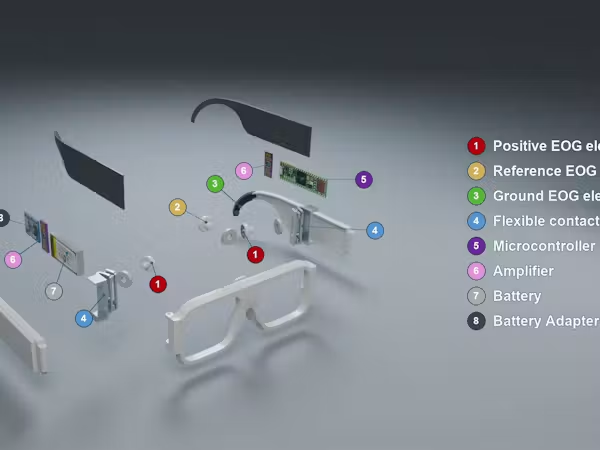
Smart glasses can already respond to voice commands, taps, and hand gestures, but what if you could control them just by changing where you focus your eyes? Researchers from Carnegie Mellon University, Tsinghua University, and Wuhan University have developed a system called VergeIO that makes this possible. Instead of tracking where you're looking with cameras, it detects the subtle eye movements that occur when you shift your focus between nearby and distant objects, turning them into commands for smart glasses. The system takes advantage of a natural eye movement known as vergence. When you look at something nearby, your eyes rotate inward to focus on it. Look at something farther away, and they rotate outward. These movements happen constantly throughout the day, but VergeIO turns them into recognizable commands. To accomplish this, the researchers used electrooculography (EOG), a technique that measures tiny electrical signals generated by eye movements. EOG sensors have already appeared in commercial eyewear, but detecting vergence presents a particular challenge. Because the eyes move in opposite directions, their electrical signals can interfere with one another, making them difficult to distinguish. The researchers addressed this problem by developing a new electrode arrangement that measures signals from each eye independently. Two electrodes sit against the temples, while a shared reference electrode contacts the bridge of the nose. A fourth electrode provides grounding behind the ear. This configuration preserves the electrical signals produced by vergence while remaining compatible with ordinary glasses. The prototype uses dry electrodes that don't require adhesive or conductive gel. Flexible contact arms help maintain contact with the skin, while two amplifier modules capture the signals. A Teensy 4.1 microcontroller processes the data in real time, using filtering algorithms and a random forest classifier to identify different eye movements. The complete prototype weighs 75 grams and costs approximately $140 using off-the-shelf components. The researchers estimate that an optimized version could cost as little as $73. Its analog sensing circuitry consumes just 3 mW, with a 570 mAh battery theoretically supporting approximately eight days of continuous sensing. To evaluate VergeIO, the team recruited 20 participants and asked them to shift their focus between targets positioned 30, 70, and 200 centimeters away. The system achieved 97% accuracy when distinguishing four different depth-based gestures, even when tested on participants whose data hadn't been used for training. Accuracy dropped to approximately 77% when all six possible gestures were included. Of course, constantly looking between nearby and distant objects could accidentally trigger commands. To address this, the researchers developed software to filter out unwanted movements and introduced an activation gesture. Users briefly raise their eyebrows to enable or disable eye-based interaction, reducing accidental activations to nearly zero in their tests. VergeIO is still a research prototype, and its accuracy was primarily evaluated under controlled conditions. But with further work, the technology could eventually allow smart glasses to select virtual objects at different depths, automatically adjust varifocal lenses, or assist with screening for certain vision disorders.VergeIO smart glasses track eye focus (📷: X. Zhang et al.) Testing the glasses (📷: X. Zhang et al.)
↑ Back to top
Originally published by Hackster News ↗
· rebuilt here from its own full-text RSS feed · all rights
remain with the publisher, please read and support them there.