← Technology, Science & Infrastructure
▣ Distilled locally
Hackers Can Make You Hear Things That Aren't There
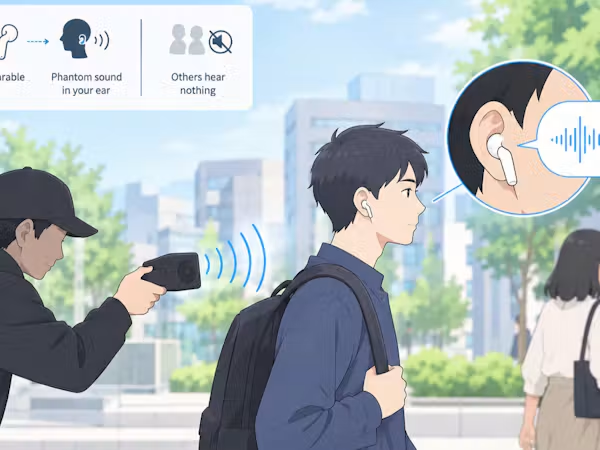
Wireless earbuds are a convenient way to listen to music, take calls, and get directions without pulling out a smartphone. And with transparency mode letting you hear what's going on around you, there's little reason to take them out. But researchers in Japan have discovered that this feature introduces an unexpected security vulnerability. With the right equipment, an attacker can secretly inject voices and other sounds into your earbuds using ultrasonic signals that are inaudible to people nearby. The technique, called UltrasonicWhisper+ , was developed by Hiroki Watanabe of Future University Hakodate and Tsutomu Terada of Kobe University. Their research shows how inaudible ultrasonic signals can be used to generate phantom voices and environmental sounds inside commercial earbuds, potentially tricking wearers into following false instructions. The attack takes advantage of a characteristic of microphones known as nonlinearity. Under normal circumstances, a microphone converts incoming sound waves into electrical signals. However, its response isn't perfectly linear, meaning certain high-frequency signals can produce lower-frequency components that fall within the range of human hearing. UltrasonicWhisper+ exploits this behavior by encoding audible sounds onto a 40 kHz ultrasonic carrier. When the signal reaches an earbud's microphone, the nonlinear response effectively demodulates it, producing an audible version of the original sound. With transparency mode enabled, that sound is then played through the earbud's speaker. The researchers built a prototype using a computer, an amplifier, and an ultrasonic speaker array containing 200 small transducers. They evaluated the technique on five commercial devices: Apple AirPods Pro, Bose QuietComfort Earbuds II, Samsung Galaxy Buds Pro, Sony WF-1000XM4, and Anker Soundcore Liberty Air 2 Pro. Audio quality varied considerably between devices, with Bose and Anker generally producing the clearest results. The attack was most effective in transparency mode, although some devices also reproduced weaker phantom sounds with active noise cancellation enabled. To determine whether people would actually fall for the attack, the researchers conducted several experiments. In one, participants received legitimate and false spoken instructions while performing a simulated factory task. Even after being warned about ultrasonic attacks and hearing examples beforehand, participants followed an average of 28% of the malicious instructions. The researchers also demonstrated that phantom sounds could appear to originate from different directions. By using two ultrasonic speakers and processing the signals to reproduce spatial audio cues, they made participants perceive sounds as coming from their surroundings rather than their earbuds. Participants correctly identified the intended direction within 45 degrees in 65.5% of trials. The most concerning demonstration involved navigation. Four participants wearing earbuds followed spoken directions through an indoor environment while an experimenter transmitted false instructions from approximately two meters behind them. All four followed every false instruction and arrived at the wrong destination. There are limitations, including differences between earbuds, reduced effectiveness in certain operating modes, and the need for specialized ultrasonic equipment. Still, UltrasonicWhisper+ reveals a vulnerability that doesn't require malware, Bluetooth access, or physical contact with the target device. As earbuds become increasingly integrated into everyday life, ensuring that the sounds we hear through them are actually trustworthy will become even more important.UltrasonicWhisper+ injects audio into earbuds (📷: H. Watanabe et al.) The nonlinearity effect (📷: H. Watanabe et al.)
↑ Back to top
Originally published by Hackster News ↗
· rebuilt here from its own full-text RSS feed · all rights
remain with the publisher, please read and support them there.