← Technology, Science & Infrastructure
▣ Distilled locally
The Battery Pal Delivers Phone-Like Battery Charging, Monitoring, and Regulation to DIY Projects
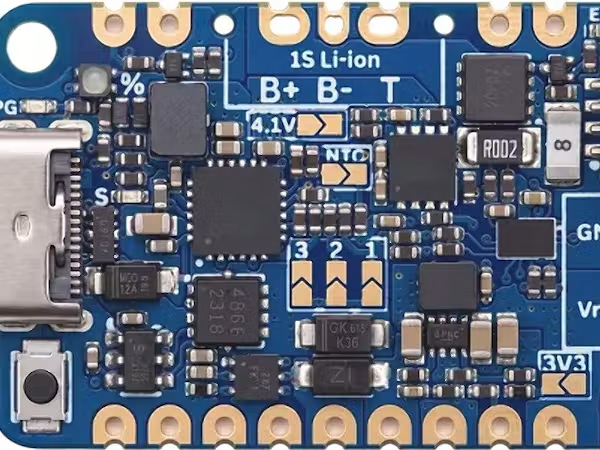
PN Labs has opened crowdfunding for a gadget designed to make the battery powering your next portable project as smart as the one that powers your phone: the Battery Pal three-in-one power module. "Getting a battery to charge is easy. Getting it to behave the way it does in your phone is a lot more work, and that's the gap Battery Pal closes," PN Labs cofounder Ethan Johnston, who runs the startup alongside Nick Kowalski, tells us of his company's creation. "Your phone tells you whether it has five minutes left or five hours. It charges from whatever USB [Type]-C charger is nearby, keeps running while it's plugged in, and won't charge a battery that's too hot. A basic charger board does none of that. It can't tell you how much charge is left, and it dims your LEDs like a dying flashlight as the cell drains." The Battery Pal, Johnston explains, is designed to simplify matters by combining key three functions into a single ready-to-run module: charging, monitoring, and regulation. "Designing the charging, protection, regulation, and fuel gauging yourself [is] a power electronics project of its own before you get to the thing you set out to build," he argues of the benefit of a drop-in solution. "We think that lowers the bar for anyone making a battery-powered product, from a student's first build to a small company's first production run." The device itself is designed to be powered from a USB Type-C Power Delivery (PD) power supply, a 4.5–13.5VDC power supply, or a "small solar panel," providing a user-selectable 3.3V or 5.1V regulated output at 1.5–2A. Available charge current can be set to 0.5–3A, with a configurable cell protection system and 8A backup fuse plus bundled temperature probe for connection to the battery itself.. An integrated "fuel gauge" monitoring system provides data over I2C and Qwiic connections, with a browser-based dashboard available through the use of an optional Raspberry Pi RP2040 board acting as a USB-to-serial bridge. For those on a budget, and for whom the planned $23.99 retail price would represent a big chunk of a project's overall bill of materials, PN Labs has designed the Battery Pal Lite. This drops the fuel gauge and 3.3V output, limits the output current to 1A, drops the charge current range to 0.2–2A, uses a fixed-voltage 5V USB Type-C input and is limited to 5.5VDC power supplies with no solar support. Battery cell protection gets a downgrade, too, swapping the configurable settings of the full-fat version for fixed thresholds and losing JEITA charging profile support for a hot/cold charging cutoff approach, in order to drop the retail price down to a planned $12.99. "Battery Pal brings the battery management used in consumer electronics to a module you can build with," Johnston tells us of his company's positioning of the part, likening it to the functionality you'd expect of the power circuitry in polished products like smartphones. "It goes on a breadboard for the first prototype and solders onto the finished circuit board, so the battery circuit you tested is the one you ship." The Battery Pal is now funding on Kickstarter , with rewards starting at CA$14 for the Battery Pal Lite and CA$21 for "early bird" backers of the full-fat Battery Pal; hardware is expected to ship in January next year. As with all crowdfunding campaigns, fulfillment is not guaranteed — but Johnston tells us PN Labs has already built 120 boards ready to send to backers, and already sells seven other hardware designs. Preliminary datasheets, meanwhile, are available on the PN Labs website .The Battery Pal aims to make your projects' power as smart as that of your phone, in a low-cost compact module. (📹: PN Labs) The module can be powered via USB Power Delivery, a DC adapter, or a small solar panel. (📹: PN Labs)
↑ Back to top
Originally published by Hackster News ↗
· rebuilt here from its own full-text RSS feed · all rights
remain with the publisher, please read and support them there.