BepiColombo is now in orbit around Mercury!
EarthSky’s famous lunar calendar is now available. Beautiful blue and silver poster shows every day’s moon phase for 2027. Order yours today!
BepiColombo mission went into orbit around Mercury on November 21
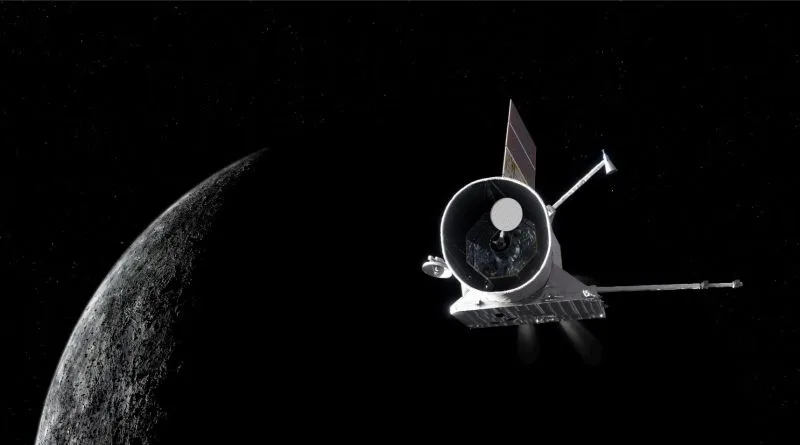
ESA’s BepiColombo mission successfully placed two science orbiters (currently still connected) into orbit around Mercury on November 21, 2026. But the mission was not without its fraught moments! In fact, when the thrusters fired, they only completed about 3/4 of the maneuver planned for insertion. Yet the mission was able to successfully enter Mercury orbit. Josef Aschbacher of ESA described the tense moments on Bluesky:
On Saturday, BepiColombo was passing just 635 km (394 mile) above Mercury’s surface, firing its thrusters to enter orbit, with no one able to talk to it. When contact came back, the spacecraft was in safe mode and the burn had stopped early, having delivered about three-quarters of the planned maneuver.
What happened next is what I’m proudest of.
Our team at ESOC in Darmstadt, working with Airbus and our JAXA colleagues, went straight into problem-solving mode. Within hours, Flight Dynamics had worked out exactly which orbit the spacecraft was in. Within days, the cause was traced to a software issue in attitude guidance and thruster control. The remaining maneuvers have already been replanned, with no extra burns needed.
The result: BepiColombo is safe, in a stable orbit around Mercury, and still on track for the separation of its two science orbiters on December 9. Science operations start in April 2027.
BepiColombo’s two orbiters will provide our first closeup look at the sun’s innermost planet since NASA’s MESSENGER spacecraft — previously the first and only craft ever to orbit Mercury — ended its mission in 2015.
BepiColombo’s mission to Mercury
Bepicolombo launched to space way back on October 20, 2018, from Kourou, French Guiana. The spacecraft spent eight years maneuvering into position so that it can orbit Mercury, the closest planet to the sun. Orbiting Mercury is a true engineering challenge, because the spacecraft picks up speed as it nears the massive sun. So Bepicolombo had to slow down to enter Mercury’s orbit and not fly straight past the planet.
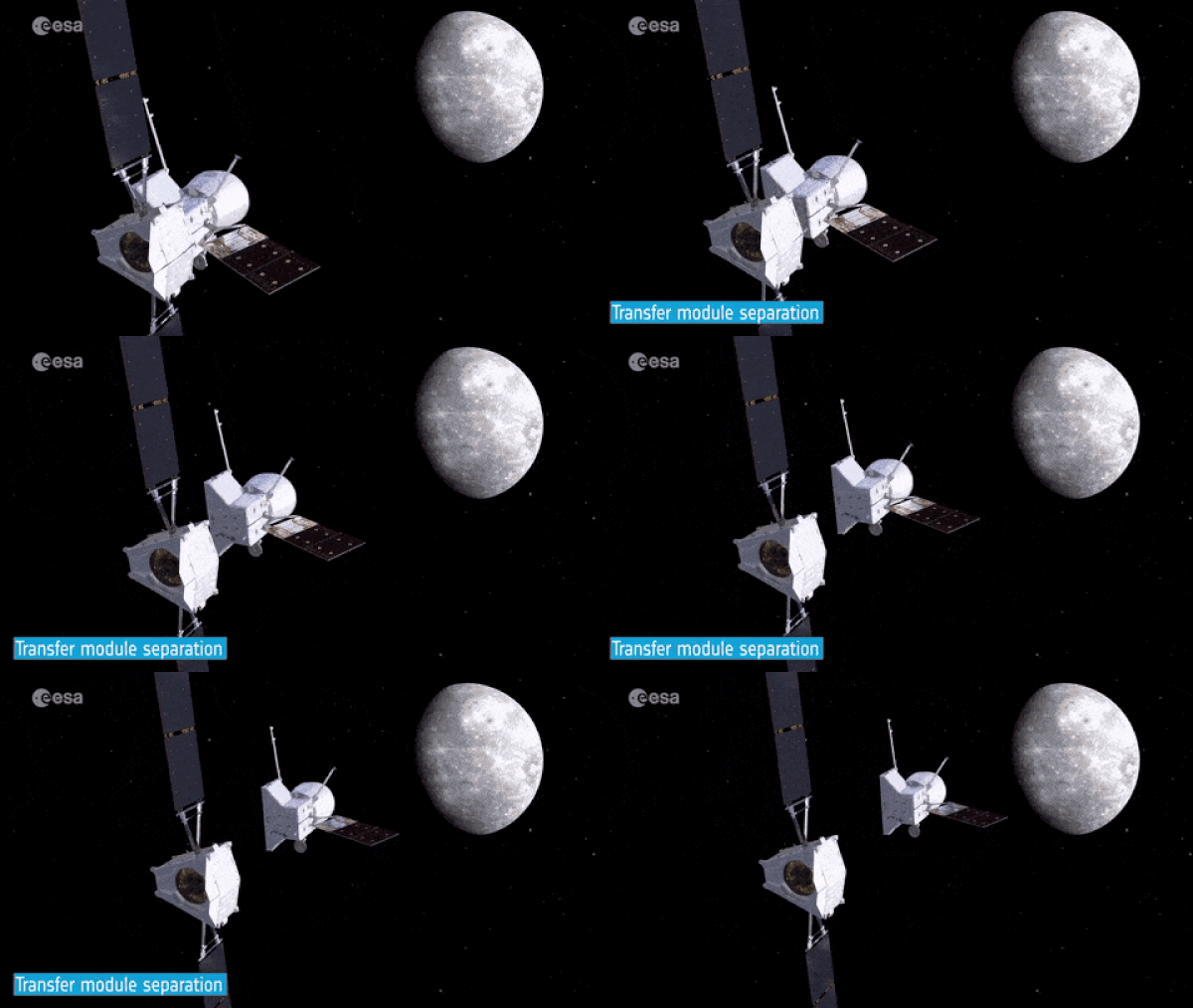
During its eight-year journey toward our sun’s innermost planet, BepiColombo made flybys — designed to help it hit the brakes — of Earth, Venus and Mercury itself. On September 3, 2026, ESA said that Bepicolombo’s Mercury Transfer Module (the spacecraft’s propulsion unit) had successfully separated from the two science orbiters. Those orbiters are called the Mercury Planetary Orbiter and Mercury Magnetospheric Orbiter. That was a crucial step in enabling them to enter orbit around a planet so near our local star. The two orbiters will separate from each other on December 9-10, 2026. Science operations will begin in April 2027.
For mission updates, follow ESA Operations on Bluesky.
BepiColombo’s flybys
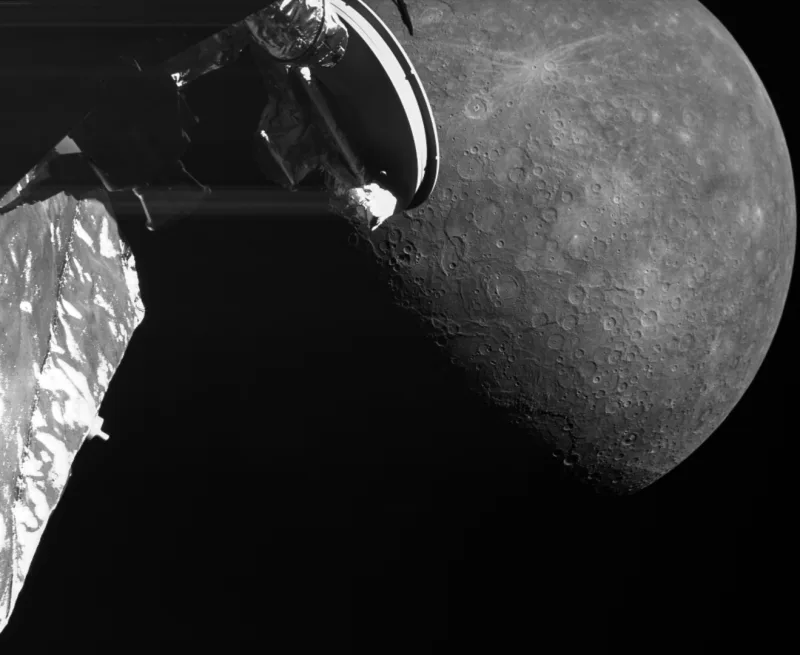
BepiColombo has made one Earth flyby, two Venus flybys, and six Mercury flybys since its launch in 2018. Click the links below to learn more about the flybys.
April 10, 2020: 1st Earth flyby
October 15, 2020: 1st Venus flyby
August 10, 2021: 2nd Venus flyby
October 1, 2021: 1st Mercury flyby
June 23, 2022: 2nd Mercury flyby
June 20, 2023: 3rd Mercury flyby
September 4, 2024: 4th Mercury flyby
December 1, 2024: 5th Mercury flyby
January 8, 2025: 6th Mercury flyby
What scientists hope to learn at Mercury
Mercury is currently the least-understood planet in the inner solar system. In fact, before BepiColombo, the only spacecraft to have visited Mercury were NASA’s Mariner 10 and MESSENGER missions.
Now, scientists hope to solve five mysteries with BepiColombo:
- Where did Mercury come from?
- Is there really water on Mercury?
- Is Mercury dead or alive?
- Why is Mercury so dark?
- Why does Mercury have a magnetic field?
To answer these questions, BepiColombo will spend at least one year orbiting Mercury. The mission will use its high-resolution instruments to learn about the mineralogical and elemental composition of Mercury’s surface. Plus, it will scan polar regions for ice. BepiColombo will look for anything that looks like it has changed on Mercury since MESSENGER visited 10 years earlier. And the two orbiters will travel through different areas of the planet’s magnetosphere to measure how it changes and interacts with the sun.
Bottom line: BepiColombo entered orbit around Mercury on November 21, 2026, though everything did not go as planned. Read more about the tense moments here.
Read more: Mercury images from final flyby of BepiColombo!
Read more: Mercury lives on? Strange streaks hint at active world
The post BepiColombo is now in orbit around Mercury! first appeared on EarthSky.