Swift spacecraft fell back to Earth in a fiery blaze yesterday
November 5 update: The U.S. Space Force said yesterday that the Swift spacecraft fell back to Earth at 12:39 UTC on November 4. It reentered Earth’s atmosphere over Northern Sumatra. A number of videos possibly showing the fiery reentry have been shared on social media. See them below.
Likely reentry of @NASA's #Swift observatory over Sumatra & Malaysia at 12:39 UTC today. https://t.co/yLCfhics3U
— Mario Billiani ? (@_starbase_) November 4, 2026
SEMENTRA itu sekitar pemandangan pada malam ini yang menunjukkan serpihan satelit atau meteor telah jatuh ke bumi dan dirakam oleh penduduk Mersing, Pulau Tioman dan Batam di Indonesia pic.twitter.com/QfOd8BMbJR
— Legendkiddo (@mohd_escobar) November 4, 2026
?????? ?? ??????? ???? ??????? ?????? ?????? ????? ??????? (SWIFT) ????? ????? ?????? ????? ??? ????!
— ???? ????? ?????? (@AstronomyCenter) November 4, 2026
???? ??? ????????? ??? ??? ?????? ????? ?????? ????? ???????? 04 ?????? 2026 ?? ?????? 12:39 ???????? ??????? (???? ???? ????? ????? ???)? ??? ????? ????? ???? ???? ???… pic.twitter.com/makhTPVNys
Watch more about Swift
Swift spacecraft rescue mission unsuccessful
On August 19, 2026, NASA said:
Due to an ongoing commercial spacecraft attitude control issue, NASA and Katalyst Space announced Wednesday the LINK spacecraft will not capture or boost an agency satellite to a higher altitude to extend its science mission as planned.
Katalyst Space launched LINK, a spacecraft meant to capture the failing Swift satellite and boost it into a higher orbit. Swift was a space telescope that watched for events such as gamma-ray bursts. But after more than 20 years, the spacecraft’s orbit had been quickly decaying. It needed a boost back in space or it would crash back to Earth. Unfortunately, the rescue mission was not able to provide that boost after all. So Swift fell back to Earth. Experts expected it to burn up entirely as it re-entered the atmosphere, posing no danger to anyone on the ground.
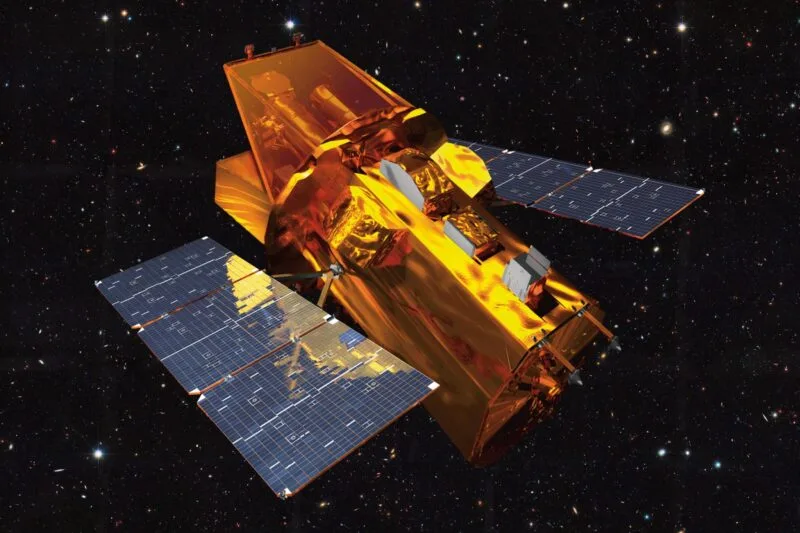
Why couldn’t the Swift spacecraft be saved?
Katalyst’s LINK spacecraft experienced attitude control issues. So it was not able to capture Swift and boost it higher above Earth. Still, while the main purpose of the mission failed, NASA and Katalyst continued to conduct rendezvous and proximity operations with Swift to gather information for the future. NASA Administrator Jared Isaacman said:
This is not the outcome we were working toward, but it does not change why this mission was worth attempting. The team moved with extraordinary speed to give Swift a chance to carry out more science while advancing capabilities America will need for satellite servicing in the future. We are going to learn everything we can from LINK’s rendezvous attempt and put those lessons to work on the missions that follow.
LINK as the would-be rescuer
The Neil Gehrels Swift Observatory, better known as Swift, had been orbiting Earth since 2004. It had been studying the most powerful explosions in the universe: gamma-ray bursts. But Swift’s orbit rapidly decayed. That meant Swift was falling back to Earth.
And it looked like nothing would stop it. It was destined to put on a spectacular, fiery show.
NASA tried to stop Swift’s fall with a 2nd spacecraft. The would-be rescuer was a commercial robotic repair vehicle called LINK, by Katalyst Space. It launched on July 3, 2026.
So LINK was supposed to chase down Swift, grab it and raise its orbit. But about three weeks into the mission, two of LINK’s three reaction wheels failed, sending LINK into an uncontrolled spin and causing communication to be intermittent.
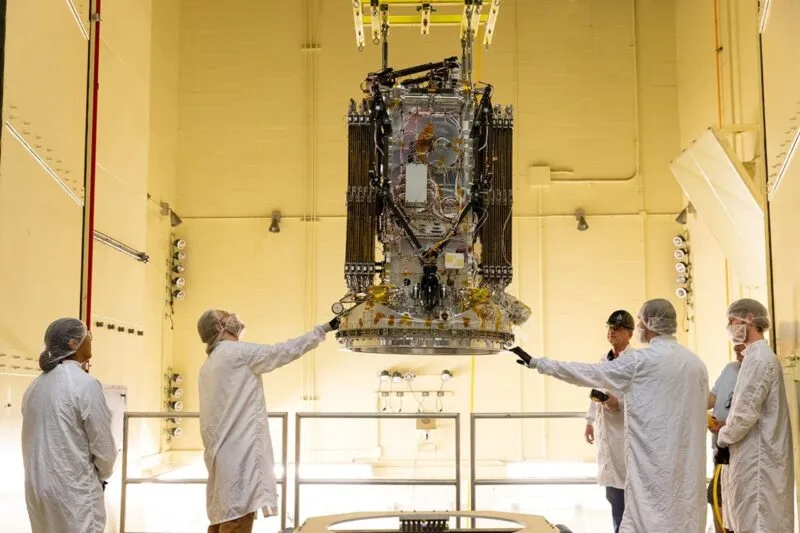
A view of the rescue attempt
Amateur astronomers in Puerto Rico — with the Sociedad de Astronomía del Caribe — captured a video of both LINK and Swift in the same (or a similar) orbit around Earth. The video comes from Añasco, Puerto Rico, at about 8:02 p.m. AST on August 10, 2026. Watch the video above and keep reading to learn more.
Science news, night sky events and beautiful photos, all in one place. Click here to subscribe to our free daily newsletter.
Seeing Swift and LINK in orbit
Amateur astronomers frequently try to spy faint spacecraft in orbit around Earth, and LINK and Swift were no exceptions. The website Heavens-Above.com is designed specifically to enable observers to become aware of satellite passes from their location.
The Sociedad de Astronomia del Caribe in Añasco, Puerto Rico, caught both Swift and LINK on video on August 2, 2026. That earlier video showed that Link was about 8 minutes behind the Swift spacecraft.
But, between August 9 and 10, the club’s cameras showed LINK as slightly ahead of Swift in orbit. That’s what you’ll see if you watch the video above. In the video, the Link rescue spacecraft passes very close to a bright star. The star is Antares, brightest light in the constellation Scorpius the Scorpion. A minute later, the Swift Observatory is seen also passing by this bright star.
The video capture was possible by analyzing the trajectory of both spacecraft using various sources including Heavens-Above.com
More about the Swift spacecraft
The Swift spacecraft had three telescopes to watch the night sky. They were the Burst Alert Telescope, X-Ray Telescope and Ultraviolet/Optical Telescope.
The Burst Alert Telescope (BAT) was Swift’s wide-field gamma-ray detector. This telescope continuously monitored a large portion of the sky, watching for sudden flashes of high-energy gamma rays from gamma-ray bursts. When it detected a burst, it quickly calculated the object’s position and sent the coordinates to astronomers worldwide. It also directed the Swift spacecraft to rapidly turn toward the event for closer study.
X-Ray Telescope and Ultraviolet/Optical Telescope
Once Swift had slewed toward a newly detected gamma-ray burst, the X-Ray Telescope (XRT) took over. It observed the burst’s fading X-ray afterglow. And it measured how its brightness changed over time and analyzed the energies of the emitted X-rays. Also, the XRT could pinpoint a burst’s location better than BAT and could continue tracking the event for days or even weeks. So the XRT helped scientists understand the physics of these powerful explosions and their environments.
Finally, the Ultraviolet/Optical Telescope studied gamma-ray bursts and other cosmic objects in ultraviolet and visible light. It provided Swift’s most precise positions for newly discovered bursts. It also captured details about their brightness, color and evolution. Overall, these observations helped astronomers determine distances, identify host galaxies and better understand the nature of the explosions and other transient events Swift observed across the universe.
You will be missed, Swift.
Bottom line: The Swift spacecraft fell back to Earth as a fiery streak of light yesterday. See videos here.
Read more: What is the Earth’s most distant spacecraft?
Read more: Remember when DART struck an asteroid? New surprises!
The post Swift spacecraft fell back to Earth in a fiery blaze yesterday first appeared on EarthSky.