← Technology, Science & Infrastructure
▣ Distilled locally
High-Speed Camera Robot Can Track a Bee in Real-Time
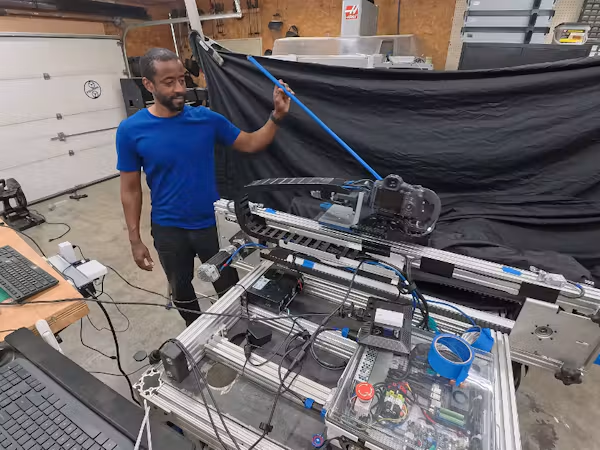
Photographers and videographers have all kinds of tricks for capturing fast-moving things. Most of those tricks rely on either anticipating the movement of the subject or brute force — just recording a lot and hoping some of it is decent. But some movement is very hard to predict and the brute force approach isn’t always practical (particularly for macro shots, because focus is so critical). That’s why Jeremy Fielding built this high-speed camera robot that can track a bee in real-time. Don’t worry if bees aren’t important to you. Really, this is about building a robot with the ability to actively track a small, fast, unpredictable subject. That isn’t easy, because it means accelerating a heavy camera at a high rate with fast reaction speed. Ideally, the camera will also move smoothly and keep the subject in the desired part of the frame. Consider everything that goes into that: detecting the subject, calculating subject movement between frames, motion planning, and then actual motor movement. Oh, and on top of all of that, the camera needs to keep the subject in focus — almost like adding another axis to contend with. For macro shots of bees at super high frame rates, that focus needs to be perfect. If it is even a millimeter off, the bee will look noticeably out of focus. This is a very complex project and Fielding wants the design to be production-ready. To date, Fielding has four long videos on the project and that is too much to cover in this one article. But the overall concept is easy enough to understand. This is a robot that holds a camera. It tilts up and down, slides left and right, and focuses in and out. All of the motion components are pretty standard fair, though Fielding definitely didn’t skimp on the budget and instead bought the good stuff. Many of the parts, like brackets and mounts, are custom, which Fielding CNC-milled. Tracking the bee is the most interesting part of the project. Speed and accuracy were really important, so there wasn’t room for any fancy modern AI stuff. Instead, it is all conventional computer vision. Two cameras, separate from the main camera that records the cinematic footage, act in unison to provide stereo vision. Together, they can calculate depth — necessary for focus — by comparing the difference between their images. They can also find the bee by simply looking for yellow pixels on the black background. That is much, much faster than attempting to actually identify a bee. From there, the calculations are simple (and therefore fast). The system looks at where the yellow pixels are in relation to the desired point in the frame. If the yellow pixels are left of that desired point, the camera slides left until they match. The same is true for every other direction. There is some fine-tuning required to prevent overshooting and oscillations, similar to PID tuning, but that all comes down to adjusting a handful of parameters. There were still some complications in the tests with real bees, such as the system changing which bee it tracks mid-shot. But overall, it was a success. It was able to easily capture great videos of landed bees, but also managed a couple shots of bees in flight.
↑ Back to top
Originally published by Hackster News ↗
· rebuilt here from its own full-text RSS feed · all rights
remain with the publisher, please read and support them there.