← Technology, Science & Infrastructure
▣ Distilled locally
Petoi's Quaddle Robot Dog Is All About Play
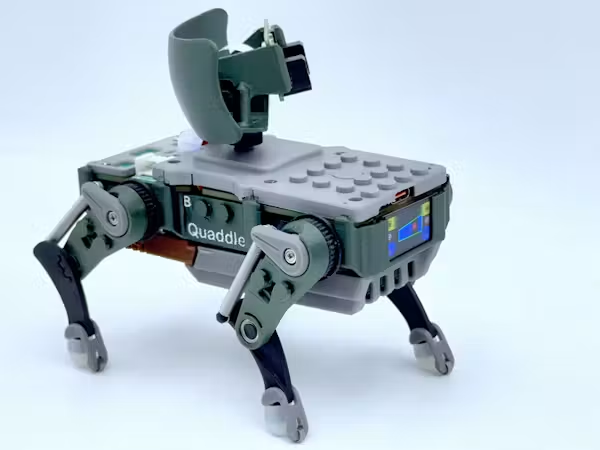
Do you remember what it was like to play? When you were a kid with a pile of LEGO bricks in an old bucket, you weren’t trying to impress online strangers with your construction prowess and you certainly weren’t attempting to monetize your assembly skills. You just played. Petoi’s robot dog, called Quaddle , is the first product I’ve seen in a long time that captures that feeling — and it isn’t an accident. At the helm of Petoi is Dr. Rongzhong Li, who began developing OpenCat back in 2016. At that time, capable quadruped robots were still quite rare. Quadrupedal gait is a difficult challenge and Dr. Li brought his expertise to the community, making the 14-DoF robotic feline design open-source for everyone to enjoy. You can still find that Dr. Li’s original OpenCat project here on Hackster. Since then, Dr. Li has been very busy at Petoi. Leveraging his growing experience, he has continued to design new quadrupeds. At the same time, he has built the Petoi business to make those robots easily accessible. After all, you should be able to play without building your own robot from scratch. That got me wondering about the balance between open-source philosophy and business success. Many of us in the maker community have considered bringing our designs to market as actual products. But the prospect is overwhelming and the financial outlook is, frankly, frightening. So, I asked Dr. Li about his experience selling robots while also releasing open-source designs. The first lesson is that this isn’t the kind of endeavor that will make you rich. Petoi has shipped more than 30,000 robots, which is a wildly impressive number. But even at that volume, Dr. Li tells me that Petoi operates at a small loss every year. Dr. Li grew up in China and received a B.S. in Physics from Nanjing University, then moved to the United States to continue his education. He earned a Master’s in Computer Science and a PhD in Physics from Wake Forest University in Winston-Salem, North Carolina. While in the US, Dr. Li developed OpenCat and launched Petoi. In 2019, he moved back to China and has taken advantage of the supply chain and manufacturing opportunities there to make Petoi’s robots affordable — there is a reason super early birds on Kickstarter were able to get a Quaddle Builder robot for just $99. Even with those opportunities, Petoi has only been able to stay afloat by providing a product people actually want. That’s the second lesson. As makers, we can build whatever we like, because it is just for us. To run a business, Dr. Li says, you have to determine what others will like and, more importantly, what they will pay for. The evolution of the original 14-DoF OpenCat design to the new Quaddle, which has only four servo motors, is a great example of the truth in that. Dr. Li put his education to use studying and developing quadrupedal gaits for robots. Over the years, he has refined his designs to rely less on actuation and more on physical dynamics through mechanical linkages. Quaddle only needs four servo motors — one for each leg — because the actuated shoulder joint also lifts the knee via linkage. It is a clever way to create more dynamic movement in a very compact package, while also reducing the number of expensive servos. Dr. Li borrowed from natural anatomy when he developed those legs. He told me, “early land-walking fish and mudskippers do something similar with simple tendons. I designed the knee to lift on its own when the upper leg swings forward and drop when it pushes back. A damper sets the timing, so you get a gait that would otherwise need a full-DoF leg.” That optimization means Quaddle is affordable enough for potential buyers to classify as a toy, which is what consumers want. Very few people are willing to pay thousands for a Unitree robot dog, but they will pay a hundred bucks for a novelty — even if it isn’t in the same class. But the third and final lesson is that even at this price point, Dr. Li made sure that Quaddle is versatile and very fun. It can do all sorts of stuff, from back flips to desk skating, and gives owners the freedom to program whatever moves they like. Its controller is built around an ESP32-S3, but that is expandable with a Raspberry Pi Zero (or Zero 2) if you want a full onboard computer. It is programmable with several different languages and IDEs, including the Arduino IDE, and there is also a neat training mode that anyone can easily use. Heck, you can even go for a ROS/ROS2 implementation if you really want to max out the capability. Right out of the box, Quaddle is fun toy that you can play with. But like a set of LEGO bricks, it has almost unlimited potential. You can program complex behaviors. You can 3D-print a new body. You can strap on additional sensors and accessories — including several offered by Petoi. The Quaddle Kickstarter campaign is already over. 503 backers raised $113,921, far exceeding the $50,000 funding goal. But late pledges are still available , if you want to bring play back into your life. When it comes to the future of Petoi, I asked Dr. Li about what may come next. He said, “I'll keep going toward pet plus toy. Not only toys — also a connection to people's intellect and emotion. We have at least four other prototypes. Not all are quadrupeds. Two are more complex, two are simpler. Each is a bit different, and fun.” It sounds like we have a lot to look forward to. We’re entering a new era of robotics and “physical AI,” and a lot of the focus will be on high-end, expensive robots. There very well may be a place for those in our lives, but there is definitely always a place for fun. Petoi is going to keep supplying that fun, so we can all keep playing.
↑ Back to top
Originally published by Hackster News ↗
· rebuilt here from its own full-text RSS feed · all rights
remain with the publisher, please read and support them there.