← Technology, Science & Infrastructure
▣ Distilled locally
This Tiny Handheld Uses 165 LEDs as a Screen
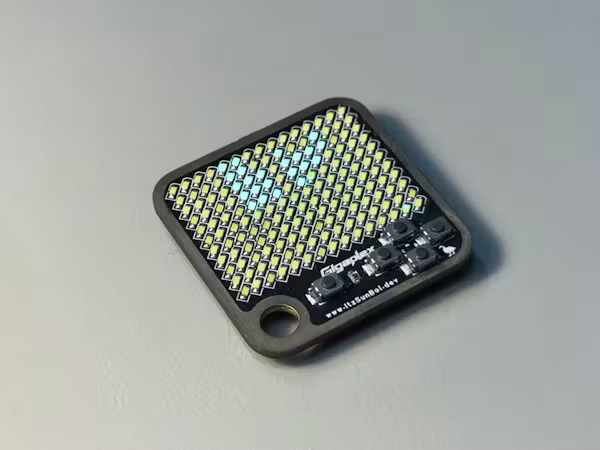
Modern handheld gaming consoles have high-resolution displays and detailed 3D graphics, but you don't need all of that to play a fun game. Some of the earliest handheld electronic games used little more than a handful of LEDs as a display, yet the games were still a blast. YouTuber ItzSunBoi decided to revisit that approach with Gigaplex, a tiny, custom-built gaming console that uses 165 individual LEDs instead of a conventional display. The project began as an experiment with Charlieplexing, a technique that allows a microcontroller to control a large number of LEDs using relatively few pins. As a starting point, ItzSunBoi arranged 165 surface-mount LEDs into an 11×15 grid on a custom PCB. Controlling that many LEDs would normally require an impractical number of connections, especially with the project's 32-pin microcontroller. Charlieplexing solves this problem by taking advantage of the ability of GPIO pins to operate in three states: high, low, and high-impedance. By switching between these states, the microcontroller can selectively illuminate all 165 LEDs using just 14 GPIO pins. The downside to Charlieplexing is that the LEDs cannot all be illuminated simultaneously. Fortunately, thanks to persistence of vision, all of the LEDs can appear to be illuminated at the same time by rapidly cycling through them in the firmware. This requires precise timing, especially when varying the brightness of individual pixels, but it is possible. In addition to the unusual display, Gigaplex also includes physical buttons that serve as the controls, and an inertial measurement unit enables motion-based input. An ambient light sensor automatically adjusts the display brightness, and a piezo buzzer produces music and sound effects. A battery and associated power management circuitry make the device completely portable. ItzSunBoi designed a custom PCB to accommodate all of these components, then used a pick-and-place machine to assemble it. Solder paste was applied through a stencil before the components were positioned and reflow soldered. A custom resin-printed enclosure completes the device. To demonstrate Gigaplex, ItzSunBoi created a Bad Apple!! animation with synchronized music. Fitting video and audio into the microcontroller's limited flash memory required some compression. Each pixel uses just two bits to represent four brightness levels, while successive frames store only changed rows. Repeated patterns are referenced through a lookup table to save additional space. The accompanying music was compressed from approximately 41 KB of MIDI data into just 1.9 KB of note events, which the microcontroller uses to generate audio through the buzzer. Altogether, the firmware and assets occupy approximately 51 KB of the available 62 KB of flash memory. ItzSunBoi also showed the device playing classic games like Snake and Breakout . It doesn't look like the best gaming experience ever, but for something you can keep on your keychain, Gigaplex would be a fun toy. Check out the video below for more details on the build. Gigaplex uses an LED matrix as a display (📷: ItzSunBoi) A closer look at the hardware (📷: ItzSunBoi) Playing a game of Breakout (📷: ItzSunBoi)
↑ Back to top
Originally published by Hackster News ↗
· rebuilt here from its own full-text RSS feed · all rights
remain with the publisher, please read and support them there.