Sea Level Rise and A Marine Corps Mentality: A Conversation with Brent Minchew (PhD '16)
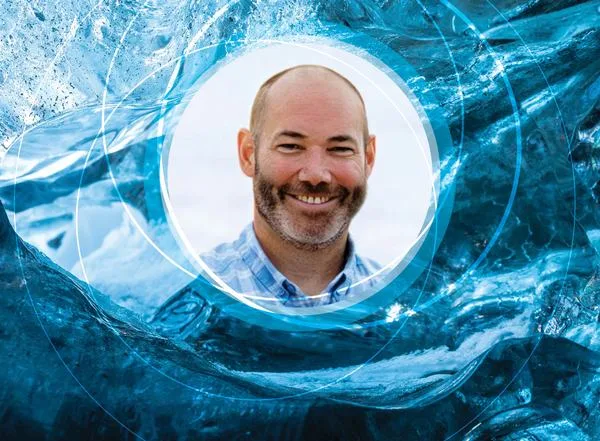
Sea level rise is one of the most pressing issues facing society today, with climate models unable to rule out two meters of rise by century's end. That could permanently displace hundreds of millions of people, several times the number displaced in Europe during World War II. To tackle this urgent problem, Caltech Professor of Geophysics Brent Minchew (PhD '16) brings a mindset he learned from eight years in the US Marine Corps: the idea of "deliberate haste."
"Being in the Marines, you get a lot of immersion in how to do big ambitious things in a practical way," he says. "There's not a lot of tolerance in that environment for endlessly discussing all the things that you need to do. It's much more like: "Let's identify a path forward. Let's move on that path and then adjust as we gather more and more data.'"
Minchew was born in the other Pasadena—in Texas—where his mother was a computer programmer at NASA's Johnson Space Center. Growing up around the Space Shuttle training center instilled an early love for science. But Minchew wanted to see the world outside of Texas and so in 1996, just out of high school, he enlisted in the Marine Corps. During deployments to Iraq, Djibouti, and Liberia, Minchew's service included everything from transporting the President to distributing humanitarian aid.
After the Marines, Minchew studied aerospace engineering at the University of Texas at Austin. He began his graduate studies at Caltech in 2010 under Mark Simons, the John W. and Herberta M. Miles Professor of Geophysics and director of the Brinson Exploration Hub. After a postdoc at the British Antarctic Survey and several years as an assistant and associate professor at MIT, Minchew joined the Caltech faculty in 2025.
We sat down with Minchew to discuss the properties of ice sheets, how to observe them from above, and his "non-linear" approach to life.
Tell us about Antarctica.
Antarctica is about twice the size of the continental United States. And it's sparsely observed. Many people don't realize how big Antarctica is because our maps are usually Mercator projections that don't capture its proper scale. It's very big, cold, remote, and expensive to get there. In most places, you can only be there for a few months out of the year; you can't do much work in the winter.
So this means that satellite observations are very important.
I'm interested in thinking about near-term sea level rise, the changes that are going to happen within my daughter's lifetime. My lab focuses a lot on one particular glacier in Antarctica, the Thwaites Glacier. The media sometimes call it the Doomsday Glacier.
Thwaites is about the size of Florida and it acts as a kind of cork for much of the West Antarctic Ice Sheet. Our current understanding is that if we are going to get something like two meters of sea-level rise by the end of the century, it would most likely be because Thwaites collapsed and took a large part of the West Antarctic Ice Sheet with it. Two meters of sea level rise could displace hundreds of millions of people on coastlines around the world.
Whether or not Thwaites stays intact or collapses very quickly is the largest source of uncertainty in our predictions.
You seem particularly interested in ice. What is the fascination?
Ice is a phenomenal material. Because it's everywhere in our day-to-day lives, we tend to think it must have common material properties, which is not true.
Under the temperatures and pressures on Earth, ice floats because hydrogen bonding creates hexagonal crystals that have a lot of empty space in them, making ice less dense than water. That's somewhat unusual and it creates interesting properties. Because ice expands whenever it freezes, squeezing it under pressure lowers the melting temperature. That means it's much easier to melt a glacier from the bottom than it is from the top.
You've probably had a glass of ice water, where the ice and water are at the same temperature, yet you can still crunch the ice. It's unusual for a material to be brittle at its melting temperature. Most materials become soft and ductile near their melting point. Ice does too if you deform it slowly enough, which is why glaciers flow. But deform it quickly and it cracks. That comes from its hexagonal crystal structure, which only lets it deform easily along one set of planes.
In Antarctica, we see these majestic tall cliffs. If a glacier was a purely viscous material like syrup or honey you wouldn't get these sheer walls of ice. The fracturing process that forms them is one of the things that makes it all quite unique and fun, and fascinating from a scientific perspective; "fascinating" is the standard euphemism for challenging.
What are you trying to understand about ice sheets?
One of the big open questions that propels a lot of my research is trying to predict how the ice sheets will evolve over human time scales. Understanding rates of sea level rise is attached to foundational questions: How do ice sheets evolve? How do they interact with the solid earth—meaning how does ice slide over its bed? What role does water play? How does the ocean melt the ice sheets at their edges? These questions are very interconnected and span across many collaborating labs here at Caltech.
What are the challenges in observing ice sheets?
Many different types of observations can be made of ice sheets. I tend to use observations of the surface taken from satellites. The big challenge in measuring how fast glaciers are flowing and how that changes over time is having good time resolution, and that is set by how often satellites can fly over and collect images. I'm working on developing solar-powered drones that we hope to fly over Antarctica and Greenland for months at a time, collecting radar observations of both the velocity of glacier flow as well as the surface elevation of glaciers and how it changes over time.
What other observations are crucial for your work?
We need to know how and why fractures develop and allow icebergs to break away. This process, known as calving, is important for setting how fast glaciers flow and sea levels rise, but it is not something we can accurately model or predict. I'm interested in understanding how the ice starts to break apart, how the flow in the areas of fractures responds to and helps to drive more fracturing, and how this behavior might change in a warming world as the ice melts and thins.
We do a lot of modeling within my group, but we tend to use observations, theory, and simple numerical models. Much of our work focuses on fundamental questions in glaciology, and we collaborate with people who run much more complex numerical models to close that final predictive gap to produce projections of sea level rise that can be useful for coastal planners. We also collaborate with a lot of people who do laboratory experiments.
Of course, there are many great collaborative opportunities on campus and a lot of excitement about science in the polar regions. For example, our inferences from satellite observations can be calibrated against in situ measurements, like those being made with ICE NODE by Andy Thompson [John S. and Sherry Chen Professor of Environmental Science and Engineering and director of the Ronald and Maxine Linde Center for Global Environmental Science] and colleagues at JPL. ICE NODE is an autonomous underwater robotic vehicle that measures ocean-driven melt rates down beneath the ice shelf.
The Brinson Exploration Hub recently supported fieldwork in Antarctica led by Zhongwen Zhan [Professor of Geophysics; Clarence R. Allen Leadership Chair and Director of the Seismological Laboratory; Associate Director of the Center for Autonomous Systems and Technologies], who deployed a suite of sensors, including a novel fiber-optic seismic array, in a technique known as distributed acoustic sensing, to study how the oceans and sediment beneath the ice influence its flow and evolution.
The list goes on. I have a lot of long-time collaborators at JPL who think about the ice sheets and remote sensing. Here on campus, Mike Lamb [professor of geology] brings a geomorphological background, understanding permafrost and how rivers flow over permafrost; Ruby Fu [assistant professor of mechanical and civil engineering and William H. Hurt Scholar] is doing a lot of interesting things with firn, the compacted old snow that slowly turns into glacier ice; and Woody Fischer [Jean-Lou Chameau Professor of Geobiology] brings in a deep-time geobiological aspect.
And John Eiler [Robert P. Sharp Professor of Geology and Geochemistry and Ted and Ginger Jenkins Leadership Chair of the Division of Geological and Planetary Sciences] is very supportive as division chair.
There's no place better than Caltech to be a scientist, especially for the kind of work that I do, which involves a lot of remote sensing, satellite observations for the ice sheets and so forth. Remote sensing has always been a great strength of Caltech.
How does it feel to be back after having been a student here?
It's super exciting. I'm really happy to be able to come back and teach students again and to be involved in such an innovative environment, immersed with people who have very different backgrounds and skill sets from my own, but who are interested in problems that I'm interested in. It affords an infinite number of exciting opportunities to develop research in these areas, both on earth and planets around the solar system and icy moons and things like that.
How has your experience in the Marines influenced how you do science?
Industries, especially the tech industry, tend to have this "move fast and break things" mentality. In academia, we sometimes get ourselves into a "paralysis by analysis" kind of mentality. But in the Marines, you move with "deliberate haste" towards something ambitious. You recognize that the risks are huge and the costs are enormous if you get things wrong—but deciding not to do something carries its own risks. In the Marines we learn that there is no zero-risk option and often the worst decision you can make is no decision. You have to decide on some course of action, you have to gather feedback on the process, and you have to be willing to adjust as you learn and as situations change.
I also came out of it with a general idea that there is a silver lining to every dark cloud in life. If somebody doesn't like my paper, I just shrug my shoulders. At least I'm not being shot at. It turns the volume down on a lot of things that can seem existential in academic science. It helps if you're able to step back and contextualize things, brush things off, and move forward.
I also took away a deeper, practical understanding of the messiness of the world and how people really interact with each other—what it takes to go do hard things.
Does that perspective give you a sense of optimism or pessimism about impending sea level rise?
It makes me more determined to try to do something about it. In the best-case scenarios of sea level rise, tens of millions of people will be displaced. My time on deployments in the Marine Corps gave me some rough understanding of what drives people toward conflict, and I worry a lot about what happens when that many people are forced to move. History doesn't give us much reason to think it will be peaceful.
I think the stakes are clear enough that we have to be open to the possibility of intervening to actively slow down sea level rise, perhaps even trying to stabilize the ice sheets, and so on, while still being responsible to the environment. These ideas are controversial right now. They should be controversial and treated with care. It should be something that we debate.
But I think that my training from the Marines taught me that you must weigh the risks and work the problem. The climate is changing rapidly and many people and ecosystems will be harmed. I believe in a duty to act. But a serious threat calls for clear thinking. As the unfolding climate crisis becomes more clear, we have to be open to asking questions, like any responsible scientist. Can we minimize the harm? Can we slow things down, give decarbonization a chance to take hold, to ward off some of the worst-case scenarios?
I joined the Marine Corps because of a sense of service and responsibility to broader communities. I wanted to be in a position to help people that were oppressed or in otherwise terrible situations. I very much look at science as service to society and an opportunity to continue to try to do good for others.