← Technology, Science & Infrastructure
▣ Distilled locally
SAWbot Makes Waves in Water and on Land
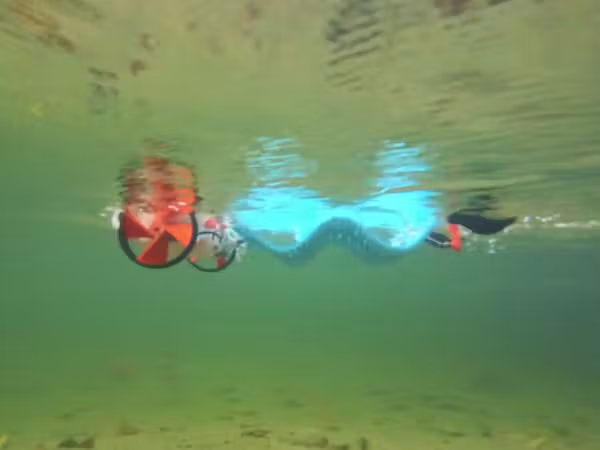
Robots are most commonly designed to operate on either land or in water, but rarely both. Those that can handle both environments often rely on separate propulsion systems, adding mechanical complexity, weight, and power consumption. Researchers at Ben-Gurion University of the Negev have developed an amphibious robot called SAWbot that works in an unusual way, using a continuous traveling wave to propel itself through water while maintaining the ability to navigate rough terrain on land. SAWbot takes inspiration from anguilliform swimming, the method of locomotion used by eels and other elongated aquatic animals. Rather than relying on propellers or articulated fins, the robot generates a continuous wave along a flexible membrane that pushes against the surrounding water. The entire wave-generating mechanism is driven by a single motor. The secret is a mechanical system that converts rotary motion into a smooth, traveling wave. A flexible membrane stretches between two structural supports extending from the robot's main body. As the motor turns, the membrane produces a continuous undulating motion that closely approximates a sinusoidal wave. This eliminates the need for multiple synchronized actuators and the complicated control algorithms required to coordinate them. The robot's front chassis houses its electronics, control hardware, and battery inside a sealed enclosure. Large, treaded wheels mounted on either side provide terrestrial mobility, and a pair of rear floats supports the wave-generating assembly in water. This design allows SAWbot to operate in both environments without requiring mechanical modifications. In swimming tests, SAWbot achieved speeds of up to 34 centimeters per second, with an advance ratio of 0.73. This means the robot traveled at 73% of the speed of its generated wave, a performance level comparable to that of efficient biological swimmers. The researchers measured a mechanical cost of transport ranging from just 0.13 at low speeds to 0.37 at maximum speed. These results place SAWbot among the most mechanically energy-efficient swimming robots reported to date. The team believes this performance comes from the combination of single-motor actuation, which minimizes mechanical losses, and the continuous wave surface, which produces smooth propulsion without the interruptions associated with segmented mechanisms. SAWbot's testing wasn't limited to just controlled laboratory conditions. Field experiments demonstrated its ability to traverse grass, gravel, wooden surfaces, slopes, and step obstacles. The robot also successfully transitioned between land and water without manual intervention, showing off the versatility of its amphibious design. That combination of efficiency, mechanical simplicity, and adaptability could make SAWbot useful for environmental monitoring, aquatic exploration, and other applications where conventional robots struggle to operate. Its relatively simple propulsion mechanism also offers opportunities for scaling the design to different sizes in the future.SAWbot is comfortable in the water and on land (📷: ZARROUK LAB) The robot on land (📷: ZARROUK LAB)
↑ Back to top
Originally published by Hackster News ↗
· rebuilt here from its own full-text RSS feed · all rights
remain with the publisher, please read and support them there.