← Technology, Science & Infrastructure
▣ Distilled locally
Mogozen's CG Deck Opens Its Crowdfunding Campaign, Promising an Open, x86-Based Handheld Dream
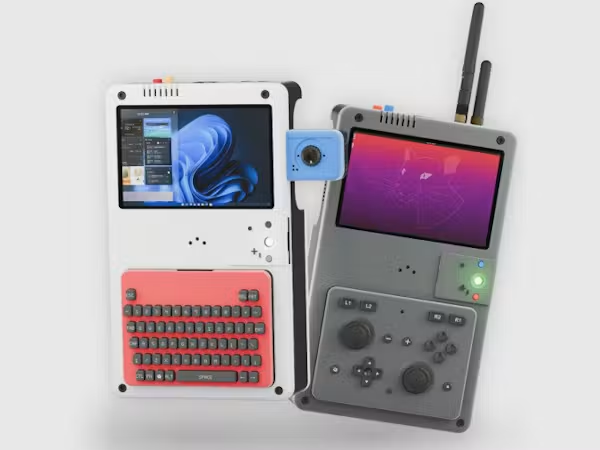
Two-person startup Mogozen has officially opened crowdfunding for the CG Deck, its LattePanda IOTA-powered handheld PC with modular input deck — with "early bird" prices starting at $299 for a DIY kit, bring-your-own IOTA. "The CG Deck is a revolutionary x86 open-source handheld mobile computer," claims Mogozen founder Zane Maldonado of the company's inaugural product. "Allowing you take ownership of your hardware and software. Challenging the closed-ecosystem big tech giants, and giving the power back to the people. The CG Deck is a completely modular handheld PC at every aspect. Designed to allow you to deck out your dream device. Customizing the style and look, take control and choose your operating system and software, upgrade the performance, swap controls and add new features with modules, repair and replace parts with no soldering, change the backplate with custom 3D printed designs, and more." Maldonado has been working on the CG Deck for some time, with the project having entered the engineering prototype stage back in May . Revised prototypes were showcased in July, with the promise that a crowdfunding campaign was to follow — and that campaign is now live, still featuring the LattePanda IOTA as the single-board computer around which the handheld is built. That means an Intel N150 processor, a four-core four-thread AMD64-architecture chip paired with either 8GB or 16GB of LPDDR5 memory and 64GB or 128GB of eMMC 5.1 storage depending on whether you're buying the base model or the upgraded "Max" variant — with the latter also benefiting from Wi-Fi 7e to the base model's Wi-Fi 6e connectivity. Both variants include a 5" capacitive touch display, a 4k60-capable HDMI 2.1 output for external displays, wired Ethernet, two USB 3.0 Type-A ports, a microSD slot for expanded storage, a 3.5mm analog audio jack, and a trio of 18650 LiFePO4 batteries delivering a 10,500mAh total good for a claimed eight-hour idle runtime. An optional expansion module, meanwhile, provides an M.2 slot compatible with high-performance Non-Volatile Memory Express (NVMe) solid-state storage devices or accelerator modules. It's what's below the screen that makes the CG Deck interesting, though: a recess designed to accept one of a number of different input devices. At launch, options include a 64-kit "clicky" microswitch keyboard module with swappable soft rubber or hard plastic keypads, a gamepad module with dual analog Hall-effect joysticks, and a 10-key macropad with rotary knob. A secondary slot provides room for further expansion, with just one device available at launch: a trackball pointing device. Finally, there's a pair of USB-connected camera modules, one offering a one-megapixel fixed-focus sensor and the other an eight-megapixel auto-focus sensor with built-in microphone. While Mogozen is hoping to sell kits and assembled units via crowdfunding, the company has also pledged to release KiCad design files, STEP and STL files, and assembly guides under open-source licenses, though these were not yet available at the time of writing. "Once the campaign has successfully wrapped up," Maldonado says, "and we have finalized all of the DFM [Design For Manufacture] designs and specifications for the CG Deck, we will be able to publish all documentation, schematics, and files for the CG Deck and modules." In the meantime, the CG Deck is funding on Kickstarter with physical rewards starting at $299 for "early bird" backers of a do-it-yourself kit without bundled LattePanda IOTA and rising to $1,299 for the 8GB/128GB CG Deck Max with bundled IOTA, all input modules, plus the eight megapixel camera module. Hardware is expected to ship in March next year, Maldonado says, though as with any crowdfunding campaign fulfillment is not guaranteed. The modular design makes it easy to hot-swap input devices, while a secondary slot makes room for a trackball. (📷: Mogozen)The CG Deck's crowdfunding campaign has finally launched, with DIY kits starting at $299 for early bird backers. (📹: Mogozen)
↑ Back to top
Originally published by Hackster News ↗
· rebuilt here from its own full-text RSS feed · all rights
remain with the publisher, please read and support them there.