← Technology, Science & Infrastructure
▣ Distilled locally
Roughened Optical Fibers Turn Soft Sheets of Silicone Into Three-Dimensional Shape Sensors
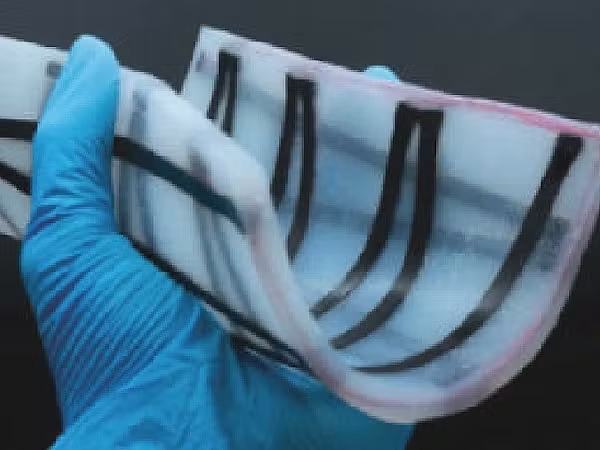
Researchers from the Department of Mechanical Engineering at the Massachusetts Institute of Technology (MIT) have detailed a soft, conformable sheet capable of tracking shape and movement as it bends and twists — targeting wearables for healthcare and more. "In physical therapy, you often need to gather patient data on how they are moving and stretching their arm during rehabilitation," explains first author Qufan Yu of the team's work. "Surface shape sensing could be very useful in that way. Our setup is targeting fully soft and stretchable sensing surfaces so it’s potentially safer for interacting with a human or a soft environment." The soft sensor is based on fiber optics, which have a long history of use as bend sensors: the more you bend an optical fiber, the less light reaches the other end. The twist: the team's custom-built waveguides ditch the usual glass fibers in favor of two-layers of a rubber-like material — a clear core and a black outer. By making one side of the inner core rough, the researchers were able to detect not only the extend of the bend in the sensor but whether it was bending towards or away from the rough side. Embedding multiple such waveguides in a soft silicone sheet then provides a form of 3D sensing. "People have used [fiber optic] waveguides to sense the shape of a line, which they have applied to a robot arm to see how it curves," Yu explains of how the team's approach differs from previous work. "But they haven’t been applied to surface shape sensing, to reconstruct the 3D shape of a surface. That’s what we're trying to do here. We use a metric that describes the distance between the actual surface and the reconstructed surface, and from that, we found our error was less than 0.4 centimeters [around 0.16 inches]. Existing designs, which are based on rigid sensors, have errors of around 1 to 2 centimeters [around 0.39 to 0.79 inches]. So that’s respectable, and at least on par with existing technologies." The researchers envision using the sensor system in healthcare, tracking patient's movement and reconstructing it in three dimensions in near real-time — though they also propose its use in other fields, including remote operation of robots or even as a controller for videogames. The next step: making the optical fibers thinner and increasing their number, in order to improve the resolution of the three-dimensional reconstruction. The team's work has been published under open-access terms in the journal Advanced Intelligent Systems . Experiments showed wearables built using the sensor sheet could track 3D shape and applied force in near-real-time. (📷: Yu et al)Researchers from MIT have created rubber optical fibers which can turn silicone sheets into 3D shape and force sensors. (📹: Yu et al)
Originally published by Hackster News ↗
· rebuilt here from its own full-text RSS feed · all rights
remain with the publisher, please read and support them there.
↑ Back to top
© 2026 PaperWeb. Content remains property of respective publishers. · Privacy Policy · Terms