← Technology, Science & Infrastructure
▣ Distilled locally
The Internet of Smells Is Here
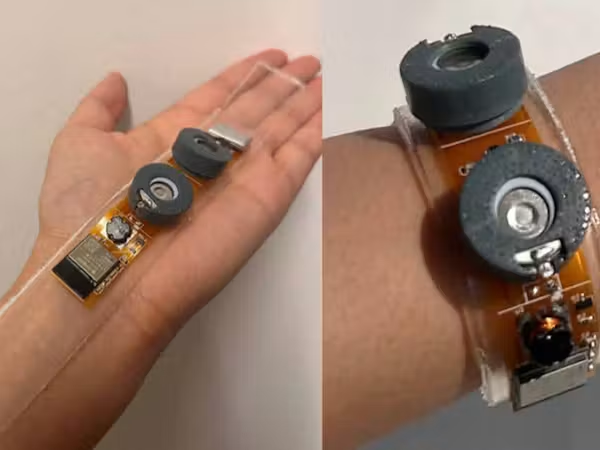
The internet allows us to share just about anything with people on the other side of the world, from text messages and photographs to live video feeds. But there are still some things that can't be transmitted digitally. Smells, for example, are things that we have to experience in person. Researchers at The Ohio State University have developed a system called Scentronic that could change that by electronically detecting odors, transmitting the information over the internet, and reproducing them at a remote location. Scentronic is made up of two primary components: an electronic nose that identifies odors and a wearable device that reproduces them. The electronic nose uses an array of six metal oxide semiconductor gas sensors, each of which responds differently to volatile organic compounds in the surrounding air. These responses produce distinctive electrical signals that can be analyzed to identify the source of an odor. Rather than attempting to identify every individual chemical compound, the researchers trained machine learning models to recognize patterns associated with particular smells. They tested the system using five common food and beverage odors: beer, cake, coffee, oranges, and red wine. A K-nearest neighbors classifier achieved 100% accuracy on a held-out test set containing 50 samples. However, the experiments used only one brand of each product, so the system's ability to recognize a wider variety of odors remains untested. Once an odor has been identified, the information can be transmitted over the internet to a Scentronic actuator that recreates the corresponding smell. Each actuator contains a small reservoir of scented liquid, a cotton filter, and a piezoelectric atomizer. When activated, the atomizer vibrates at ultrasonic frequencies, forcing tiny droplets of liquid through microscopic openings and dispersing them into the air. An ESP32 microcontroller controls the atomizer using pulse-width modulation, allowing the intensity of the released odor to be adjusted electronically. Multiple actuators can also operate independently or simultaneously to produce combinations of smells. The researchers demonstrated several configurations, including a wristband with two odor channels and handheld and necklace-style devices with five channels. The system uses Wi-Fi and a cloud server to relay information between the electronic nose and the actuators. Communication latency averaged approximately 65 milliseconds, while a complete sensor-to-actuator demonstration exhibited a response latency of 0.6 seconds. The researchers conducted experiments in which volunteers used Scentronic to identify odors, distinguish between different intensities, and recognize combinations of smells. Participants correctly identified individual odors 72.86% of the time and two-odor combinations 71.43% of the time. The team also developed a cup containing five odor generators and five liquid dispensers that can reproduce both smells and tastes. In one demonstration, the cup was connected to a Meta Quest 3 headset, allowing users to select virtual beverages and trigger the corresponding physical sensations. Scentronic is still an experimental system, and its ability to reproduce arbitrary odors is limited by the scents available in its reservoirs. But with further development, technology like this could make it possible to smell a product before buying it online, experience scents in virtual reality, or have your sense of smell evaluated by a doctor without leaving home.One of Scentronic's wearable actuation systems (📷: C. Yang et al.) An overview of the system (📷: C. Yang et al.) The components work together to reproduce scents at a remote location (📷: C. Yang et al.) A machine learning model recognizes scents (📷: C. Yang et al.)
↑ Back to top
Originally published by Hackster News ↗
· rebuilt here from its own full-text RSS feed · all rights
remain with the publisher, please read and support them there.