← Technology, Science & Infrastructure
▣ Distilled locally
PLACARD Is an 8-Bit Computer With No Microprocessor
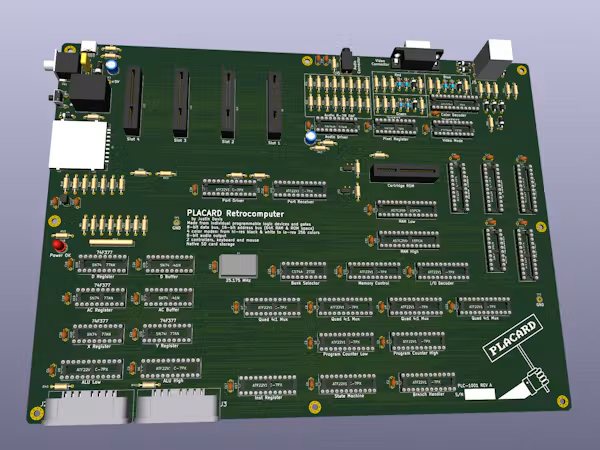
Building an 8-bit computer from scratch is a common project in the retrocomputing community. But most projects rely on an existing microprocessor, an FPGA, or a mountain of discrete logic chips. Justin Davis has taken a different approach with PLACARD , a homebrew computer that builds nearly everything, including the CPU and graphics hardware, from programmable logic devices (PLDs) that wouldn't have been out of place in the early days of personal computing. PLACARD uses 20 ATF22V10C PLDs and 13 conventional logic and memory chips to implement an entire computer. There is no dedicated microprocessor, and every component is a through-hole DIP package that is still in production today. Davis originally intended to use only 7400-series logic chips but switched to PLDs after realizing how many individual gates the design would require. The computer is fairly powerful, considering the hardware involved. Its custom 8-bit CPU operates at 25.175 MHz, with a 16-bit address bus and instructions that execute in two to four clock cycles. Davis estimates that it averages approximately seven million instructions per second, putting plenty of older commercial computers to shame. PLACARD generates a 640×480 VGA signal at 60 Hz and supports several display modes, ranging from high-resolution monochrome graphics to 256-color output at 80 pixels per line. These modes can be mixed freely across the screen, so a program could display sharp text above a colorful image, for example. The video circuitry handles memory access automatically, briefly pausing the CPU when it needs to fetch display data. This eliminates the need for programmers to carefully time their instructions around the video signal, something that can make developing software for older computers particularly frustrating. The computer comes equipped with 64 KB of RAM, bank-switched ROM, 8-bit audio, PS/2 keyboard and mouse interfaces, two SNES controller ports, and an SD card interface supporting FAT16 and FAT32 filesystems. There are also four expansion slots and a cartridge interface for loading software. Davis has already written a library ROM providing graphics, sound, storage, input, and mathematical functions. Demonstration software includes a parallax-scrolling platformer, a Wolfenstein-style textured raycaster running at 60 frames per second, and familiar benchmarks like Mandelbrot fractals and Conway's Game of Life. The benchmarks show that the custom CPU is no slouch. It calculates 1,000 digits of pi in 69.9 seconds, compared with 295.57 seconds for a Commodore 64. A Game of Life benchmark processes 1,000,000 cells per second, compared with 2,250 for a Commodore 64. For now, however, PLACARD exists as a fully operational FPGA implementation rather than a physical PLD-based computer. Davis has recreated the individual chips in VHDL and verified the design on a Digilent Basys 3 development board, complete with VGA output. The motherboard and accompanying cartridge boards have been designed in KiCad. The next step is to manufacture the PCBs and test the actual hardware. If everything goes as planned, the physical build of PLACARD will work exactly like the FPGA implementation.A rendering of the PLACARD motherboard (📷: Justin Davis) Testing the design on an FPGA board (📷: Justin Davis) Cartridges can be used to store software (📷: Justin Davis)
↑ Back to top
Originally published by Hackster News ↗
· rebuilt here from its own full-text RSS feed · all rights
remain with the publisher, please read and support them there.