How FEA and CFD Reports Are Being Used to Prove a Manufacturer Knew a Part Would Fail
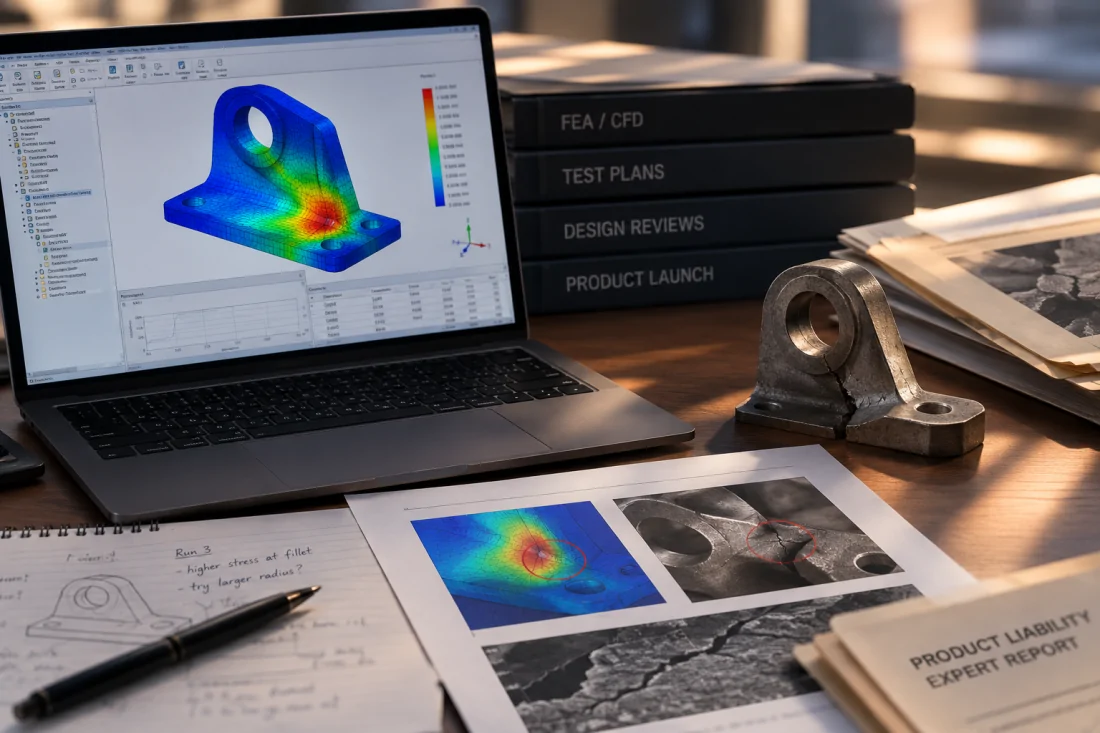
Most engineers assume the FEA deck sitting on the shared drive is a private design artifact, an internal sketchpad protected by the same NDA that covers the CAD. But in a product liability case, that solver run is discoverable, and if it flagged a stress concentration or a resonance the shipped part still carries, it becomes one of the cleanest pieces of evidence a plaintiff can put in front of a jury.
The simulation ran. The physical test that would have confirmed or refuted it didn’t. That contrast is the story. What follows is the arc that keeps showing up in expert reports: how a routine simulation done years before launch turns, step by step, into proof that the manufacturer knew.
Before Launch, The Simulation Is Just Homework
Early in a program, FEA and CFD get used the way spreadsheets get used in finance: quickly, iteratively, and often by junior engineers exploring the design space. Simulation shortens the loop between a concept and a workable geometry, which is why it gets adopted so heavily in the first place. A team can rank three bracket designs in an afternoon without cutting metal.
The problem is what those files look like a decade later, pulled out of a PDM archive by a forensic engineer. Every solver run is timestamped. Every mesh refinement, every boundary condition, every peak stress plotted in a contour map is sitting there in the record.
Homework doesn’t vanish. It gets version-controlled. If those early runs flagged a hot spot, a fillet radius too tight, a weld line landing on the load path, a natural frequency uncomfortably close to the operating range, someone made a decision about what to do next. That decision is what the litigation turns on, and for anyone hurt by a defective product, it’s the decision that gets reconstructed first.
During Development, The Validation Step Gets Skipped
A simulation result on its own doesn’t tell you the part is safe. It tells you what the model predicts. The industry has a formal name for closing that loop: verification, validation, and uncertainty quantification. ASME publishes standards for it, V&V 10 for solid mechanics, V&V 20 for fluid and thermal, V&V 40 for medical devices, and the V&V hub lays out what a credible simulation program is supposed to include.
The failure pattern is familiar. The model gets built, the run gets executed, and the correlating physical test, whether it’s the coupon, the shaker table, the burst rig, or the fatigue cycle out to end-of-life, gets scoped, then deferred, then quietly dropped when the launch date tightens.
What ships can be a part backed by a prediction that may not have been checked against a real specimen. A forensic engineer reading that record sees two things at once: a manufacturer with the analytical capability to identify the failure mode, and a manufacturer that chose not to spend the days it would have taken to confirm or refute it.
After The Failure, The Same Tools Are Turned Around
Once a part fails in the field, the plaintiff’s expert runs the analysis the manufacturer didn’t. Modern forensic practice treats simulation as a core reconstruction tool, used to back-calculate the stress state, the thermal history, or the dynamic loads that produced the fracture surface investigators are staring at. A technical overview of FEA in failure analysis walks through how this gets done in automotive recall and product liability work.
The comparison the jury eventually sees is simple. Here is the manufacturer’s own early run, showing a stress riser in the exact location the part later cracked. Here is the test plan that would have caught it. Here is the email deprioritizing that test. Here is the field failure.
At Trial, The Model Has To Clear The Gatekeeper
A simulation-based opinion doesn’t walk into court unchallenged. The judge screens expert methodology under the Daubert framework, and simulation gets the same scrutiny as any other technique. The Daubert standard asks whether the method has been tested, peer-reviewed, has a known error rate, and enjoys general acceptance in the relevant engineering community.
For an FEA or CFD reconstruction, that translates into a specific set of things the expert has to show:
- Model provenance. Where the geometry, material cards, and boundary conditions came from, and why each choice reflects the real part and the real event rather than a convenient assumption.
- Mesh discipline. Evidence of a mesh convergence study, so the reported stresses aren’t an artifact of element size.
- Validation anchor. A tie to physical data, coupon tests, published material properties, a benchmark case, that shows the model predicts something measurable before it’s asked to predict the failure.
- Uncertainty budget. An honest accounting of what the model doesn’t know, and how that uncertainty affects the conclusion.
A defense expert who can poke holes in any of those four will get the opinion trimmed or excluded. A plaintiff’s expert who has all four turns the manufacturer’s own solver output into the centerpiece of the case. The simulation that ran will be found. The test that didn’t will be noticed.