← Technology, Science & Infrastructure
▣ Distilled locally
Print & Place Software Turns Your 3D Printer Into a Electronics-Building Pick-and-Place Machine
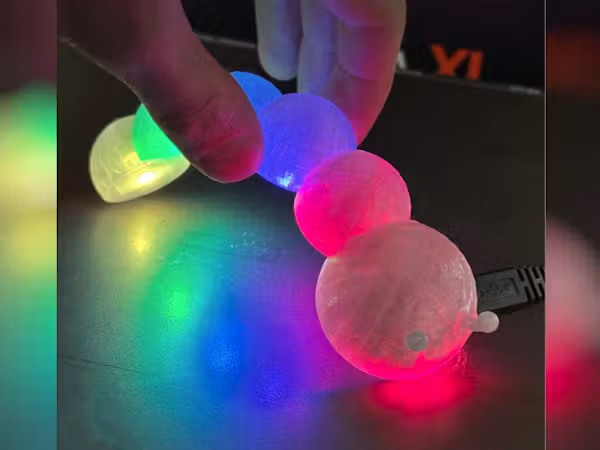
Researchers from the University of Bristol and the Hasso Plattner Institute have developed a way to use an off-the-shelf fused filament fabrication (FFF, also known as FDM) 3D printer as a pick-and-place machine — allowing them to created fully-functional electronic devices ready to run as soon as they're printed. "Print & Place is a novel process that appropriates unmodified commodity FDM 3D printers to enable in-situ pick-and-place of electronic components," the researchers explain of their work. "Traditionally, producing functional 3D-printed electronics has required manual assembly, extensive post-processing, or compromises using high-resistance filaments. Our approach overcomes these barriers by automating the continuous positioning, electrical connection, and encapsulation of parts throughout the print process, broadening the range of devices that can be additively manufactured." The idea behind Print & Place is surprisingly simple, and doesn't require any hardware modification to the 3D printer itself. Instead, components — which range from individual parts and conductive traces to pre-assembled printed circuit boards — are picked up using the existing print head by extruding a small amount of filament onto the component then cooling it, adhering it to the print head and allowing it to be positioned onto the model before being detached either by heating the filament to its melting point or just shearing it off with a rapid tool head movement. The team's prototype used a standard, entirely unmodified Prusa XL printer — chosen for its large print area, which provides room for a tray of components as well as the model being printed — with Bambu Lab and Elegoo PLA filament. Testing proved the printer capable of picking and placing parts as small as 0805 surface-mount devices (SMDs), conductive traces as thin as 1.25mm, and PCBs as large as an Adafruit Flora development board. Its limit was found at a 0603 resistor, which was simply too small. Devices produced on the printer, using the team's custom software to both print a sacrificial parts tray and to pick and place the components, include a light-up articulated caterpillar, an LED fridge magnet, and a robotic firefly with vibration movement — designed to demonstrate the approach's ability to produce a device that is ready-to-run as soon as it's printed, and which "can autonomously 'walk' off the print bed upon completion," the team says. The team's work has been published in the Proceedings of the 39th Annual ACM Symposium on User Interface Software and Technology (UIST '26) under open access terms. Print & Place, a software-only approach to rapid manufacturing, can put together fully-functional electronic devices on a standard FFF 3D printer. (📷: Child et al) The software has been used to produce everything from LED fridge magnets (left) and articulated glowing caterpillars (top) to a robot that can walk off the print bed (right). (📷: Child et al)
↑ Back to top
Originally published by Hackster News ↗
· rebuilt here from its own full-text RSS feed · all rights
remain with the publisher, please read and support them there.