Hera mission spots asteroid eclipse. Plus, livestream reveal Wednesday!
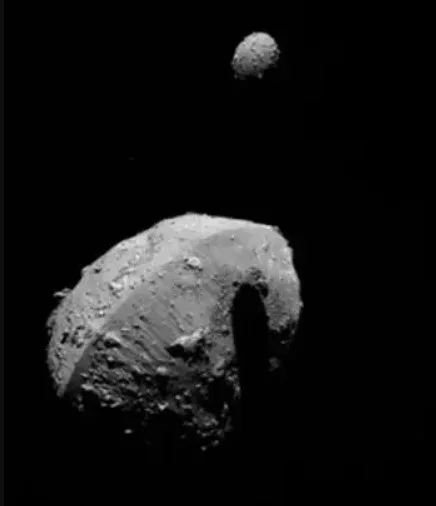
Asteroid’s solar eclipse and livestream reveal
At 12:45 pm CST on Wednesday, November 25, 2026, ESA will reveal the first close-up images of the asteroid Dimorphos after it was struck by NASA’s DART mission in 2022. ESA will livestream the event on their YouTube channel. You can watch in the player below.
In the meantime, we’re getting a sneak preview of those amazing images from the asteroid Didymos and its little moonlet Dimorphos. In the image above, we can see the smaller Dimorphos (the one impacted by the DART mission) casting a shadow on Didymos below. The sun is shining from above in this image, creating a solar eclipse on the surface of the larger asteroid.
Hera’s 1st views of Didymos and Dimorphos
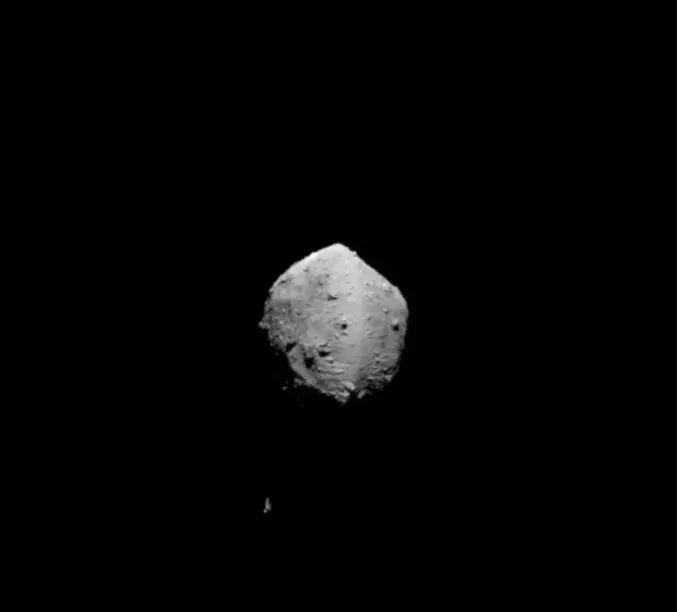
The European Space Agency (ESA) said on November 5, 2026, that its Hera mission has caught a first glimpse of its target asteroid system (see below). The larger asteroid in this binary system is Didymos. The smaller object, considered a moonlet of Didymos, is Dimorphos. NASA’s DART mission — the world’s first planetary defense test — struck Dimorphos back in 2022.
Hera is the follow-up mission, meant to gather details on DART’s strike. The spacecraft was about 37 miles (60 km) away from Didymos when it acquired the image above. Little Dimorphos also makes an appearance in this image, from its hiding place in the larger asteroid’s shadow. Hera principal investigator Patrick Michel said:
The first thing we said was wow! This is the other side of Didymos from the one that DART’s camera showed us shortly before impact, so this feels like looking at a whole new world. This side of Didymos has the same central ridge along its equator that we saw before, but otherwise appears very different, with multiple boulders and craters and what look like patterns of grooves or ridges.
ESA’s Hera mission scientist Michael Kueppers added:
Since we expect a lot of impact-ejected material to have made it across the approximately 1 km (.6 mi) of space from Dimorphos to Didymos, it might be that some of these characteristics originate from this transport of material.
And we have an exciting work ahead of us to sort it out. We look forward to seeing much more of both bodies and systemically mapping all the changes we identify.
ESA said that detailed images of both asteroids will be unveiled on November 25.
DART mission and Hera mission
In 2022, the groundbreaking DART mission struck and moved an asteroid. It was a test of Earth’s ability to defend itself from an incoming asteroid threat.
Read more: When DART struck Dimorphos
ESA’s Hera launched two years later, on October 7, 2024. It’s a follow-up mission to DART. It will spend six months investigating the aftereffects from the DART impact. Hera’s main mission is to determine how effectively the impact changed the orbit of Dimorphos. It’ll also look at Dimorphos’ and Didymos’ physical structure. In other words, DART demonstrated that we can deliberately alter an asteroid’s motion. Hera is going back to investigate the details.
Why? Because if an asteroid were headed for Earth, we’d want to know as much as possible about how to knock it off course!
When Hera reaches the two asteroids, it’ll release two cubesats, Milani and Juventas. Milani is in charge of spectral surface observations (splitting light bounced off the asteroid into a rainbow array of colors, then analyzing that light) of both Didymos and Dimorphos. And Juventas will take the first radar soundings in the heart of an asteroid.
According to ESA — the mission planner — Hera will conduct a “crime scene investigation” at Dimorphos. But Hera will also check out both Didymos and the dusty environs unleashed by the impact.
Here are 3 mysteries that Hera will help solve
ESA shared three mysteries that Hera will help solve:
- Hera will measure the density and composition of Dimorphos in detail and help scientists determine whether it is a “rubble pile” loosely held together by gravity, or a solid core covered in boulders and gravel.
- Hera will map the crater created by DART’s impact down to 4-inch (10-cm) resolution to help scientists better understand how the surface material responded to the collision. It’s possible that there is no crater at all, but rather the impact reshaped the entire asteroid!
- About 15% of known asteroids are actually binary systems, but their origins remain mysterious. Hera will determine whether Dimorphos and Didymos are made from the same material, which would hint that the rapidly spinning Didymos once threw off debris into space that later formed Dimorphos.
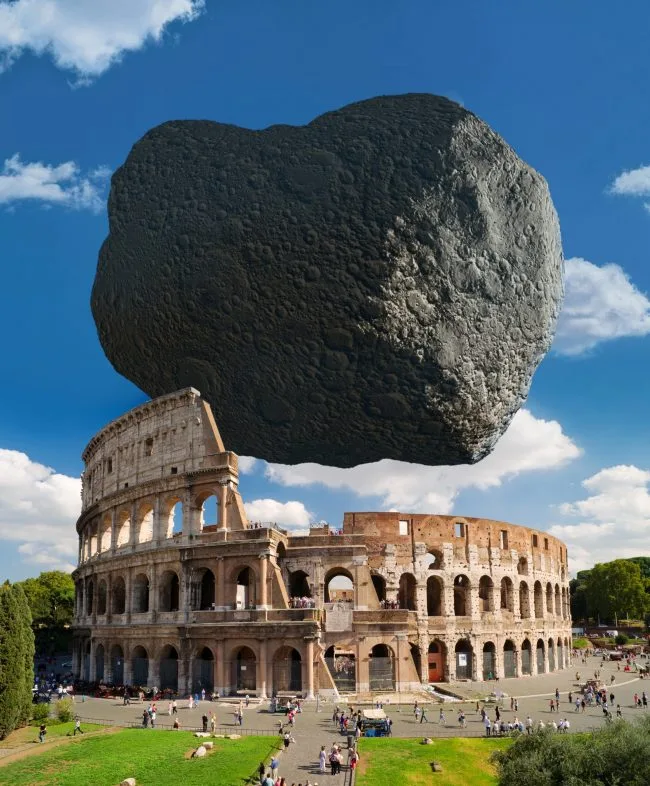
Video: Keeping Earth Safe From An Asteroid Collision
Watch EarthSky’s Deborah Byrd speak with Hera project scientist Michael Küppers below. Get the latest here about keeping Earth safe from asteroids.
Bottom line: The Hera mission captured a solar eclipse on the asteroid Didymos, as the smaller asteroid Dimorphos passed between it and the sun. Watch the livestream reveal more pics here!
Read more: Boulders from asteroid Dimorphos, after spacecraft impact
Read more: Remember when DART struck an asteroid? New surprises!
The post Hera mission spots asteroid eclipse. Plus, livestream reveal Wednesday! first appeared on EarthSky.