← Technology, Science & Infrastructure
▣ Distilled locally
Jay Doscher's Recovery Kit 3 Scales Things Up — And Gains Dual Batteries for Field Use
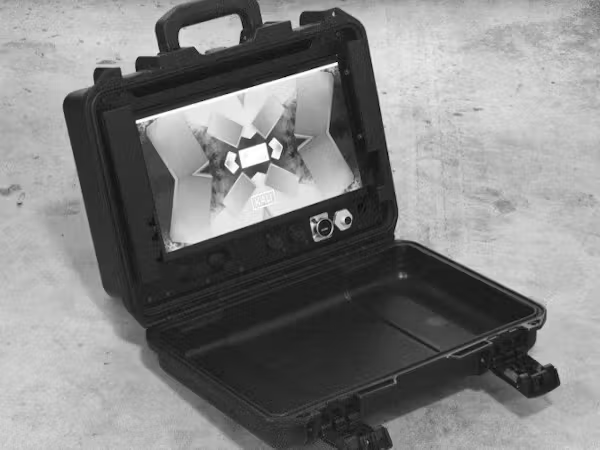
Maker Jay Doscher has unveiled the latest version of his Recovery Kit rugged do-it-yourself portable computer, now featuring dual batteries for true off-grid operation: the Recovery Kit 3 cyberdeck. "There's some nostalgia here as I write this, looking back at the original Raspberry Pi Recovery Kit, the Recovery Kit 2 and 2b, and the many other small projects along the way. The Recovery Kit series has seen every iteration I can think of, especially with finally adding substantial battery support in this project," Doscher writes by way of introduction to the new luggable. "Overall I have made a cyberdeck with a beautiful screen, dual batteries, fully modular for different CPUs, and no soldering this time to make it as easy to build as possible while still keeping the Recovery Kit aesthetic." This next-generation iteration of the Recovery Kit, which crams compute, display, and more into a rugged Pelican case using custom-designed mounting hardware, is powered by a Raspberry Pi 4 Model B single-board computer — "I want[ed] to keep it realistic," Doscher explains, "especially considering how expensive a [Raspberry] Pi 5 is for what it does." The base of the build is Doscher's Compute Unit, though, meaning that it would be trivial to upgrade the design to the Raspberry Pi 5 or, as Doscher says, "even something else." Inside the Pelican Storm iM2200 case is a Waveshare 13.3" AMOLED display panel, housed in the larger base but oriented so it becomes the lid, with panel-mount USB, Ethernet, and general-purpose input/output (GPIO) connectors beneath. Power for on-the-go use comes courtesy of a pair of Smallrig V-Mount batteries, one powering the display and the other powering the Raspberry Pi. "The dual batteries are easy to pop in and out, and lock in place with a release button," Doscher says. "Each is a 99Wh battery, so the runtime is as good as I can get without going full custom pack. The batteries are not hot-swap though, there's no circuit to buffer the component they power, so removing the battery for the display or computer cuts power to that component." The framework to fit the hardware inside the case is a mixture of 3D-printed and laser-cut aluminum parts. "Going with a larger Pelican case [than in previous designs] meant a case bigger than the print area of my printer," Doscher says, "so printing the full front panel was out of the question. This leaves the metal frame to cover the full width and height of the panel, but with key plastic handles and other tidbits to keep it light and functional." A full project write-up is available on Doscher's blog , along with a bill of materials, while design files are available to paid subscribers. Jay Doscher is back with another Recovery Kit build, this time packing a 13.3" AMOLED display: the Recovery Kit 3. (📷: Jay Doscher) The system is usable entirely off-grid, thanks to a pair of V-Mount batteries — one for the Raspberry Pi 4, one for the display. (📷: Jay Doscher)
↑ Back to top
Originally published by Hackster News ↗
· rebuilt here from its own full-text RSS feed · all rights
remain with the publisher, please read and support them there.