← Technology, Science & Infrastructure
▣ Distilled locally
Arduino's Latest App Lab Update Brings "Production Grade" Release Bundles, Phone Sensor Streaming
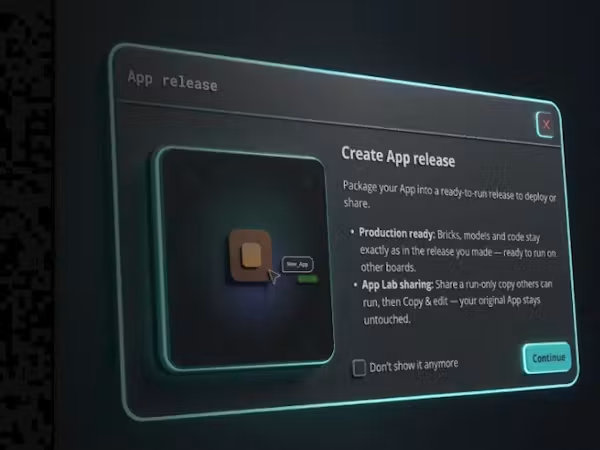
Arduino has announced a new version of the Arduino App Lab, its all-in-one integrated development environment (IDE) for the Arduino UNO Q and VENTUNO Q single-board computers — designed to help you get to grips with both sides of their "dual-brain" architecture at once. "You build something great on your Arduino UNO Q board. Now what? Arduino App Lab 0.11 is about taking your project further," the Arduino team says of the latest IDE release, "whether that means shipping it to another board, getting help while you code, or teaching your device to recognize a tennis swing." Announced at the same time as the company's acquisition by Qualcomm, the Arduino UNO Q — along with its more powerful successor, the VENTUNO Q — is a single-board computer with what Arduino calls a "dual-brain" architecture: an application-class Qualcomm Dragonwing system-on-chip as the primary processor, linked to an STMicroelectronics STM32 microcontroller for real-time workloads. The Arduino App Lab lets you handle both in one IDE, programming for the Dragonwing in Python and the STM32 in Wiring-flavored C/C++. In this latest release, App Lab extends its ability to export projects for redistribution — offering what the Arduino team calls "production grade" bundles dubbed "Apps Releases," created directly within the IDE itself. This goes beyond Arduino's direct ecosystem, too: the team says that the new distribution bundles are compatible not only with the Arduino UNO Q and VENTUNO Q but with "compatible third-party hardware" from within its "Works with Arduino" program. Other new features include a new pose estimation model, dubbed a "Brick" in App Lab terms, which delivers a 17-point body skeleton estimation at up to 10 frames per second — but requires the more powerful processor of the Arduino VENTUNO Q, rather than the cheaper UNO Q. The Large Language Model (LLM) Brick gains the ability to import compatible models from Hugging Face, while a new sidebar provides a chatbot interface. The Arduino App Lab's link to the mobile companion app has also been extended: in addition to existing support for using your phone's camera as an input, the new release includes a WebSocket-based remote sensor peripheral that can stream data from phones' microphones and inertial measurement unit (IMU). Finally, there's a Terrestrial Positioning Service (TPS) Brick, which uses Wi-Fi, Bluetooth Low Energy (BLE), and cellular network signal scanning to track the board's position. The latest Arduino App Lab is now available on the Arduino website , as a free download; its source code is published to GitHub under the reciprocal GNU General Public License 3.Arduino has released a new App Lab IDE, which brings with it a 17-point pose estimation model for the VENTUNO Q. (📹: Arduino) The new release also includes a "Brick" showcasing Qualcomm's TPS location-tracking demo from The Things Conference last month. (📹: Arduino)
↑ Back to top
Originally published by Hackster News ↗
· rebuilt here from its own full-text RSS feed · all rights
remain with the publisher, please read and support them there.