← Technology, Science & Infrastructure
▣ Distilled locally
Banana Pi Launches the Raspberry Pi 5-Like Allwinner 733-Powered BPI-M8, Starting at $69
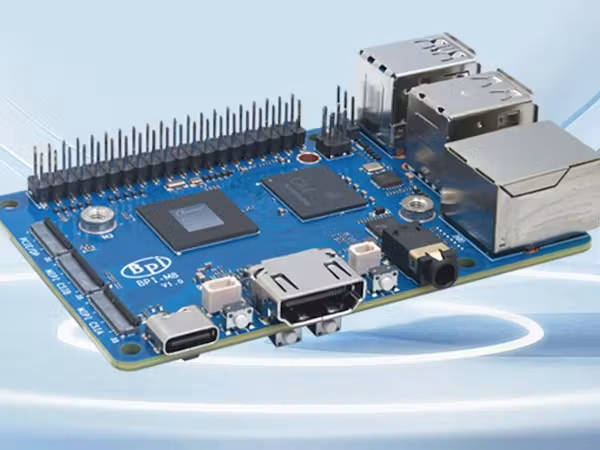
Embedded and hobbyist computing specialist Banana Pi has announced a new single-board computer, gently borrowing the Raspberry Pi form factor but powered by an Allwinner A733 system-on-chip: the Banana Pi BPI-M8. "The BPI-M8 is built on the high-performance octa-core AI [Artificial Intelligence] platform chip [Allwinner] A733," the company writes of its creation, "which combines a dual-core Arm Cortex-A76 and a hexa-core Arm Cortex-A55 [processor clusters]. It supports an Imagination PowerVR BXM-4-64 MC1 GPU, a three TOPS [Tera-Operations Per Second] NPU, and LPDDR4, LPDDR4X, LPDDR5 DRAM and UFS/eMMC memory." Banana Pi describes the BPI-M8, brought to our attention by CNX Software , as being the "same size as [the] Raspberry Pi 5" — and one look at its layout shows that it's not just the footprint that has been used as inspiration. As with a Raspberry Pi 5, the BPI-M8 has a general-purpose input/output (GPIO) header to the top, USB and Ethernet ports to the right, power and HDMI ports to the bottom, and flat flexible circuit (FFC) connectors to the left. Where the Raspberry Pi 5 is based on the Broadcom BCM2712 quad-core system-on-chip, though, the BPI-M8 uses the Allwinner A733. This gives it two high-performance Arm Cortex-A76 cores running at up to 2GHz plus six lower-power Cortex-A55 cores running at up to 1.8GHz. There's a single RISC-V core as a system control processor, an Imagination BXM-4-64 MC1 graphics processor, and a neural coprocessor delivering a claimed three TOPS of compute at minimum precision for on-device machine learning and computer vision workloads. While Banana Pi says that the board supports both current-generation LPDDR5 and last-generation LPDDR4 memory — which could give it the flexibility it needs to avoid, or at least limit, the ruinous price hikes that have beset its competition of late — the only variants available at launch come with 4GB of LPDDR5 memory. To this, the buyer can expand on the board's microSD slot with a choice of 8–128GB of eMMC flash, with 64GB as the default option, and an optional 16MB of SPI flash. Connectivity isn't a complete copy of the Raspberry Pi 5: while the 40-pin GPIO header is present and correct the BPI-M8 only has one USB 3.0 Host port, alongside two USB 2.0 Host ports; there's only one HDMI 2.0b output, supporting up to 4k60 displays, with additional displays connectable via a four-lane MIPI Display Serial Interface (DSI) port with DisplayPort also available via a PCI Express FFC connector. There's a single gigabit Ethernet port, with optional Power-over-Ethernet (PoE) support, along with two MIPI Camera Serial Interface (CSI) connectors and on-board Wi-Fi 6 and Bluetooth 5.0 wireless radios. Interestingly, there's also a 3.5mm jack for analog audio — a feature dropped from the Raspberry Pi 5. More information is available on the Banana Pi documentation site , while two models have been listed for sale on the company's store : the BPI-M8A, with 4GB of RAM and 64GB of eMMC storage, at $103, and the BPI-M8B, with 4GB of RAM and 16MB SPI flash, at $69. Banana Pi has launched a new low-cost alternative to the Raspberry Pi 5, the BPI-M8 — with six-core Allwinner 733 chip. (📷: Banana Pi) Launched models include 4GB of RAM and the choice of 16MB of SPI flash or 64GB eMMC storage on board. (📷: Banana Pi)
↑ Back to top
Originally published by Hackster News ↗
· rebuilt here from its own full-text RSS feed · all rights
remain with the publisher, please read and support them there.