Hidden planet lurking beyond Neptune? New simulations offer clues
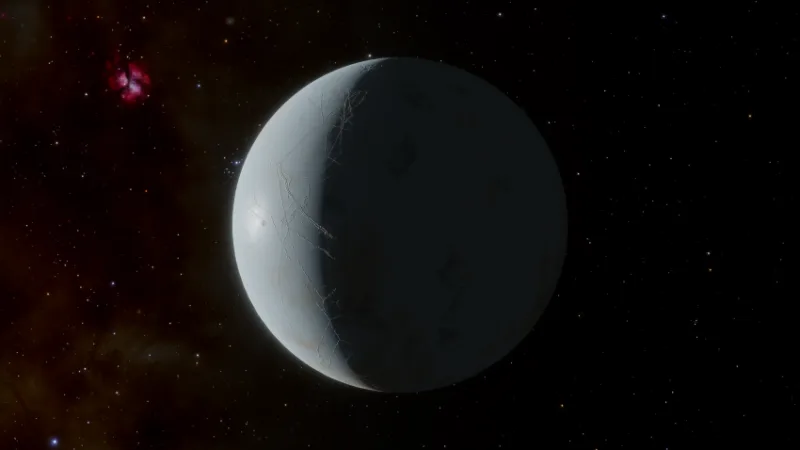
Is a hidden planet lurking beyond Neptune?
For decades, astronomers have been searching for a hidden planet in the far reaches of our solar system. Now, new simulations have outlined how massive this hypothetical planet might be, and where it might reside.
Astronomers say such a world would explain the strange orbits of some small icy bodies discovered beyond Neptune. And according to the much-discussed Planet 9 hypothesis, such a planet would be up to 10 times larger than Earth.
But on November 23, 2026, the Royal Astronomical Society said new models of the solar system don’t necessarily call for a world beyond Neptune that’s extremely massive. The researchers say a planet in this region that’s just 1.5 to 2 times the mass of Earth could account for the unusually orbiting icy bodies. They’re calling this smaller hypothetical world Planet X2.
Lead author Patryk Sofia Lykawka of University of Southern Queensland in Australia and Kindai University in Japan said:
Imagine discovering, after decades of mapping our solar system, that another planet has been hiding from us all this time. If this planet exists, it could change how we understand the history of our solar system and how its most distant objects came to follow such unusual orbits.
The researchers published their peer-reviewed study on November 23, 2026, in the journal Monthly Notices of the Royal Astronomical Society.
Small icy objects in strange orbits
Our solar system beyond Neptune is populated with icy bodies known as trans-Neptunian objects. Many of these live in the Kuiper Belt. This region extends from roughly 38 to 50 times the Earth-sun distance. A Earth-sun distance is called an astronomical unit, or AU.
But astronomers have also found icy objects much farther out. Some travel on long, stretched-out orbits. Others have orbits tilted at unusual angles. And their movements can be difficult to explain using only the gravitational influence of the planets we know.
One of the most intriguing of these distant objects is Sedna. It might even be a member of the still-hypothetical Oort Cloud. Its diameter is only 1/13 the size of Earth’s. And its orbit carries it from 76 AU to 937 AU. Its year — the time it takes to orbit the sun once — equals 11,400 Earth years.
So how did Sedna and other distant objects end up with such strange orbits?
The hypothetical world of Planet X2
One of the leading theories to explain the wild orbits of some of the solar system objects is that there’s a large planet somewhere amongst the small icy bodies. So the researchers used computer simulations to model the proposed planet’s mass, orbit and gravity. They wanted to find the parameters necessary for a distant planet to influence these far-out icy objects over the solar system’s 4.5-billion-year history.
The hypothetical Planet X2 would have an elliptical orbit that would average about 350 to 500 AU from the sun. At its closest approach, it would still be at least 200 AU away. Considering that Neptune — the most distant known world in the solar system — is “only” 30 AU from the sun, it’s no wonder we haven’t found this world yet, if it does exist!
For comparison, the larger world of the Planet 9 hypothesis is expected to have a similar average distance from the sun. Various models have placed it between 290 and 460 AU away on average. However, it wouldn’t come quite as close to the sun as X2, with a closest approach typically modelled around 300 AU.
The biggest difference between these hypothetical worlds is the mass. While Planet 9 is imagined to be between five and ten times the mass of Earth, the newly hypothesized Planet X2 is only slightly more massive than our world.
Just think: Way out in the outskirts of the solar system, where Neptune’s gravitational influence has waned, a planet just a little larger than Earth could be shepherding these icy objects. Lykawka said:
Our model reproduces several of the unusual orbital patterns observed among distant icy objects, although there are still differences between the model and observations that we need to investigate further.
So there’s still much uncertainty here. It could be that both Planet X2 and Planet 9 exist … or that neither do.
Computer simulations of Planet X2’s orbit
The following three diagrams zoom progressively farther out in the solar system. They also move in time from the early solar system to now. It shows how Planet X2 could have migrated to the outer reaches of the solar system, where it influences small icy bodies.
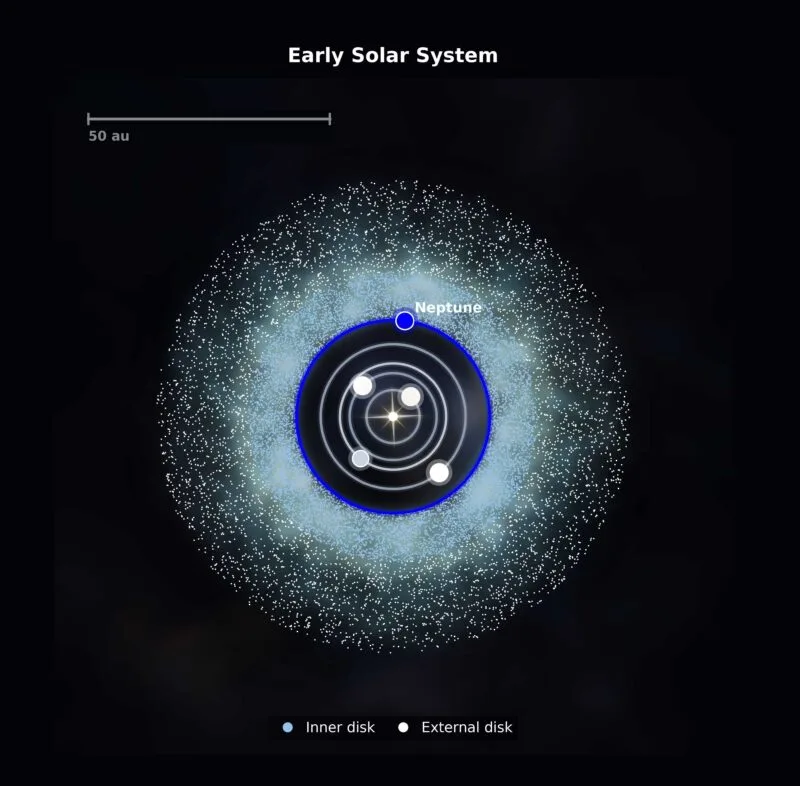
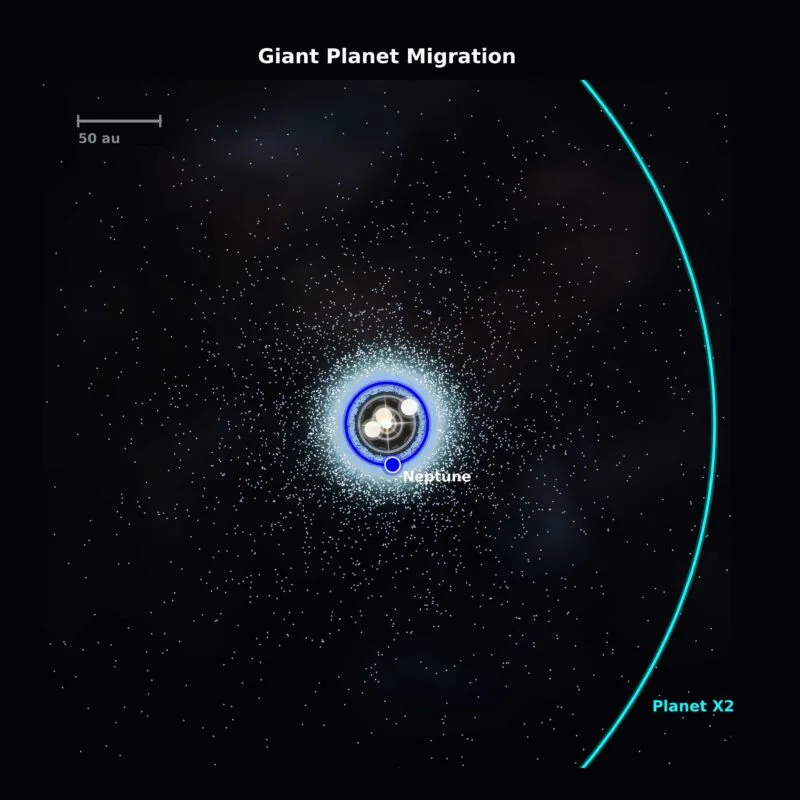
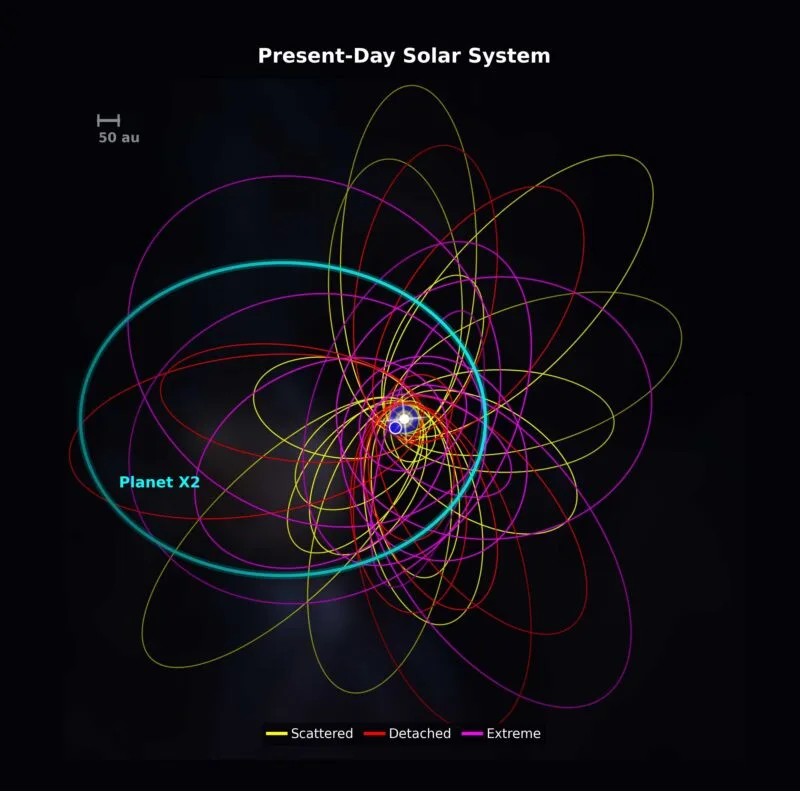
Hidden planet history
Behind this hypothetical world’s name lies a long history of planet hunting.
Back in the early 1900s, astronomers were searching for a so-called Planet X. Astronomer Percival Lowell led the search, believing the planet would explain some irregularities they’d observed in the orbits of Uranus and Neptune.
This search led to Clyde Tombaugh discovering Pluto (which we now call a dwarf planet) in 1930. However, Pluto was not big enough to explain the irregularities.
Then in 1989, the Voyager 2 spacecraft made better measurements of Uranus and Neptune, which revealed that there were no irregularities in their orbits after all!
So Lowell’s Planet X appears not to exist. But the term is now used more generally to refer to a world that might exist beyond Neptune. The Planet 9 hypothesis is a specific prediction about this theorized world, and how it would make sense of some of the strangely orbiting bodies beyond Neptune.
Will the Rubin observatory find Planet X2?
Co-author Jonti Horner of the University of Southern Queensland in Australia said the Vera C. Rubin Observatory’s Legacy Survey of Space and Time could help in the search for Planet X2. Horner said:
The exciting thing is that we now have an opportunity to put this idea to the test. As the Rubin observatory surveys the sky, we will find new clues that help us understand the distant reaches of the solar system — and whether another planet is still waiting to be discovered.
Bottom line: Researchers have modeled the solar system, trying to explain why distant icy objects have such strange orbits. They said a hidden planet 1.5 to 2 times the mass of Earth could lurk beyond Neptune.
Source: Signatures of an Earth-class Planet in the Distant Solar System
Via Royal Astronomical Society
The post Hidden planet lurking beyond Neptune? New simulations offer clues first appeared on EarthSky.