NASA seeks to begin ‘intergalactic freight network’ with $1.3 billion block purchase of rockets, orbital transfer vehicles
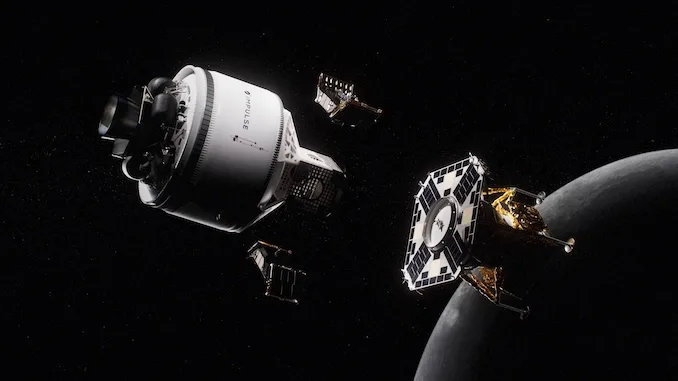
NASA said it is “flipping the formula” on how they go about purchasing flights to the Moon as they look to establish a permanent presence on the lunar south pole.
That’s how NASA’s Moon Base Manager Carlos García-Galán described it when he announced a suite of six task orders to multiple providers under the agency’s 10-year Venture-Class Acquisition of Dedicated and Rideshare (VADR) launch services contract earlier this month. Collectively, those awards are valued at about $1.3 billion.
“We’re going to be flipping the formula from being mission-focused to basically getting rockets, payloads, landers, and matching them to maintain the oversight and ownership of that mission,” García-Galán said during a news conference on Saturday, Nov. 8.
He said having transportation services on standby through a combination of both rockets and orbital transfer vehicles (OTVs) will be critical in order to meet the aggressive timelines that they Moon Base program is chasing. Phase One of the program runs from now through 2029 and focuses on technology demonstrations and science experiments focused on what the agency calls the “science of survival.”
“Our goal is also to have a ready inventory of payloads queued up, whether it’s a solar communication tower or a scientific payload,” García-Galán said. “Having those ready — we know we need them, we know what it is — having those ready so we can match them to the lander and then we’ll select the transportation service, which we procure a number of when we’re ready to send that.”
On the launcher side, NASA is calling upon Blue Origin’s New Glenn, Relativity Space’s Terran-R, and SpaceX’s Falcon 9 rockets. Of those, only the Terran R rocket has yet to fly, but is expected to have its launch debut in 2027.
For the OTVs NASA is turning to Blue Origin, Firefly Aerospace, Impulse Space, and Quantum Space. These spacecraft are also in various stages of development, but have yet to fly in space as of yet.
“We’re buying transportation capacity to accelerate industry in alignment with the requirements NASA has for Moon Base missions” said Mark Wiese, manager of NASA’s Moon Base Transportation office. “That gives companies a clear demand signal. These missions will help us mature orbital transportation capabilities being developed by commercial industry, while leveraging these missions to deliver Moon Base assets. This paves the path for more capable transportation options we need to build the Moon Base.”
García-Galán said some of the launches announced Saturday evening have payloads attached to them.
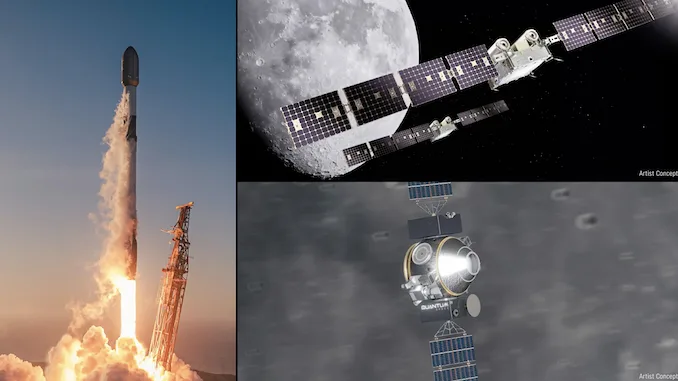
The first of these is a $185 million award for the launch of the Cislunar Autonomous Positioning System Technology Operations and Navigation Experiment (CAPSTONE) 02, which is being developed by Advanced Space.
The integration and prime contractor of CAPSTONE 2 mission Arrow Science and Technology. Their team includes SpaceX, which will launch the mission on a Falcon 9 rocket, and Quantum Space, which is providing its Ranger as the OTV.
García-Galán said the mission is slated to launch somewhere in the 2027-2028 timeframe.
“CAPSTONE 2 is a series of two satellites. It builds up from the CAPSTONE 1 from Advanced Space, and it’s two spacecraft that are going to be in cislunar space, basically testing the navigation and communication capabilities that we’re going to have to master before we start sending the Orion spacecraft with landers that have to dock in cislunar space and come down to the ground,” García-Galán explained.
“So they’re going to do different set of activities in cislunar space, all to gather data on how the gravity gradients work, how navigation in cislunar space works, and how we can communicate with those assets.”
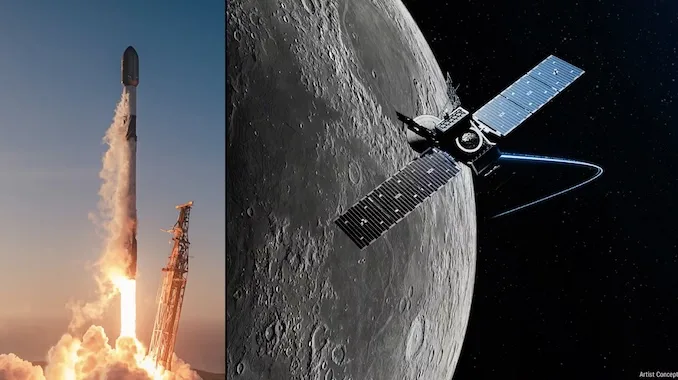
Next up on the series of six launches awarded will also fly on a SpaceX Falcon 9 rocket. This time, it will carry a set of communication satellites built by Intuitive Machines. Impulse Space will be the prime contractor on this mission and will be responsible for integration.
“Impulse has different orbital transfer vehicles. We may be using their Mira orbital transfer vehicle for this mission, but the key thing about this is by procuring this transport capability, it gave us the ability to basically take several of the Altus communication spacecraft and put them in one ride, optimizing how fast we can get those spacecraft out there, and also liberating, you know, future CLPS missions from having to take one of these satellites,” García-Galán said. “So, perfect example of how this helps us achieve the missions that we want.”
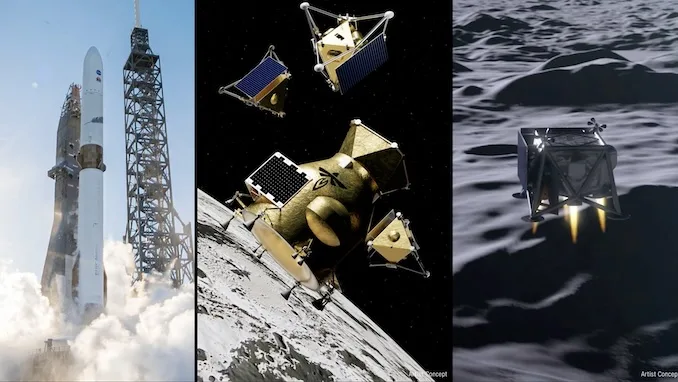
The next three missions announced will fly on Blue Origin New Glenn rockets with a variety of OTVs.
The first of these will use the Elytra OTV from Firefly Aerospace to transport three of NASA’s MoonFall hopper drones (built by NASA’s Jet Propulsion Laboratory) close to the surface of the Moon in 2028.
“They’ll fly to their first landing location, can communicate with each other and with us, and then they’ll be hopping around to the designated locations that we send them,” García-Galán said. “Doing it with this transportation approach allows us to maximize the performance that’s left on the drones. So by putting an orbital transfer vehicle, Firefly’s Elytra, we can basically reduce the amount of propellant that those drones are using until they get to the surface to execute their mission.”
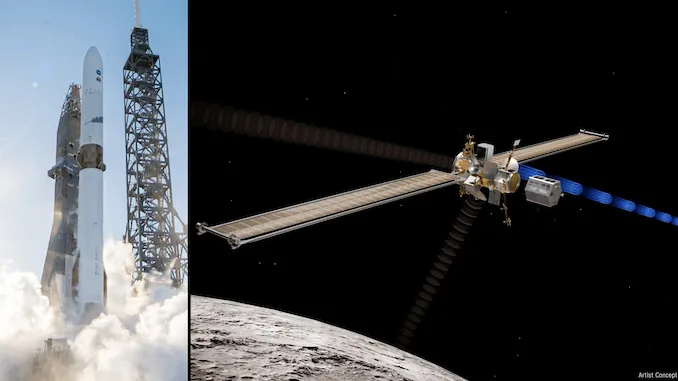
The two other missions on Blue Origin’s New Glenn rocket will use the company’s own orbital transfer vehicle, the Blue Ring. The finer details of those flights will be fleshed out down the road, but offer some options for how NASA may use them.
“[Blue Origin] proposed an innovation which is about communications. So, in one of these missions, which primary mission will be to deliver a NASA payload, again a lander or a satellite or whatever, they’re going to have communication satellites,” García-Galán explained. “And the combination of those satellites around cislunar space with Blue Ring will give us tremendous communication capability.
“It’s just a demo. We’re going to test it. We have certain requirements because we want this to be standard, and all the assets that we have on the Moon be able to communicate with them. But if it works, they’ll be able to on ramp into a services contract in the future. So again, flexibility and capability.”
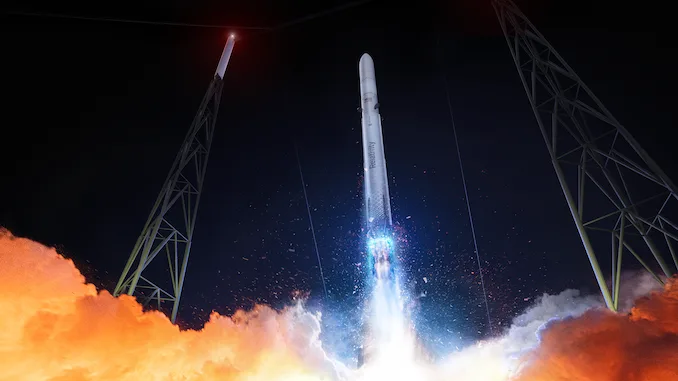
Lastly, Relativity Space’s Terran R rocket was also tapped for a mission, which will be led by Impulse Space as the prime contractor. In a press release, Impulse Space said that the rocket would carry the company’s Helios as the kick stage along with their lunar lander, which will “perform a descent profile, testing out upsized cargo delivery to the lunar surface.”
“It’s not a task order for like specific payloads that we have because it’s kind of a high risk, high reward demo. But we’re going to evaluate what comes out of that, and then eventually we’ll see based on the results of that where we can take that forward,” García-Galán said. “Again, we have not selected a payload for it. We’re looking at different options. We have plenty already in work.”
Wiese said it’s critical that NASA set up “an intergalactic freight network to get the amount of mass we need on the surface.” He said having the capacity to get cargo to the cislunar space is going to help smooth out other logistics and could also be a benefit beyond NASA.
“The amount of mass is tremendous and we have to not put all of that on our landers,” Wiese said. “We’ve got instruments and assets we need to stack up and be ready to go work that transportation network, just like we do terrestrially.
“We’re partnering with the Commercial Access to Space program because if Moon Base can’t fill all that need, we’ve got partners across the government, we’ve got Nicky’s team that has science instruments, and that Commercial Access to Space program is going to help us make sure we run the trains on time and don’t leave any capacity unused in these launches.”