← Technology, Science & Infrastructure
▣ Distilled locally
This Homemade Hoverboard Floats on Magnets
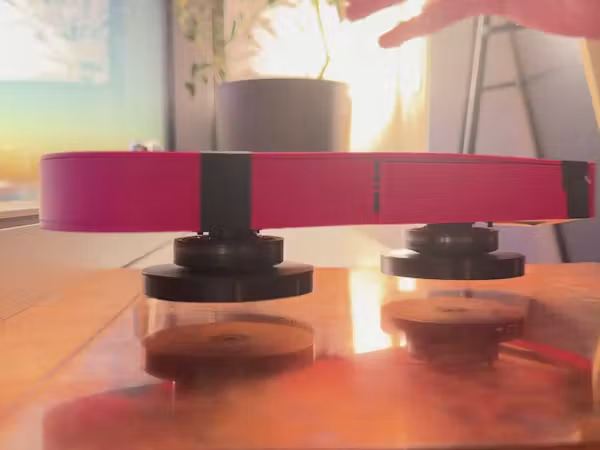
Hoverboards have been a staple of science fiction for decades, but the closest thing most of us have seen in real life is a two-wheeled scooter that doesn't actually hover. Building a board that floats above the ground without wheels is obviously a much bigger engineering challenge. YouTuber Jake Rogers decided to take a crack at it, and while his ultimate goal is a rideable hoverboard, he's already built a smaller prototype that can float above a copper surface without any external power or support. The secret behind Rogers' hoverboard is a phenomenon known as electromagnetic induction. When a magnetic field moves across a conductive material, it generates electrical currents called eddy currents. These currents produce magnetic fields of their own that oppose the original field, creating a repulsive force. By spinning powerful permanent magnets above a sheet of copper, it's possible to generate enough lift to get a lightweight platform off the ground. Rogers started with a brushless motor, an electronic speed controller (ESC), and an ESP32 development board. He designed and 3D-printed a rotor containing a ring of permanent magnets, then held the assembly above a thick copper plate. When the motor spun up, the magnetic field generated enough lift to push the assembly upward. Unfortunately, there was a problem. The spinning rotor also produced reaction torque, causing the entire assembly to twist uncontrollably. That's not exactly ideal for something you're eventually hoping to stand on. To solve this, Rogers added a second motor with another magnet-filled rotor. By spinning the two rotors in opposite directions, their reaction torques could largely cancel each other out. After some troubleshooting, including discovering that both motors were initially spinning in the same direction, he managed to get the platform hovering much more steadily. The next challenge was cutting the cord. Until this point, the prototype relied on external power and a USB connection to a computer. Rogers added a buck converter to supply the ESP32 with 5 V, along with an inertial measurement unit (IMU) to monitor the platform's orientation. Wi-Fi connectivity also made it possible to send commands and upload firmware wirelessly. For power, he connected two 3S lithium polymer batteries in series, providing a nominal 22.2 V supply. But adding batteries meant adding weight, which made generating sufficient lift more difficult. His first arrangement even required dead batteries as counterweights to keep the platform balanced. A redesigned chassis solved that problem by positioning the working batteries between the motors. Rogers also created a 3D-printed enclosure to house the electronics and give the prototype a more finished appearance. The completed hoverboard prototype successfully floats above a copper plate using only its onboard batteries. It's still a long way from something you could ride to work, and it requires a conductive surface to operate. But Rogers has shown that the basic concept works, bringing his dream of a real hoverboard one step closer to reality.This hoverboard glides over conductive surfaces (📷: Jake Rogers) An early test with one motor (📷: Jake Rogers)
↑ Back to top
Originally published by Hackster News ↗
· rebuilt here from its own full-text RSS feed · all rights
remain with the publisher, please read and support them there.