Humanity’s 1st intentional signal to space 52 years ago
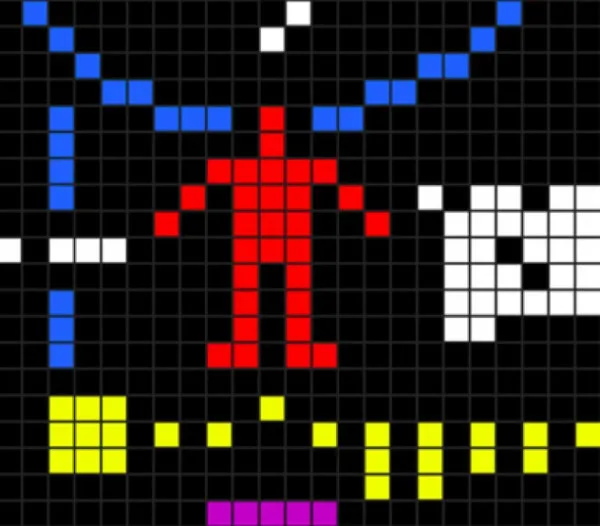
1st intentional signal to space in 1974
On November 16, 1974, astronomers used the Arecibo telescope in Puerto Rico to beam out the first intentional signal to space. It was the most powerful broadcast ever deliberately sent outward. The astronomers said their goal was to contact alien life. And some applauded it, but others didn’t.
On the plus side, it reminded people that Earth likely isn’t the only planet in our Milky Way galaxy where intelligent life has evolved. But others felt — if alien civilizations do exist out there — we shouldn’t call attention to ourselves.
The message in our signal to space
The message was designed by Cornell astronomy professor Frank Drake with input from other scientists including Carl Sagan. So, the final result was a simple and elegant broadcast. Basically, it consisted of a pattern of binary numbers. This message contained information about the basic chemicals of life and the structure of DNA. Plus, it included Earth’s place in our solar system and even a stick figure of a human.

Sending the Arecibo message
It took three minutes to send 1,679 bits of information, a snail’s pace compared to modern computer modems. And according to the SETI Institute:
The broadcast was particularly powerful because it used Arecibo’s megawatt transmitter attached to its 1,000 feet (305 meter) antenna. The latter concentrates the transmitter energy by beaming it into a very small patch of sky.
The emission was equivalent to a 20-trillion-watt omnidirectional broadcast, and would be detectable by a SETI experiment just about anywhere in the galaxy, assuming a receiving antenna similar in size to Arecibo’s.
In fact, the 1974 signal went out in the direction of M13, a globular star cluster orbiting the center of our Milky Way galaxy. Basically, it was chosen because it’s a large collection of stars and was available in the sky at the time and place of the ceremony.
Also, globular star clusters are very far away. For instance, M13 is about 25,000 light-years from Earth.
And now, the 1974 signal is 52 light-years away from us.
Messier 13 (NGC 6205), a globular cluster 25,000 ly away in Hercules, holds hundreds of thousands of stars. In 1974, the Arecibo message was sent toward it. One of the brightest clusters in the northern sky! #Astrophotography @xipteras @Astro_KPage1986 @jaythegrumpy @AlphaAstro2 pic.twitter.com/Q4pnKtN2Zd
— Rad van Mad (@rvanmad) March 14, 2025
By the way, the Arecibo radio telescope collapsed in 2020 when its 900-ton receiver platform came loose from its cables and fell onto the reflector dish more than 400 feet (120 meters) below.
Read more: Video shows Arecibo telescope crash
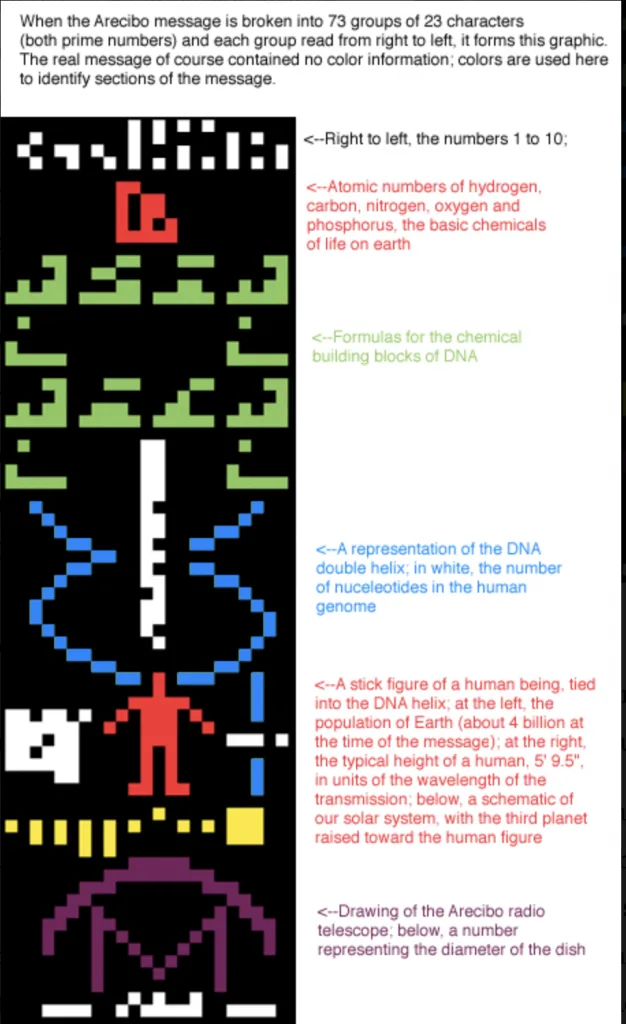
Bottom line: Iconic Arecibo telescope is no longer operational, but its legacy lives on. Fifty years ago, on November 16, 1974, Arecibo sent our first intentional signal to space. What do you think? Should we be advertising our presence in space?
The post Humanity’s 1st intentional signal to space 52 years ago first appeared on EarthSky.