← Technology, Science & Infrastructure
▣ Distilled locally
A Conference Badge Powered by a Piece of Computing History
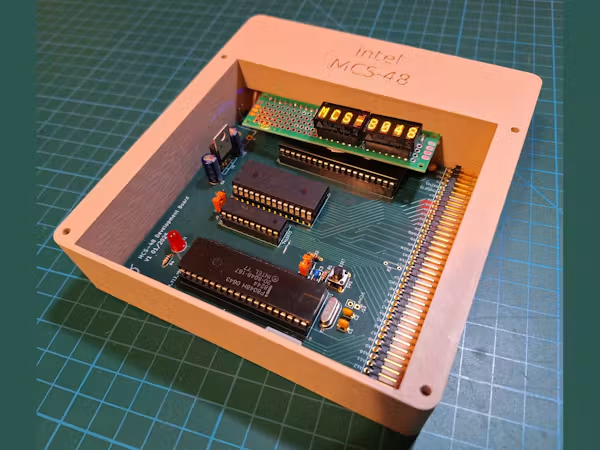
Microcontrollers have come a long way over the past 50 years. Modern chips pack powerful processors, plenty of memory, and wireless connectivity into packages that cost just a few dollars. Back in 1976, Intel introduced the 8048, an 8-bit microcontroller that helped lay the groundwork for the embedded systems we use today. Maker mwfeurtado decided to revisit that piece of computing history by building a development board around the original chip, then turning it into a retro conference badge. The Intel 8048 was part of the MCS-48 family, Intel's first microcontroller lineup. It featured an 8-bit processor, 27 GPIO pins, an external data bus, and clock speeds reaching 11 MHz. Unlike modern microcontrollers with reprogrammable flash memory, the original 8048 contained a mask ROM that was programmed during manufacturing. That wasn't particularly convenient for experimentation, but Intel provided a way around the limitation. By configuring the External Access (EA) pin, MCS-48 chips could execute programs stored in external memory instead of their internal ROM. This capability is central to mwfeurtado's development board, which uses an external EEPROM to hold its firmware. An SN74HC573 8-bit latch handles address demultiplexing, allowing the microcontroller to access external program memory through its shared address and data bus. The board also includes an Intel 8155 RAM and I/O expansion chip, an 8 MHz crystal, and a 7805 voltage regulator. A 40-pin RCBUS connector provides additional expansion capabilities, allowing the board to interface with external hardware. A custom development board of this sort is interesting enough for retrocomputing enthusiasts, but mwfeurtado wanted something that would really stand out at the Vintage Computer Festival Southwest. The solution was to turn the board into a conference name badge using a pair of vintage LED character displays. The displays are OSRAM SLY2016 modules, each capable of showing four characters using 5×7 yellow LED matrices. They accept 7-bit ASCII data, making them relatively straightforward to interface with an 8-bit microcontroller. Rather than adding extra address-decoding logic, mwfeurtado connected the displays directly to GPIO pins on the 8155 expansion chip. Separate write signals select between the two four-character displays, providing eight characters of output. The displays were mounted on a small piece of perfboard, hand-wired, and connected to the development board's expansion header. With the hardware complete, mwfeurtado wrote assembly routines to clear the displays and cycle through messages. When first powered up, the badge introduces itself with scrolling text reading "Hello! My Name is MCS-8048 1976 Intel MCU." It may not have the processing power or flashy graphics of modern conference badges, but there's something fitting about using a 50-year-old microcontroller at a vintage computing event.The DIY Intel MCS-48 development board (📷: mwfeurtado) A vintage 8048 microcontroller (📷: mwfeurtado) Coding time! (📷: mwfeurtado)
↑ Back to top
Originally published by Hackster News ↗
· rebuilt here from its own full-text RSS feed · all rights
remain with the publisher, please read and support them there.