← Technology, Science & Infrastructure
▣ Distilled locally
Rob Newport's Xerxes Home Lab Blade-ifies Raspberry Pi CM5, NVIDIA Jetson COMs for Neat Clusters
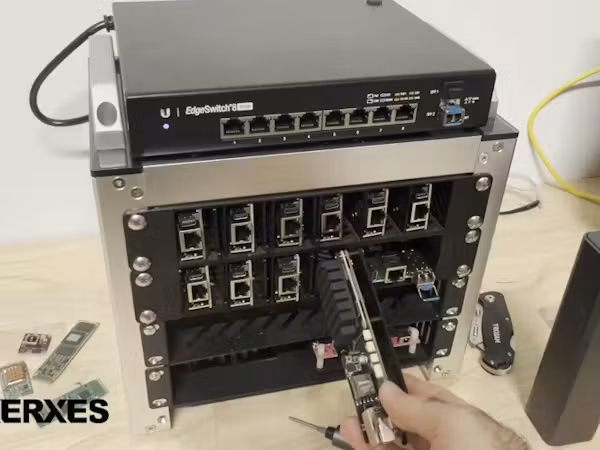
Engineer and computational neuroscientist Rob Newport has opened crowdfunding for a blade-style home lab setup compatible with the Raspberry Pi Compute Module 5, NVIDIA Jetson Nano, and other computers-on-modules (COMs): the Xerxes Home Lab. "The Xerxes Home Lab is a private, affordable, and compatible hardware platform for home lab engineers of all backgrounds," Newport claims of his creation. "We wanted cheap machines to run open office tools and light web hosting. We needed pro features like PCIe M.2 for NVMe [Non-Volatile Memory Express] and PoE [Power-over-Ethernet] for power management. So we developed Xerxes for affordable, private, compatible home lab hardware." The heart of the Xerxes system is its blade-format nodes. Designed to accept either NVIDIA's Jetson family of computers-on-modules (COMs) or Raspberry Pi's Compute Module 4, Compute Module 5, or third-party compatible COM, depending on model chosen, each blade offers an M.2 PCIe slot for high-speed storage or accelerators, a microSD slot for storage, I2S and debug serial connectivity, optional Power-over-Ethernet (PoE) support on a gigabit Ethernet support, and connectors for I2C and I2S. If you pick up the Raspberry Pi-flavored blade, you also get an expansion connector for optional mezzanine cards that brings out MIPI Camera Serial Interface (CSI) and HDMI display connectivity. The NVIDIA Jetson version, meanwhile, comes with an OCuLink expansion port carrying PCI Express signals. Alternatively, Newport has also designed an in-house COM based on the Rockchip RK3566, with four up-to-1.8GHz Arm Cortex-A55 cores, a Mali-G52 graphics processor, and an up-to one tera-operation per second (TOPS) accelerator for on-device machine learning workloads. These blades are designed to slot into neat desktop racks, in six-blade mini or 12-blade full-size 19" variants. In addition to selling the racks, Newport has also released the files required to 3D-print your own racks. "We want to make it easier for makers, developers and self-hosting enthusiasts to customize their hardware without being locked into expensive proprietary enclosures," he explains. "Build a rack that suits your setup, experiment with different configurations and expand your system as your home lab grows." Newport is currently funding the Xerxes Home Lab on Kickstarter , with physical rewards starting at AU$49 for a Raspberry Pi CM5-compatible Xerxes blade carrier; the Xerxes Nano, for the NVIDIA Jetson Nano COM family, is only available in an AU$399 bundle that includes a single Xerxes Nano blade carrier plus four Xerxes Pi 2026 carriers, four sets of PoE accessories, and a six-slot mini rack. All hardware is expected to ship in December this year, and while no crowdfunding campaign comes with guaranteed fulfillment Newport has already successfully completed a campaign for an earlier design of Xerxes blade carrier board. The campaign includes a second-generation Raspberry Pi CM4/5 blade carrier plus a new one for the NVIDIA Jetson Nano family. (📹: Rob Newport)The Xerxes Home Lab turns the Raspberry Pi 5 CM4/5, NVIDIA Jetson Nano, or compatible computers-on-modules into compact blade systems. (📹: Rob Newport)
Originally published by Hackster News ↗
· rebuilt here from its own full-text RSS feed · all rights
remain with the publisher, please read and support them there.
↑ Back to top
© 2026 PaperWeb. Content remains property of respective publishers. · Privacy Policy · Terms