← Technology, Science & Infrastructure
▣ Distilled locally
A Budget-Friendly Depth-Sensing Board for Robots
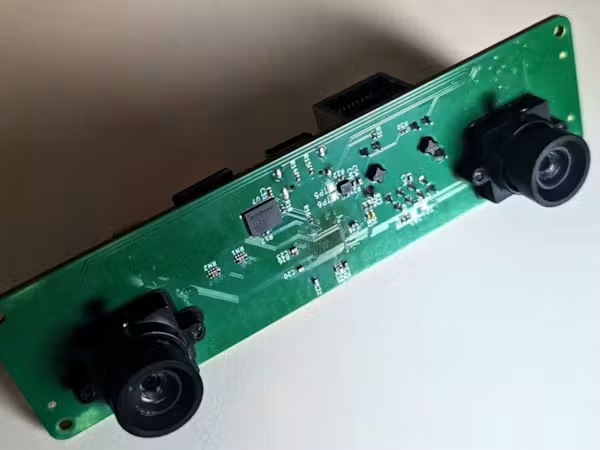
High-end navigation systems not only identify objects, but also measure the distance to them. Sensors like LiDAR and ultrasonic rangefinders can get the job done, but another option is to use a pair of cameras to calculate depth in much the same way that our own eyes do. Stereo vision systems can be computationally demanding, however, which makes them difficult to integrate into embedded projects. To make this technology more accessible, hardware hacker Ryan Walker developed a low-cost stereo vision board that handles image capture and depth processing without relying on an external computer. The board is built around a Rockchip RV1103 SoC, which packs a 1.1 GHz Arm Cortex-A7 processor, 64 MB of DDR2 RAM, and a MIPI CSI-2 interface into a QFN-88 package. The chip also includes hardware acceleration capabilities that make it particularly well-suited for processing camera images. Walker paired the processor with two OV9281 cameras, creating a self-contained stereo vision system that can run Linux. The idea is to use the board as a peripheral for other devices, such as an Arduino-based robot that needs obstacle avoidance capabilities. Once powered up, it can process images and transmit information over a serial connection, leaving the host microcontroller free to handle other tasks. The hardware is implemented on a four-layer PCB with controlled-impedance traces for high-speed interfaces, including MIPI, USB, and Ethernet. Walker notes that the initial design was largely successful, although a few problems did pop up. These included incorrectly sized lens mounting holes, undersized LED resistors, and a power trace that was thinner than intended. On the software side, Walker used Buildroot to assemble a Linux system with the necessary bootloader, kernel, and drivers. Some components, including the MIPI camera drivers and hardware acceleration support, had to come from Rockchip's vendor software package. The resulting system provides access to the cameras through Linux's Video4Linux2 interface, while a USB-C connection can be configured for Ethernet communication and SSH access. The key to the board's depth-sensing capabilities is the Rockchip Video Engine, which includes a hardware-accelerated sum of absolute differences (SAD) engine. This allows the system to compare small regions of images captured by the two cameras and identify matching features. Because the cameras are separated horizontally, objects appear at slightly different positions in each image. By measuring how far corresponding features are displaced, the software can estimate their distance from the cameras. Nearby objects produce larger disparities, while distant objects produce smaller ones. Walker has already demonstrated image capture and depth processing on the hardware. Future plans include improving the software, optimizing image processing, and potentially adding simultaneous localization and mapping (SLAM) and YOLO-based object detection. For now, Walker is gauging interest in a small production run. If enough people express interest , he plans to manufacture another 10 boards with the necessary hardware fixes and offer them for sale at $110.4reel Stereo Camera (📷: Ryan Walker) An overview of the system (📷: Ryan Walker)
↑ Back to top
Originally published by Hackster News ↗
· rebuilt here from its own full-text RSS feed · all rights
remain with the publisher, please read and support them there.